Thailand, Cambodia exchange fire along border as both sides trade blame; renewed conflict stems from the failure to resolve the core demands of both sides: expert
By Feng Fan and Published: Dec 08, 2025 07:50 PM

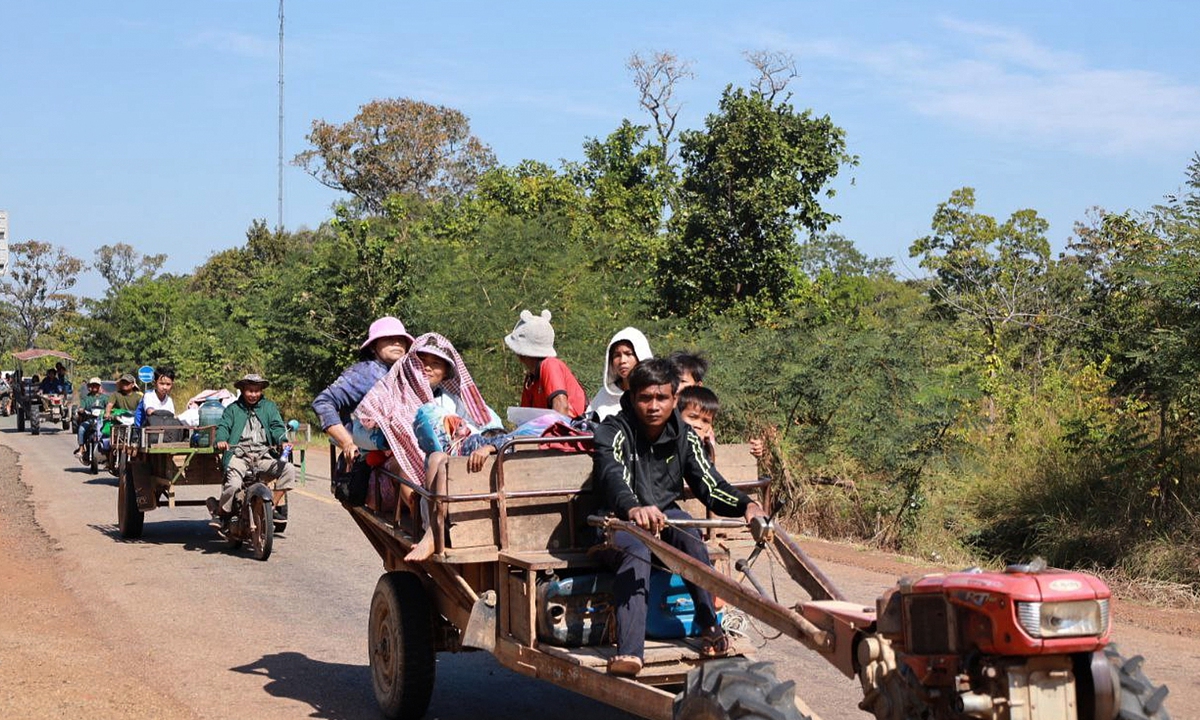
In this photo released by Agence Kampuchea Press (AKP), Cambodian villagers sit on tractors as they flee from the home of Preah Vihear province, Cambodia, on December 8, 2025.Renewed armed clashes erupted between Thai and Cambodian forces along their border on December 7 and 8, with both sides accusing the other of firing first. Photo: VCG
Renewed armed clashes erupted between Thai and Cambodian forces along their border on Sunday and Monday, with both sides accusing each other of firing first.
The Thai military on Monday said it deployed fighter jets in response to Cambodian attacks that left two soldiers killed and four wounded. Meanwhile, a Cambodian defense spokesperson said Thai soldiers on Monday opened fire on Cambodian armed forces for the second straight day, adding that Cambodia did not fire back, according to Xinhua News Agency.
According to Thai Army Spokesperson Winthai Suvaree, the incident occurred at around 7:00 am Monday local time in the Chong Bok area of Nam Yuen District, where Thai soldiers operating in the area were attacked with "supporting fire weapons," resulting in casualties.
On the same day, Cambodian Defense Ministry's Undersecretary of State and Spokesperson Lt. Gen. Maly Socheata said around 5:04 am on Monday, the Thai military launched an attack on Cambodian forces in the An Ses area of Preah Vihear province.
"Subsequently, they continued firing multiple shots with tanks at Tamoan Thom temple, 5 Makara in the vicinity of Preah Vihear temple and Chomka Chek area," Xinhua quoted Socheata as saying.
Cambodia's Senate President Hun Sen urged frontline troops to exercise restraint amid renewed armed conflict with Thai soldiers amid the latest flare-up, according to Xinhua, while Thailand Prime Minister Anutin Charnvirakul has ruled out the possibility of talks, saying "From now on, there will be no negotiations of any kind. If the fighting is to stop, Cambodia must follow the course of action set by Thailand," Thailand media The Nation reported.
When Charnvirakul was asked about the joint declaration between Thailand and Cambodia signed in Malaysia, and whether it still applied in the current context. He answered briefly: "No. I do not remember it," according to The Nation. The media noted that such statement is "a stark signal that past agreements are no longer regarded as binding."
The latest clashes mark another breakdown of calm following a peace agreement signed by Thailand and Cambodia on October 26 in Kuala Lumpur, Malaysia. The border situation had already deteriorated again in early November, raising concerns over the fragility of the truce.
According to Xinhua, the new round of conflict began on Sunday. The Cambodian Ministry of National Defense said Thai soldiers opened fire on Cambodian armed forces, but Cambodian troops did not fire back. On the same day, the Thai military accused Cambodia of firing first, claiming that Thailand was forced to retaliate.
An expert said the renewed conflict stems from the failure to resolve the core demands of both sides, making another outbreak expected, while the likelihood of a further expansion of hostilities remains low.
"Since the signing of the joint declaration after the previous round of clashes, frictions between Thailand and Cambodia have never truly subsided, and the two sides have remained locked in repeated confrontations," Gu Jiayun, director of the Center for Cambodia Studies at Beijing Foreign Studies University, told the Global Times on Monday. "Thailand has yet to release the 18 Cambodian soldiers it detained, and its territorial claims remain unresolved. These issues lie at the core of the current tensions."
Gu noted that the risk of the situation escalating into a full-scale war remains limited at present.
However, the conflict could pose challenges to ASEAN's political and security integration process, and in the long run, it could have a potential impact on the ASEAN security community, Gu warned.
Malaysia on Monday expressed "deep concern" over the reported clashes, conveying condolences to the families of those killed or injured, according to Xinhua. Malaysian Prime Minister Anwar Ibrahim said on social media that the renewed fighting risks unraveling the careful work that has gone into stabilizing relations between the two neighboring countries. As close partners of Malaysia and key members of ASEAN, Thailand and Cambodia were urged to "exercise maximum restraint, maintain open channels of communication and make full use of existing mechanisms to ease tensions."
Vietnamese Prime Minister Pham Minh Chinh called on Cambodia and Thailand to pursue dialogue to resolve their border tensions while holding talks with his Cambodian counterpart Hun Manet on Monday, the Vietnam News Agency reported. At the event, Chinh urged Cambodia and Thailand to exercise restraint, respect each other's legitimate interests, and adhere to their peace agreements, according to the report.
The latest escalation follows a series of deteriorations in ties after the October 26 peace agreement. On November 10, two weeks after the deal was signed, Thailand said it was suspending implementation of its "peace deal" with Cambodia over a disputed border, after soldiers were injured in a landmine explosion near the Cambodian border in Sisaket province, BBC reported, citing a Thai government spokesperson.
The two countries experienced their worst clashes in more than a decade earlier this July. According to Reuters, the five-day conflict killed at least 48 people—mostly civilians—and displaced an estimated 300,000 residents, with heavy artillery fire and rocket attacks reported across multiple frontlines.
China has repeatedly voiced concern over the Thailand-Cambodia conflict and actively promoted peace talks since the outbreak of hostilities. Following the November clashes, Chinese Foreign Ministry spokesperson Lin Jian said at a regular press conference that "China noted some new developments and issues during the implementation of the joint declaration between Thailand and Cambodia." As a close friend and neighbor, China sincerely hopes both sides will "exercise restraint, work in the same direction, carry out friendly consultation, give play to existing bilateral mechanisms, and find a solution that is acceptable to both sides as soon as possible and prevent any escalation," he said, adding that China will continue to play a constructive role in promoting deescalation.
The Chinese Embassy in Cambodia on Monday reminded Chinese nationals near the Cambodia-Thailand border to strengthen safety precautions.
According to the embassy's notice, a new round of conflict erupted along the Cambodia-Thailand border on Monday, causing casualties. The Chinese Embassy in Cambodia urged Chinese nationals in the country—especially those near border areas to closely follow the local security situation, remain vigilant, enhance protective measures, stay safe, and avoid traveling to border areas.
RELATED ARTICLES