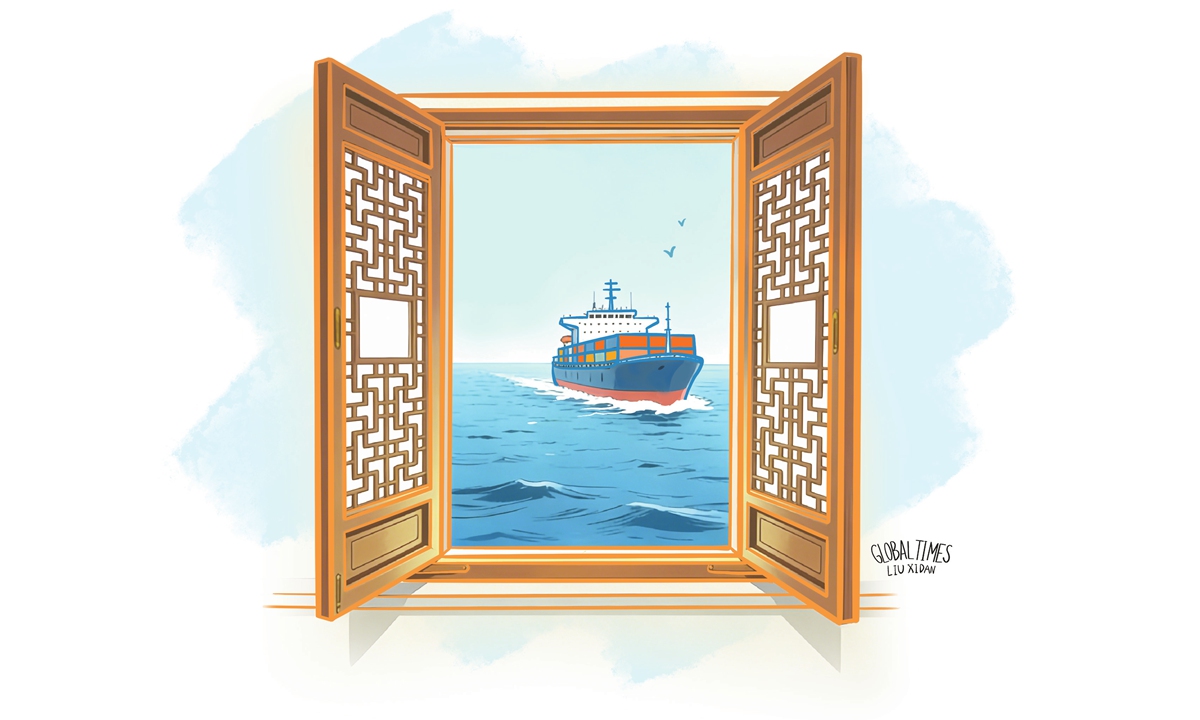
Illustration: Liu Xidan/GT
According to data released by the General Administration of Customs on Monday, China's total goods imports and exports in yuan-denominated terms rose to 41.21 trillion yuan (about $5.82 trillion) in the first 11 months of 2025. Imports amounted to 16.75 trillion yuan, an increase of 0.2 percent. In November alone, China imported goods worth 1.55 trillion yuan, representing a year-on-year increase of 1.7 percent.These figures stand in stark contrast to the recent narrative propagated by some Western politicians and media outlets, which repeatedly claim that China "only exports but does not import." For instance, the Wall Street Journal (WSJ) recently published an article asserting that "China's growth is coming at the rest of the world's expense," accusing the country of pursuing a "beggar-thy-neighbor" model.
What is truly ironic is that this narrative itself represents a kind of discursive "beggar-thy-neighbor" strategy: It constructs a fictional "China threat," and uses it as a convenient external scapegoat for deep-seated internal structural problems. In reality, China's growth is not squeezing the world; rather, it is sharing opportunities and developing alongside it.
A glance at the latest customs data makes this clear: How can a country whose imports are seeing an increase be described as one that "only exports but does not import"?
"In the Western narrative, imports are portrayed as a burden, instinctively labeled as a loss - this is a fundamental misreading of basic trade principles. Whether it is China's imports or exports, both are valuable to its trading partners," Tu Xinquan, dean of the China Institute for WTO Studies at the University of International Business and Economics in Beijing, told the Global Times.
Indeed, China has never closed its doors and "simply pushed goods outward," but has rather been a consistent advocate of expanding imports and opening its market to the world. The China International Import Expo (CIIE) is the best example.
As the world's only national-level exhibition dedicated entirely to imports, the CIIE has, over the past few years, brought together new products, technologies and services. According to the CIIE Bureau, the 8th CIIE in 2025 recorded $83.49 billion in one-year intended deals, up 4.4 percent from the previous edition and marking a new high. More than just an open platform, the CIIE has become a vital bridge for global companies seeking access to China, demonstrating the country's firm commitment to high-level opening-up through concrete action.
What kind of "beggar-thy-neighbor" country would host the world's largest import-themed expo and invite global businesses to bring their products into its market?
"In contrast, China's trade with neighboring countries has grown rapidly in recent years, with the stability of their supply-chain cooperation. This shows that China's neighbors are gaining steady, reliable benefits through deepened cooperation with China - an attractiveness driven by predictability, stability, and mutual benefit,'' said Zhou Mi, a senior researcher at the Chinese Academy of International Trade and Economic Cooperation.
China is pursuing a path of high-level opening-up and mutually beneficial development. Pilot Free Trade Zones continue to expand; negative lists for market access keep shortening; and new areas such as cross-border e-commerce, trade in services, and data flows are opening wider.
From ASEAN to Africa, from Latin America to the Middle East, an increasing number of countries are benefiting from the stable demand of the Chinese market, as well as from investment and technological cooperation. They understand better than any media that China is not a "beggar-thy-neighbor" actor - it is a partner that shares opportunities.