Research group highlights China’s cleantech overseas layout; expert rejects supply glut rhetoric


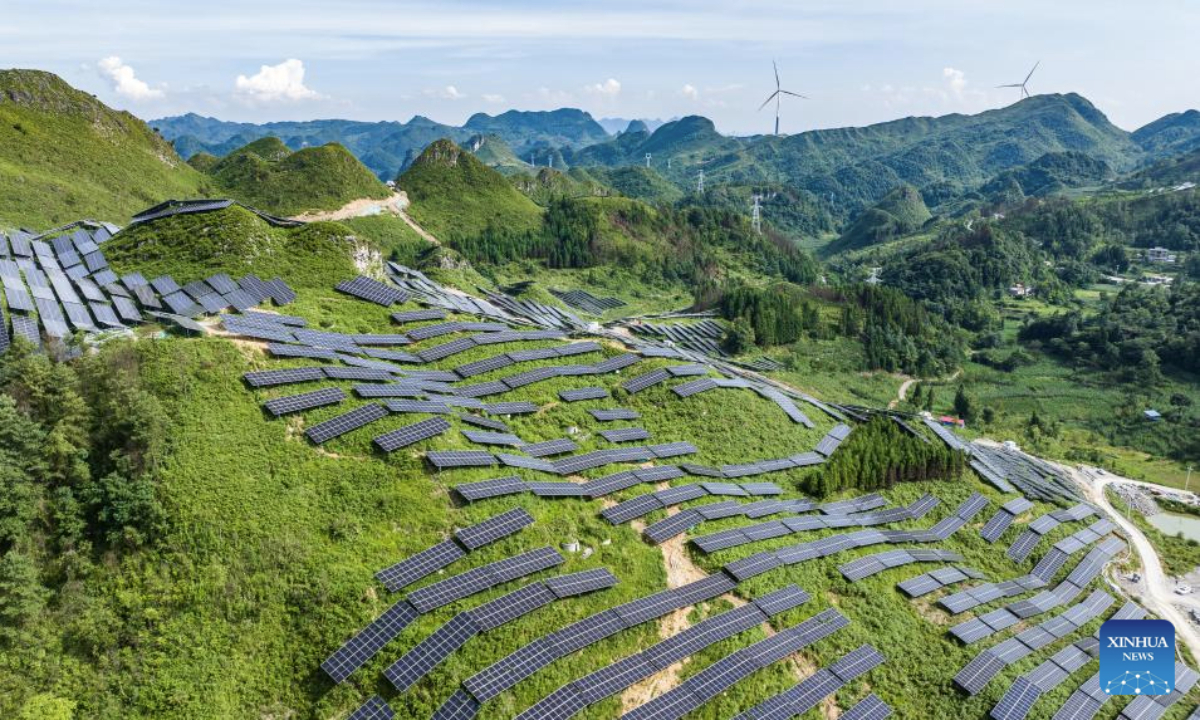
An aerial drone photo taken on July 17, 2025 shows an agricultural photovoltaic project in Liupanshui City, southwest China's Guizhou Province. In recent years, Guizhou Province has accelerated the construction of a new comprehensive energy base with well-ordered steps to build an advanced coal-fired power generation units and develop wind power, photovoltaic power and other new energy industries. According to the energy administration of Guizhou, by the end of June 2025, Guizhou's total installed power capacity has exceeded 100 million kilowatts, of which clean energy accounted for more than 60 percent. (Xinhua/Tao Liang)
Overseas layout of China's clean technology over the past year has captured attention. A newly released report by Australian research group Climate Energy Finance (CEF) said Chinese firms have committed some $80 billion in clean technology investments overseas and many countries deepened their cleantech cooperation with China, Reuters reported on Monday.
China's leadership in the clean energy sector is predominantly demonstrated in the realm of wind power, photovoltaics, electric vehicles, and energy storage, Lin Boqiang, director of the China Center for Energy Economics Research at Xiamen University, told the Global Times on Tuesday.
China's contribution to the global green transition stems fundamentally from this robust industrial chain, Lin noted.
However, report author and CEF China engagement lead Caroline Wang alleged that Chinese firms' overseas investment is to seek to absorb a supply glut, as Reuters reported. The expert rebuffed that the so-called "overcapacity" rhetoric promoted by some countries is an excuse for trade protectionism.
China's new energy products are competitive in the global market by virtue of their technological, industrial chain and market advantages, thereby playing a pivotal role in facilitating the global energy transformation Lin said.
For example, fore than 600 million people on the African continent currently lack access to electricity, according to the International Energy Agency. Against this backdrop, China's capacity for new energy products is hardly excessive; instead, it is a timely response to the urgent African demand for clean energy, a Xinhua News Agency report in 2024 said.
The vast amount of investment presents opportunities for emerging economies seeking to reduce their dependence on imported fossil fuels. One of incentive for emerging economies is "not wanting to miss out on this technological revolution," report author and CEF China engagement lead Caroline Wang said, per Reuters.
"China's leading the world in the technologies, in the innovation, and if you don't get into the supply chain quickly, there's a risk you miss out on innovation opportunities."
"Belt and Road markets have been a major scene in which these buildups took place, boosting economic development and creating jobs by nurturing industrialization in many countries in the Middle East and Africa," an industry expert told the Global Times on condition of anonymity.
"Sometimes, if a top-tier clean energy firm decides to set up plant, many supply chain partners will follow, so it is not investment by one Chinese company, but rather a group of Chinese companies to that country, greatly boosting investment and enhancing the manufacturing capacity of the local economy," the industry expert added.
RELATED ARTICLES