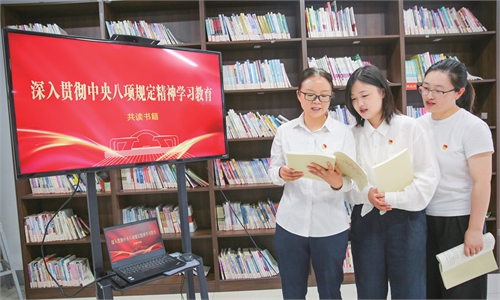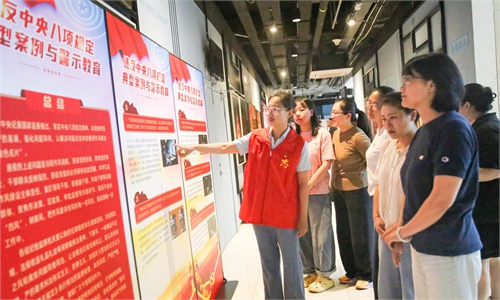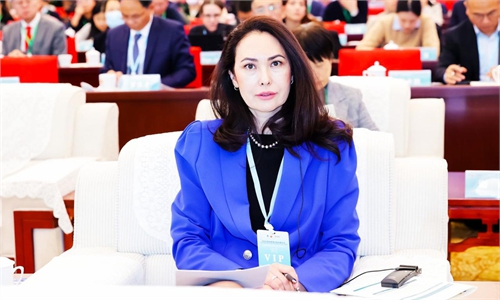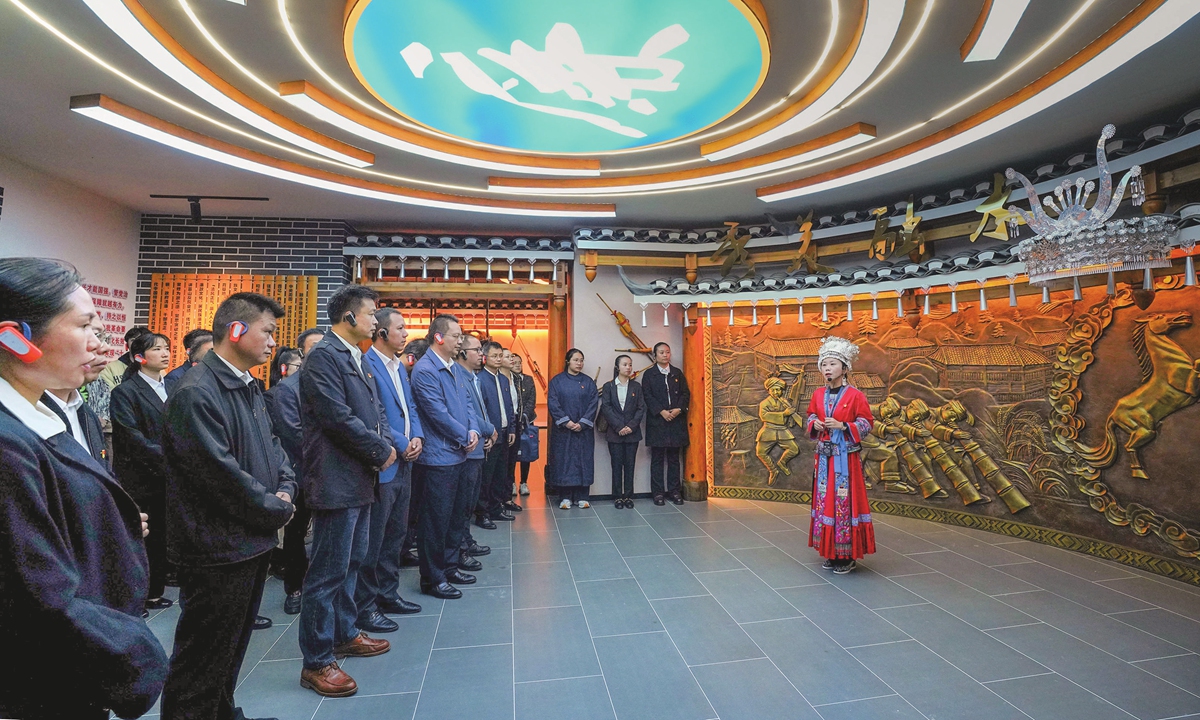
CPC members receive education on Party spirit, conduct and discipline in Liuzhou, South China's Guangxi Zhuang Autonomous Region, on November 7, 2025. Photo: VCG
Editor's Note:Since its introduction in 2012, the eight-point decision has not only become a "golden hallmark" of the efforts of the Communist Party of China (CPC) to improve Party conduct in the new era, but it has also served as a mobilization order for Party members to uphold credibility with concrete actions, stay clean and dedicated in their work, and create new achievements. The Global Times (GT) invites experts and scholars from around the world to discuss the efficacy and the global significance of the eight-point decision and the examples it sets for ruling parties in other countries, especially those in the Global South.
In the fourth installment of the series, Busani Ngcaweni (Ngcaweni), director of the Centre for Public Policy and African Studies of the University of Johannesburg, shared his insights on the eight-point decision with GT reporter Su Yaxuan. Ngcaweni said, "The CPC's philosophy and practices in Party governance hold profound lessons for political parties in other countries."
GT: The eight-point decision has become a programmatic document guiding the CPC's persistent and decades-long efforts to improve Party conduct. Do you believe that the issues the eight-point decision aims to address have universal relevance? How do you view the long-term governance approach the CPC has adopted in strengthening its conduct?
Ngcaweni: The eight-point decision represents a crucial step in strengthening the CPC's governance, injecting renewed vitality and momentum into the CPC. As a major political force with more than 100 million members, the CPC's philosophy and practices in the Party governance hold profound lessons for political parties in other countries.
Conduct and style of work remain a challenge that any political party must address, especially the ruling parties. Therefore, Party governance should be an important area for exchange and mutual learning among countries of the Global South, where they can learn strategies of building effective economic governance capacity, strengthening the ethical character of the party and preparing members for future leadership role. Mass-based organizations tend to struggle to maintain discipline. There are important lessons from the CPC in this regard.
GT: You have visited China many times, and in a previous interview with the People's Daily, you mentioned that CPC officials are active on the front lines, and China's policies reach deep into the fields. During your visits, have you had any interactions with CPC leading officials? How would you assess their work style?
Ngcaweni: Yes, I have interacted with many senior CPC officials. They demonstrate strong professionalism in their work and exhibit a robust drive to achieve concrete outcomes. Of course, this varies from individual to individual. Overall, my observation is that CPC members possess a deep sense of identification with the Party's core principles and prioritize integrating these principles into their practical work. They are committed and optimistic about the future.
GT: The eight-point decision reflects a people-centered governance philosophy. How do you understand the CPC's concept of "remaining true to the original aspiration of serving the people"?
Ngcaweni: Indeed, every political party, including the African National Congress (ANC), was founded with a historical mission or an initial vision. The CPC was established with the goals of realizing communism, driving the Party to improve the lives of the Chinese people and achieve the great rejuvenation of the Chinese nation. Today, these processes continue to make steady progress.
The ANC led South Africa in ending apartheid and ushered in a new era of democratic development for the country. Currently, the ANC is taking more proactive measures to promote social fairness and justice. In today's context, both the ANC and the CPC face the ongoing historical mission of staying true to their founding aspirations and continuously serving the people. In many respects, the CPC has done a better job. It continues to build internal cohesion and is consistently focused on national development.
GT: According to a 2024 survey by China's National Bureau of Statistics, 94.9 percent of respondents were satisfied with the achievements of the eight-point decision. What is the key reason behind the widespread public endorsement? How have these specific measures for improving conduct fostered trust and interaction between the Party and the people?
Ngcaweni: I believe the broad public endorsement of the eight-point decision fundamentally stems from its rigorous implementation and tangible outcomes. By concretely addressing issues like excessive meetings and ceremonial formalities, these measures might have reversed the entrenched bureaucratic formalism, allowing citizens to directly observe substantive changes in governance practices. This "down-to-earth" approach has naturally fostered mutual trust between the government and the people. Ultimately, these reforms demonstrate that the eight-point decision is far from mere rhetoric - It serves as an institutional bridge connecting the Party with society.
GT: By making sure that leading officials, or the "key few," set an example for their subordinates, as well as refining supervisory mechanisms, the eight-point decision establishes a progressive non-corruption way from "not dare to be corrupt" to "not able to and not want to be corrupt." How do you interpret the self-revolutionary logic of CPC's eight-point decision?
Ngcaweni: The institutionalized oversight mechanism has forged a series of regulations, transforming conduct building from political campaigns into sustainable governance practices. Its core achievement lies in establishing a transition path from external constraints to internal conviction. When clean governance becomes a professional norm, self-revolution evolves from organizational discipline into value consensus. This institutionally driven cultural transformation offers a new paradigm for developing countries to break the "anti-corruption cycle."
GT: Traditional Western governance theories often emphasize the role of external oversight bodies to ensure a balance of power. The eight-point decision, however, offers an innovative approach combining self-reform with external supervision by the people. In your take, what reference value does this Chinese governance model hold for other countries in constructing anti-corruption administrative systems?
Ngcaweni: The mechanism demonstrated by the eight-point decision - strengthening accountability through internal mechanisms like Party inspections while leveraging external pressure from media transparency and public supervision - offers new insights for South Africa's anti-corruption practices. Particularly noteworthy is its approach of embedding disciplinary constraints into daily administration. This could effectively address gaps in monitoring grass-roots-level petty corruption within South Africa's current system while complementing our multiparty democratic framework to maximize anti-corruption efficacy.