China to ban mercury thermometer production in 2026 due to safety concerns over toxic mercury leaks when devices break
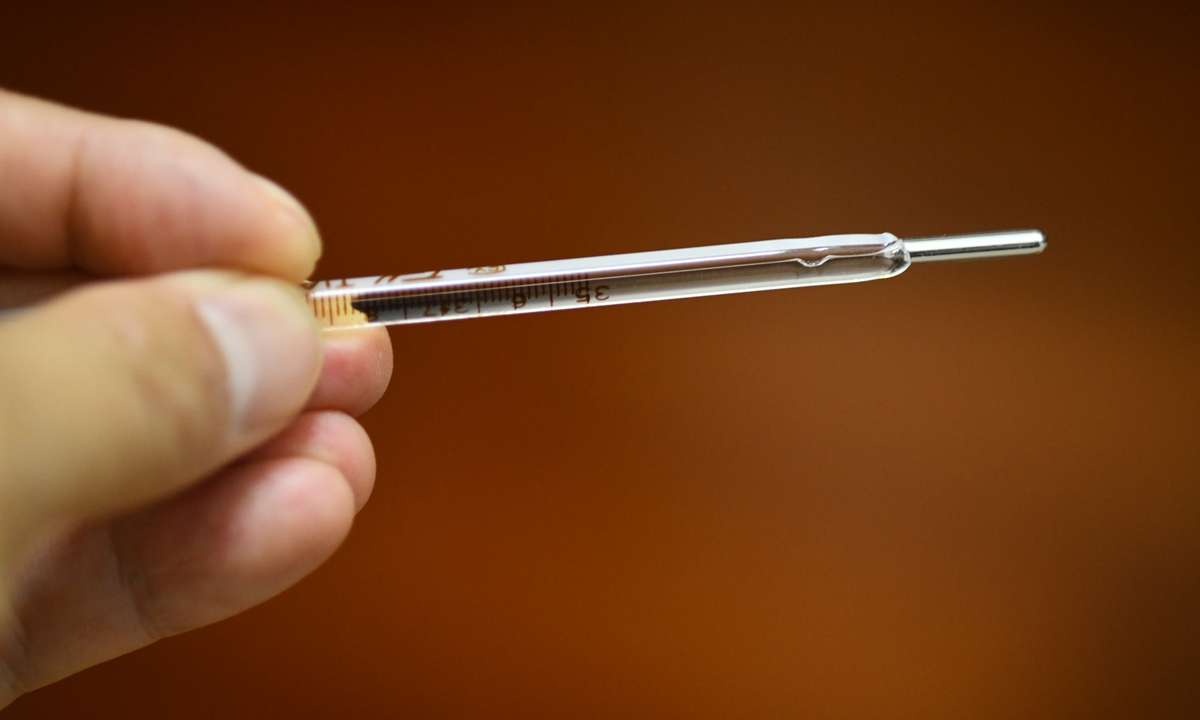
A mercury thermometer. Photo: icphoto
As 2025 is ending, social media has been abuzz with news about the upcoming full ban on the production of mercury thermometers and mercury sphygmomanometers starting January 1, 2026 due to safety concerns.The online discussion refers to a notice issued by China's National Medical Products Administration in 2020.
The notice stated that starting from January 1, 2026, the production of mercury thermometers and sphygmomanometers will be fully prohibited. Within less than a month remining in 2025, the old-school clinical mercury thermometers are officially scheduled to be in the history of body temperature measuring.
Although mercury thermometers are affordable and highly accurate, and have long been familiar tools in household healthcare, the decision to phase them out is driven primarily by safety concerns. Since mercury is highly toxic, authorities have prioritized public health in moving toward a full production ban, according to local media.
Mercury thermometers need to be shaken before use to reset the mercury level of temperature from previous measurement which stays up in the capillary tube at the recorded temperature. Shaking helps bring it back down below normal body temperature (usually below 35°C), according to Medical Production Administration's use instruction.
Risks occur when using excessive force to shake the thermometer before use. Hitting it against a hard object, accidentally dropping it during measurement, or allowing it to fall without a protective case may all result in the thermometer breaking and mercury spilling.
According to the National Institute for Occupational Health and Poison Control of the Chinese Center for Disease Control and Prevention (China CDC), mercury is the common name for metallic mercury, which is the only metal that remains in liquid form at room temperature. After a thermometer breaks, mercury falling onto the ground will form many silver-colored beads of different sizes. If not collected and handled in time, it will quickly evaporate into the air and turn into mercury vapor. Mercury vapor is highly toxic. Inhaling a high concentration of mercury vapor (greater than 1.0 mg/m³) in a short period of time can lead to acute mercury poisoning. Common symptoms of acute mercury poisoning include dizziness, headache, fatigue, and fever.
There are now many good alternatives to mercury thermometers. Ding Weiqiang, a traditional Chinese medicine doctor at Guangzhou Qitai Clinic, said that the most commonly used options today are digital thermometers and infrared thermometers such as non-contact forehead thermometers and contact ear thermometers, according to a media report.
Ding also noted that mercury thermometers are now rarely used when measuring body temperature in hospitals. Using a mercury thermometer usually requires waiting around 10 minutes, making it far less convenient than other electronic thermometers. Electronic thermometers are also more accurate and fully capable of replacing mercury thermometers. Therefore, phasing out mercury thermometers from the market is an inevitable trend.
Global Times
RELATED ARTICLES