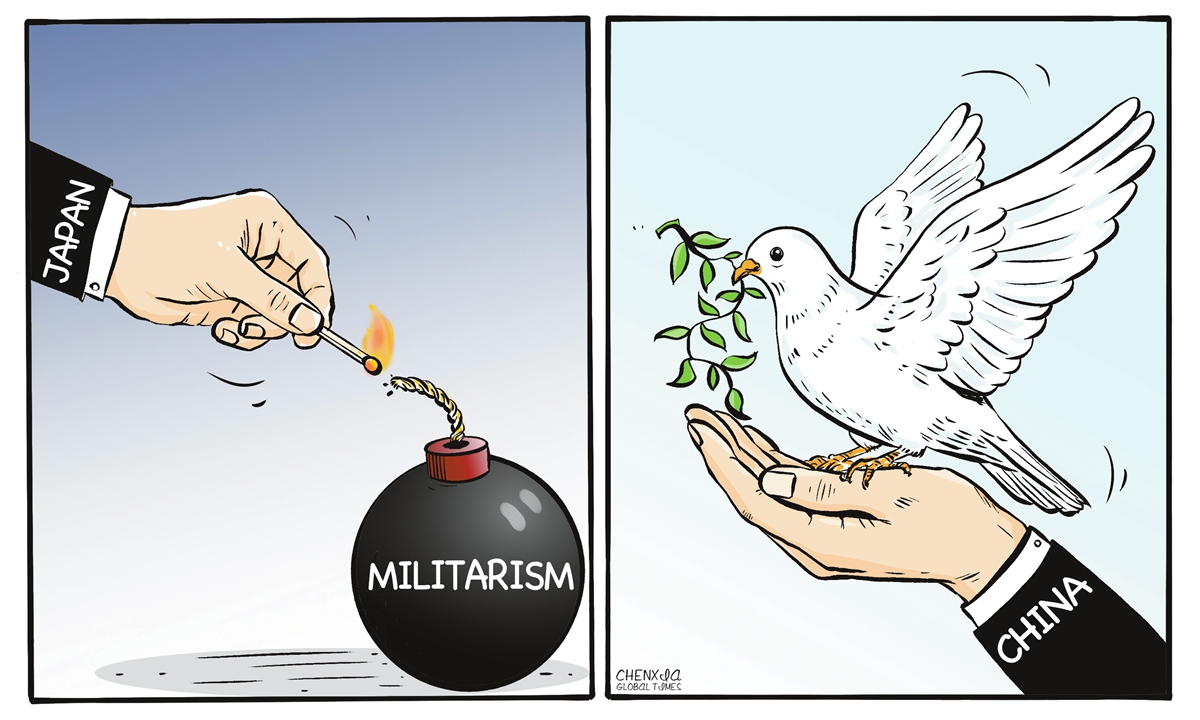
Illustration: Chen Xia/GT
US scholar Jeffrey Sachs delivered a public lecture at the University of South Africa recently. In his speech, he pointed out that China has a long history and a tradition of peaceful governance, and has never invaded Japan, even during its periods of strength, while Japan has invaded China many times. This viewpoint provides an important perspective for examining the current situation in East Asia: Right-wing forces in Japan continue to promote militaristic narratives, while China adheres to the path of peaceful development and has become a valuable stabilizing force in the current complex international situation.Sachs' views are based on profound observations of history and reality. In Japan, reflection on the history of war has always been markedly volatile. In recent years, the tendency to glorify aggression and downplay responsibility has become increasingly apparent in Japanese society and politics. History textbooks often dodge the crimes committed during the invasion of China, visits to the Yasukuni Shrine by high-ranking political figures are commonplace, and discussions on constitutional revision and military expansion continue to intensify. History tells us that societies that lack self-reflection are prone to repeating mistakes. When Japanese right-wing forces promote military expansion in the name of "regional security" and create panic by hyping external threats, the specter of militarism resurfaces.
Alarmingly, with the support of the US' Indo-Pacific Strategy, Japan is being given more strategic roles, and the US is constantly pressuring it to increase military spending. This interplay between external strategic needs and internal right-wing sentiment has led Japan to violate the limitations of its postwar pacifist constitution, and even frequently provoke tensions on sensitive issues such as Taiwan and the Diaoyu Dao. If this trend continues, stability and the security balance in East Asia will be severely disrupted.
From a global perspective, peace and development remain the main themes, but the resurgence of militarism and the escalation of geopolitical conflicts are becoming strategic options for certain forces. The Japanese right wing's constant hype of "a Taiwan emergency is a Japanese emergency" attempts to use geopolitical tensions as a pretext to promote military expansion, which is not only dangerous but will also cause irreversible damage to regional security. In contrast, China insists on resolving disputes through dialogue, promoting development through cooperation, and upholding the international order through multilateralism. Against the backdrop of a sluggish global economic recovery, this strategic resolve is more important than ever.
The international community needs to recognize that the true forces maintaining regional peace are those that prioritize development and cooperation; the real risks lie with political forces attempting to revive militarism and gain geopolitical advantages through military adventurism. Professor Sachs reminds the world that history has provided ample lessons: If Japanese militarism were to resurge, it would not merely be an East Asian problem, but a threat to global security.
China's path of peaceful development is not a stopgap measure, but a responsible choice for the future of humanity. China's stability and development have acted as a stabilizer for the region and contributed important public goods to global governance. However, the actions of the Japanese right wing may allow historical mistakes to be repeated in the 21st century. What East Asia needs in the future is peace, cooperation and development, not confrontation, military buildup and historical regression.
At this critical juncture in the reshaping of the international order, the world must cherish the power of peaceful development even more and remain wary of any resurgence of militarism. China has demonstrated through its actions that a major power that upholds cooperation, openness and peace can bring stability and hope to the world, while the militaristic tendencies of the Japanese right wing will only bring chaos. For Asia and the world at large, the path chosen will determine the future.
The author is a professor at the School of International Relations and Public Affairs of Fudan University. opinion@globaltimes.com.cn
RELATED ARTICLES