Japan companies see strained China ties as top 2026 risk; expert says Takaichi's wrongful remarks inflict damage on Japanese firms
Takaichi's wrongful remarks inflict damage on Japanese firms: expert
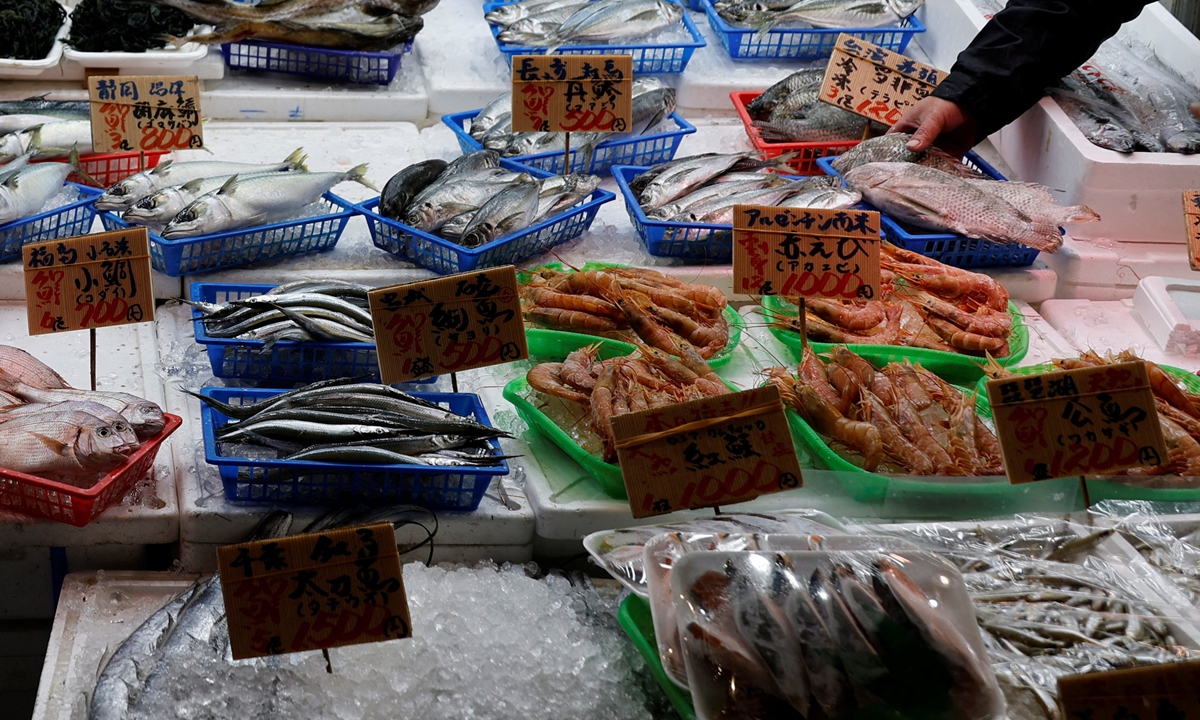
A vendor arranges seafood in his store on November 19, 2025, in Tokyo, Japan. Photo: IC
A Reuters survey released on Thursday showed that Japanese companies said strained diplomatic relations with China are their primary concern as they head into 2026, followed closely by US trade policies. Chinese analysts said that the findings underscore growing alarm within Japan's business community as Prime Minister Sanae Takaichi pursues an increasingly confrontational China policy.
Asked what makes companies most concerned when forecasting business conditions next year, one-quarter of survey respondents chose ties with China, while 22 percent picked US trade policies, according to Reuters.
Japan's corporate concerns emerged against the backdrop of China-Japan relations hitting rock bottom, a downturn triggered by Takaichi's erroneous remarks last month on the Taiwan question, experts said.
Chen Zilei, director of the Research Center for Japanese Economics at Shanghai University of International Business and Economics, told the Global Times on Thursday that the erroneous remarks and provocative actions by Takaichi and some other Japanese politicians have seriously disrupted what should have been a stable trajectory for China-Japan relations, and have increased concern among Japanese firms about economic prospects between China and Japan.
Driven by domestic political interests, these politicians have taken highly irresponsible positions on Taiwan-related issues, recklessly disturbing the regional atmosphere of peace and artificially generating bilateral tensions, Chen said. He warned that if Takaichi continues to advance an extreme political agenda, it will inflict "significant damage" on Japanese society and its companies.
China remains one of the most important sources of overseas profit for Japanese firms, and many Japanese-funded companies in China continue to maintain healthy profitability.
"This is exactly why Japan's business community is deeply alarmed by the reckless behavior of certain politicians - their actions directly undermine the core interests of Japanese companies," Chen said. "These politicians are completely disregarding the real interests of their own corporate sector."
Japan's economy is already under mounting pressure. The Japan Times reported on Monday that Japan's GDP contracted at an annualized pace of 2.3 percent in the July-September period, a sharper downturn than the initial estimate of 1.8 percent - the first decline in six quarters.
The Xinhua News Agency reported last month that concerns over the fallout from Takaichi's wrongful remarks are spilling over into Japan's already struggling economy, and that the deterioration in Japan-China relations risks pushing Japan's economy into contraction in the fourth quarter.
Moreover, sectors in Japan that rely heavily on the Chinese market such as tourism are being hit hard. Since early December, multiple regions across the country have reported a sharp decline in visitors from the Chinese mainland. Bookings by Chinese travelers to Osaka for this winter and next spring have plunged by 55 to 65 percent, industry data showed.
Backlash against Takaichi's provocative stance has continued to mount inside Japan. Scholars, former government officials and media figures held a press conference in Tokyo on Monday, urging Takaichi to immediately retract her earlier erroneous remarks, warning the comments could further strain Japan-China relations, Xinhua reported.
Amid the tensions and rising anxiety, some Japanese organizations, including the Japan-China Friendship Parliamentarians' Union and Keidanren (Japan Business Federation), have conveyed to the Chinese side their willingness to visit China in the near future, according to media reports.
Responding to questions as to whether China will arrange their visits, Foreign Ministry spokesperson Guo Jiakun said on December 2 that "we noted the reports and also found that many visionary people in Japan are deeply concerned over the negative influence and grave consequences of Prime Minister Sanae Takaichi's erroneous remarks on Taiwan."
The Chinese side urges the Japanese side to do soul-searching, rectify its wrongdoings, retract Takaichi's erroneous remarks, stop harming the sentiments of the two peoples, take practical steps to honor its political commitments to China, and create the necessary conditions for the normal exchanges between the two countries, the spokesperson said. "We hope relevant Japanese organizations will play a more positive role in Japan," Guo added.
Chen stressed that Japanese business groups should recognize that the root cause of their current difficulties lies in Takaichi's erroneous remarks, and they should urge the Takaichi cabinet to correct course.
He also pointed to China's continued rollout of high-level opening-up policies, noting that "China has always adopted a supportive, encouraging and protective approach toward all foreign-invested enterprises, including those from Japan."
Many Japanese companies remain committed to the Chinese market, according to a June white paper published by the Japanese Chamber of Commerce and Industry in China. At that time, the survey found that 58 percent planned to increase or maintain investment in 2025, with many also noting an improving business environment.
RELATED ARTICLES