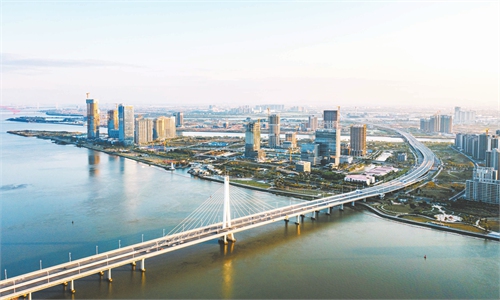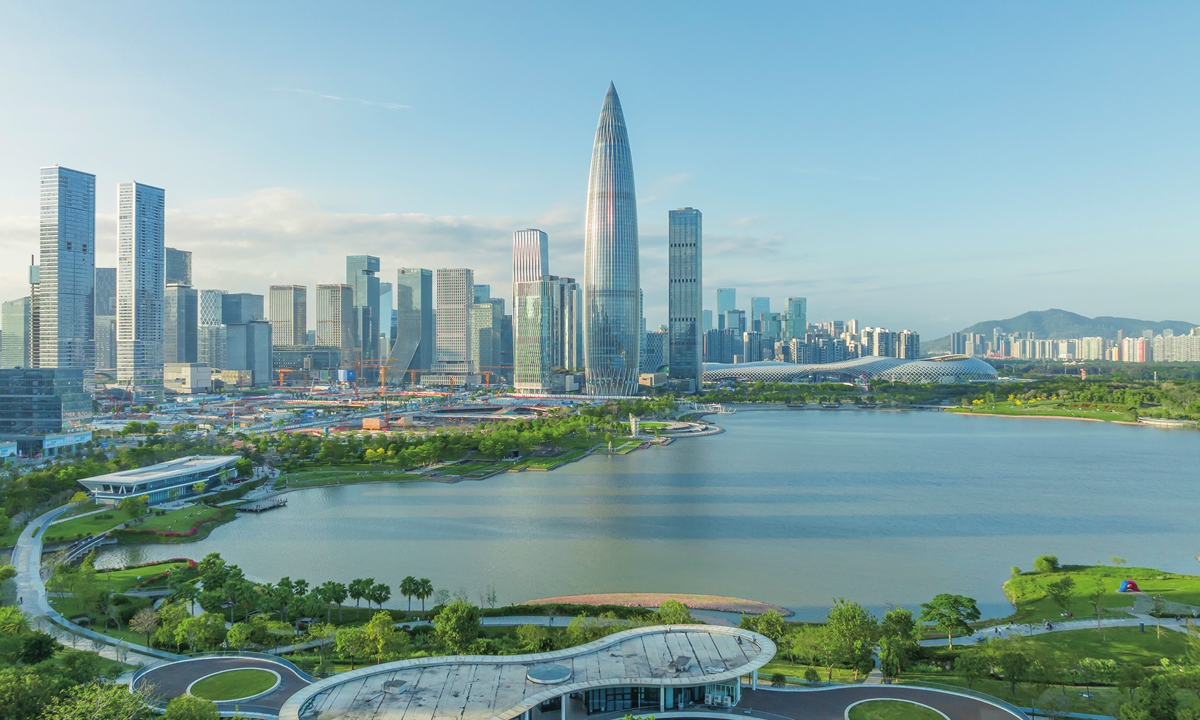
A view of Shenzhen, South China's Guangdong Province. Photo: VCG
As the 14th Five-Year Plan (2021-25) nears completion and the 15th Five-Year Plan (2026-30) is set to begin, reflecting on the past shows how much has been weathered, while the path ahead reminds us of how much remains to be done.
A market economy is, to a large extent, an economy of expectations. Stabilizing expectations, strengthening confidence and supporting growth reinforce one another.
Guided by Xi Jinping Thought on Economy, China has maintained strategic resolve, advanced high-quality development and accelerated the building of a new development paradigm, achieving historic leaps in economic and social progress. China's economy remains resilient and dynamic, with bright development prospects. We are confident in our ability to navigate risks and challenges, and determined to turn China's new development into new momentum and new opportunities for the world.
Economic certainty
Where does that confidence come from? From the certainty of China's economic fundamentals.
Many of the "core components" in China's offshore wind turbines come from Luoyang Bearing Group Co in Central China's Henan Province.
With each shaft carrying immense weight, the company has helped drive China's offshore wind expansion during the 14th Five-Year Plan period. Founded during the First Five-Year Plan period, Luoyang Bearing has navigated market uncertainty and undergone painful reforms while staying focused on its main business and mastering key technologies. Today, high-end bearings account for 70 percent of its output value.
"China has always adhered to the path of developing the real economy... which has proven to be the right path," President Xi said during his inspection tour of the Luoyang Bearing Group Co in May.
The more firmly we stay on the right path, the greater our confidence becomes. Amid global uncertainty, China has maintained strategic focus and concentrated on managing its own affairs. During the 14th Five-Year Plan period, China's GDP surpassed 110 trillion yuan ($15.6 trillion), 120 trillion yuan and subsequently 130 trillion yuan, and is expected to reach around 140 trillion yuan this year.
From 2012 to 2024, China's average annual growth rate was nearly twice the global average. This sustained, high-quality growth has enabled China to navigate external uncertainties while providing the world economy with rare and much-needed stability.
Confidence stems from the certainty of a sound development logic. From the foundational First Five-Year Plan to the 14th Five-Year Plan focused on high-quality development, each planning cycle has steadily advanced China's modernization. With consistent and stable macro policies and regulations that are increasingly targeted, flexible and forward-looking, China has been able to smooth potential fluctuations in economic activity and keep growth within a reasonable range - an approach that has significantly strengthened public confidence.
Confidence is rooted in the certainty of China's development trajectory. "The Chinese economy is like a vast ocean," - defined by enormous market potential, strong growth momentum and a promising long-term outlook. Its massive domestic market and innovation-driven development reinforce one another in a virtuous cycle, forming a powerful engine of growth and a solid foundation of confidence.
China's vast domestic market is a strategic anchor for Chinese modernization. This year, even as tariff and trade conflicts disrupted the global economic order and unilateral bullying impacted multilateral mechanisms, China's economic vessel has pressed ahead undeterred. Technological innovation is powering the modernization of the industrial system, while future-oriented investment - from infrastructure to public services - holds enormous potential. China's talent advantages, especially its "engineer dividend," continue to strengthen. This clear trajectory of future growth has become solid proof that "believing in China means believing in tomorrow."
New growth engines
During the 14th Five-Year Plan period, China's economic growth continued to lead major global economies. The upcoming 15th Five-Year Plan will be a crucial stage for laying the foundation for basically achieving socialist modernization and accelerating progress on all fronts.
The rise of embodied intelligence offers a fresh lens for observing China's economy as it seeks to seize new opportunities and reinforce confidence.
Shenzhen is building an innovation center for embodied-intelligence robots and establishing a 10-billion-yuan AI and robotics industry fund to invest early, invest small and invest in hard tech to secure a first-mover advantage. Having achieved major development by seizing opportunities during reform and opening-up, Shenzhen understands well the importance of moving early and making the right opening move.
On the supply side, the shift from old to new growth drivers is opening major opportunities for developing new quality productive forces. China has ranked first globally for three straight years in the number of top 100 innovation clusters, and high-tech manufacturing above designated size grew 9.6 percent year-on-year in the first three quarters.
On the demand side, the push for a higher-quality life is creating new opportunities in areas such as urban renewal and the silver economy. Shenzhen has rolled out 100 application scenarios for the AI and robotics sector this year; in one local eldercare centre, robots play ping pong with residents and robotic dogs deliver medicine - a sign of how embodied intelligence is weaving into senior life.
Confidence grows stronger as China seizes new opportunities and rises to new challenges.
Long-term commitment
Confidence is the sail, and hard work is the oar - what matters is turning that confidence into the drive and determination to compete and win.
President Xi said that we have the confidence and capability to navigate all kinds of risks and challenges.
Chinese modernization is an undertaking that breaks new ground, and real progress depends on hard work and self-reliance. Addressing the principal challenges of China's new era can only be achieved by China itself.
China has long contributed around 30 percent to global economic growth. Its role as both an engine and a stabilizing anchor stems from its focus on strategic goals and advancement through steady, pragmatic innovation.
By acting locally while serving the national picture, regions are leveraging their strengths to capitalize on momentum. Since 2014, East China's Zhejiang Province has seen its digital economy post double-digit growth in value added for 11 consecutive years.
"Identifying one's strategic role within the national landscape" means building local strengths around national priorities - competing where appropriate, differentiating where needed and together reinforcing the broader momentum of China's economy. Major economic provinces are taking on heavier responsibilities, while other regions are leveraging their comparative advantages to drive more balanced urban-rural and regional development, injecting strong momentum into high-quality growth.
China is balancing immediate progress with long-term goals by focusing on "quiet gains" that take sustained effort. After eight years of targeted action and five years of consolidation, nearly 100 million people have achieved stable poverty alleviation, making China's poverty-reduction practice and its homegrown anti-poverty framework a valuable contribution to global efforts.
This year marks the final stage of the five-year transition, linking the gains of poverty alleviation with rural revitalization. No one should be left behind on the path to a Xiaokang society; "on the march towards common prosperity, no one will be left behind." Ensuring and improving people's livelihoods has no finish line - only new starting points that call for sustained effort, step by step.
This was compiled from an article originally published on the front page of the People's Daily on December 11, 2025. opinion@globaltimes.com.cn