Some groups for war victims from China, ROK urge Japanese govt to apologize, compensate
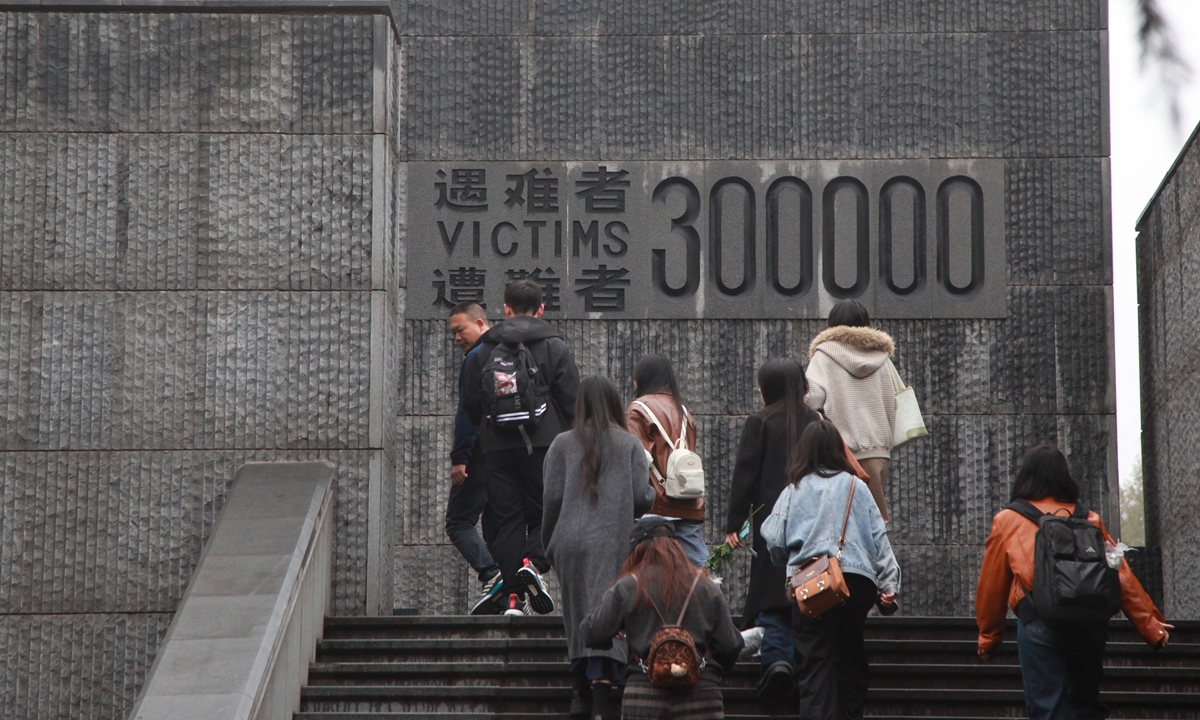
People visit Memorial Hall of the Victims in Nanjing Massacre by Japanese Invaders in Nanjing, East China's Jiangsu Province on November 9, 2025. Photo: IC
As this year marks the 80th anniversary of the victory in the Chinese People's War of Resistance Against Japanese Aggression and the World Anti-Fascist War, some groups from China and South Korea have recently been working to urge Japanese government to resolve issues stemming from its aggressive war and the damage it caused, media reports said.
Analysts warned that Japanese militarism has been resurfacing from the ashes, and has never even truly died out, calling for groups from China and South Korea to cooperate in presenting their demands to Japan.
On Wednesday, supporters of family members of Chinese laborers forcibly conscripted from China during the war submitted an open letter to the Japanese government within the National Diet, according to Japanese newspaper Asahi Shimbun.
The letter, compiled at a gathering held in North China's Tianjin in September, called for recognition of the history of Chinese forced labor, apology and compensation, and the search and return of remains to their hometowns, per Asahi Shimbun. The official from the Japanese Ministry of Foreign Affairs who received the letter said the report will be presented to the relevant departments.
On Tuesday, a group of volunteer lawyers from Japan and South Korea held a press conference in Tokyo, releasing a joint declaration urging the resolution of issues stemming from Japan's colonial rule of Korea and the damage caused by the war, Asahi Shimbun reported.
Both China and South Korea were victims of aggression and colonial rule of Japanese militarism during the war. The issue of civilian compensation remains unresolved. It is hoped that Japan will seriously address the reasonable demands of the surviving war victims, Lian Degui, director of the Center for Japanese Studies at Shanghai International Studies University, told the Global Times.
Japan should be reminded that its war of aggression caused immense suffering to the peoples of Asian nations and that it should engage in genuine reflection on its wartime actions, Lian said.
A separate report by South Korea's Yonhap News Agency on Thursday wrote that the Supreme Court of South Korea upheld a lower court ruling ordering Nippon Steel Corp to pay compensation to the family of a late South Korean forced into wartime labor during Japan's 1910-1945 colonial rule.
It marked the top court's first ruling on cases involving forced labor victims filed since its landmark 2018 ruling that Japanese companies are liable for damages to such victims. The top court upheld the order for Nippon Steel to pay 100 million won ($67,900) in compensation to the family of the Korean victim, per Yonhap.
Lian further said it is worth noting that the right-wing forces in Japan, represented by Prime Minister Sanae Takaichi, have been inciting nationalism and populism by hyping so-called external threats and national crises, and taking the route of military expansion.
This trend showed that the Japanese right-wing forces have failed to reflect on its war crimes of aggression during World War II, which is also the reason that Takaichi made erroneous remarks on the Taiwan question, he said.
The UK-based The Economist and the US journal Eurasia Review recently commented that Japan is transforming from a constitutionally pacifist state to a modern military power. The commentary also said it's alarming that Japan's attempt to resurrect militarism can only threaten regional and global peace and stability.
In response, Chinese Foreign Ministry spokesperson Guo Jiakun said on Wednesday that Japan has in recent years been revamping its security and defense policies, accelerating the revision of its pacifist constitution, and breaching the exclusively defense-oriented principle.
The reckoning with Japanese militarism has never been completed. Instead, we see the rising trend of reviving militarism, Guo said, calling on all peace-loving countries to guard against and thwart any dangerous moves of reviving Japanese militarism and jointly defend the hard-won victorious outcomes of WWII.
RELATED ARTICLES