Japanese civil group representative and some netizens call for Chinese film on Unit 731 to be screened in Japan
By Published: Sep 18, 2025 05:47 PM


Photo: VCG
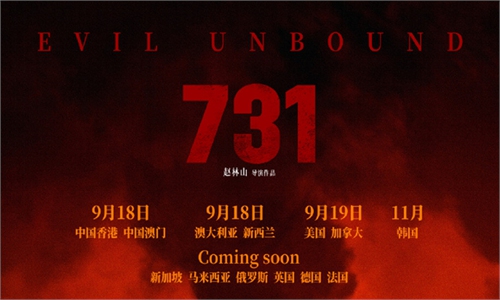
The highly-anticipated film Evil Unbound, which revisits the horrific World War II-era human experiments conducted by Japan's notorious Unit 731, hit Chinese cinemas on Thursday with screenings timed to coincide with a painful national memory - the September 18 Incident that marks the start of Japanese military's aggression of China in 1931. The film has attracted attention and discussion in Japan, even though, according to its official poster listing multiple international release countries, the Japanese market is not among them.According to Maoyan, the film had already grossed over 219 million yuan ($30.81 million) as of press time including its presale revenue, with more than 4 million people expressing interest in watching it.
In Japan, a civil group representative, who has held multiple exhibitions on Japanese army's chemical warfare and other war crimes, and some Japanese netizens also have expressed their wish to watch the film in their country.
A Japanese peace activist, Nobuharu Goi, also a representative of the civil group Yokohama Committee for the Exhibition on Japanese Army's Chemical Warfare, expressed strong interest in the film in an email to the Global Times as early as June.
In an exclusive email interview with the Global Times on Thursday, Goi stated, "I understand that the film about Unit 731 was released in China on September 18. I also very much wish to watch it!" He expressed hope that the film would be released in Japan someday.
He stated that "the live human experiments, bacteriological warfare research, and actual deployment of biological weapons conducted by Unit 731 in China are absolutely unforgivable."
However, despite the existence of evidence, the Japanese government continues to conceal the details of Unit 731 and claims, "There is no evidence," according to Goi.
"While I firmly believe that war crimes must not be forgiven, it seems that many people in Japan today choose to pretend ignorance," he noted.
To fight against the collective amnesia on the past Japanese war crimes, Goi and some like-minded Japanese partners have held exhibitions in Tokyo and Yokohama in May and August, which focused on bacterial warfare units of the Japanese Imperial Army including Unit 731, the Japanese Imperial Army's use of chemical weapons and the dangers posed by abandoned chemical munitions during the Chinese People's War of Resistance against Japanese Aggression. They plan to hold another such exhibition in December in Tokyo.
On Sunday evening, the Chinese Embassy in Japan posted a bilingual Chinese-Japanese message on X, sharing the poster for the film Evil Unbound. This has sparked discussion, with some Japanese netizens calling for the film to be released in Japan.
"I'd like to watch it, but it's probably unlikely to be screened here in Japan... I think there should be a clearer recognition in Japan about Unit 731. Without acknowledging not only the suffering from the atomic bombs but also the history of Japan's aggression toward other countries, peace education remains incomplete," mizuni555 commented in Japanese, which gained over 100 likes, comments and retweets.
Netizen 1969peaceful said in Japanese that "The Empire of Japan was no different from the Nazis. It must be screened in Japan as well. Just watching the trailer makes one want to turn away from its brutality — yet like Germany, Japan must confront and accept its own horrifying history."
Mikey River commented in Japanese that "I heard about Unit 731 just a few days ago." The netizen added that "Japan should establish a Unit 731 memorial or museum — to ensure we never descend into madness again, and to prevent war from ever repeating."
During a recent exclusive interview with Hideo Shimizu, a former member of Unit 731, in his hometown Nagano Prefecture, received the film trailer provided by Global Times reporters. He told the Global Times that "Such cruelty, once committed, can never be forgotten for a lifetime." In March 1945, Shimizu, not yet 15 years old then, was sent to Harbin, Northeast China's Heilongjiang Province as one of the last teenage recruits of the Imperial Japanese Army's Unit 731. Seventy-nine years later, the 94-year-old Shimizu returned to Harbin to repent and apologize in 2024.
A slew of WWII-commemorative movies has been and is scheduled to be on screen this summer in China including Mountains and Rivers Bearing Witnesses on August 15, Evil Unbound on September 18 and Dead to Rights on July 25.
However, instead of reflecting its country's aggression history, some Japanese media outlets, including Nikkei Shimbun, have labeled the related WWII films in China as "anti-Japanese."
TBS News claimed Thursday that in China, a film themed around the Imperial Japanese Army's Unit 731 has been released, raising so-called concerns about "a potential surge in anti-Japanese sentiment."
Also, last Thursday, the Japanese Embassy in China issued a security advisory to Japanese nationals in China, urging them to "exercise particular caution around historically significant dates related to China-Japan history, as heightened anti-Japanese sentiment may be observed."
The embassy claimed that, citing the anniversary of the September 18 Incident and the 80th anniversary of the victory in the Chinese People's War of Resistance against Japanese Aggression (1931-45) and the World Anti-Fascist War, a series of related films, television dramas, and various commemorative events have been and will continue to be held. The embassy continued to claim that "When going out, please remain vigilant of your surroundings..."
Eighty years after the WWII, on the issue of how to reflect on wartime history correctly, Japan appears to have sent contradicting messages to the world.
On August 15, which marks the 80th anniversary of Japan's unconditional surrender in WWII, Japanese Prime Minister Shigeru Ishiba sent a ritual offering to the infamous Yasukuni Shrine, Kyodo News reported. Also at Japan's national memorial ceremony on the same day, Ishiba said Japan would "keep in mind" its "remorse" over WWII as it continues its pursuit of peace 80 years since its surrender, becoming the first premier in over a decade to use the term at the event, Kyodo News reported.
However, Ishiba's administration broke with precedent by not issuing an official statement marking the 80th anniversary, instead intending to release his personal views, while some cabinet members visited the notorious Yasukuni Shrine, according to Japanese media.
In response to a question about the film Evil Unbound, the Chinese Foreign Ministry spokesperson Lin Jian said on Thursday that China's grand commemoration of the 80th anniversary of the victory of the Chinese People's War of Resistance against Japanese Aggression and the World Anti-Fascist War aims to remember history, honor the martyrs, cherish peace, and create a better future. Related films and television works also serve as reminders for people to draw lessons from history and safeguard peace, Lin said.
China is an open, inclusive, and safe country. "We welcome people from all countries, including Japan, to visit China for tourism, study, business, and living. We will continue to safeguard the safety of all foreigners in China equally," the spokesperson said.
RELATED ARTICLES