Japan's defense chief holds phone call with US counterpart amid criticism over 'radar illumination'; attempt to gain support miscalculation: expert
By Published: Dec 12, 2025 12:32 PM


US Secretary of War Pete Hegseth and Japanese Defense Minister Shinjiro Koizumi Photo: VCG
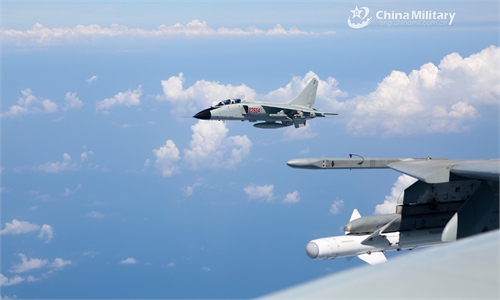
After facing growing criticism for its inconsistent statements regarding the so-called "radar illumination" by a Chinese warplane, Japan's defense ministry claimed on Friday that Japanese Defense Minister Shinjiro Koizumi held a phone call with Secretary of War Pete Hegseth, and they raised "serious concerns," although the US' official readout notably did not use such wording.
A Chinese expert said on Friday that Japan's attempt to further escalate tensions with China and secure US backing is a dual miscalculation of the strategic landscape in the Asia Pacific and the US' policy, and is doomed to fail.
In a statement, the Japanese Ministry of Defense claimed that Koizumi and Hegseth exchanged candid views on the increasingly severe security situation in the Indo-Pacific region, including the radar incident against Self Defense-Force aircraft by Chinese military aircraft on December 6. "The Ministers expressed serious concern over any actions to increase regional tensions, as China's actions are not conducive to regional peace and stability, and concurred to closely communicate and collaborate with each other," it asserted.
However, a readout of the phone call released by the US Department of War did not mention any particular incident, and did not say they raised "serious concerns" as claimed by the Japanese side. "The two leaders discussed Japan's efforts to increase its defense spending and strengthen its capabilities, China's military activities, and the importance of realistic training and exercises across Japan," the US readout said.
Japan's current behavior makes its intentions unmistakably clear: it wants to leverage US support to counterbalance China, Li Haidong, a professor at China Foreign Affairs University, told the Global Times on Friday. Given that Japan's own capabilities do not give it an advantage in competition with China, it has long sought to act as Washington's "follower," attempting to create instability around China to highlight Japan's "indispensability" to the US, Li noted.
"However, the current US administration's policy is no longer what it once was. Washington is now more focused on its own homeland and the Western Hemisphere, and expects its allies in the Asia-Pacific to shoulder more of the responsibility and costs themselves," Li said.
Amid rising tensions between China and Japan provoked by Japanese Prime Minister Sanae Takaichi's erroneous remarks regarding China's Taiwan region, the US government has adopted a cautious stance, according to media reports.
The White House said on Thursday that the US president can maintain both a "good working relationship" with China and a "very strong alliance" with Japan even as tensions have risen between those two countries, Reuters reported.
Friday's phone call comes as, Tokyo has accelerated its outreach in recent days to Western partners in what appears to be a coordinated attempt to secure external backing, amid its self-provoked tensions with China, experts said.
Bloomberg reported that Koizumi held a flurry of calls on Wednesday, briefing NATO Secretary General Mark Rutte and Italian Defense Minister Guido Crosetto on the so-called "radar illumination" by Chinese aircraft and a joint flight by Chinese and Russian bombers south of Okinawa, citing Japan's Defense Ministry.
These attempts also come as the Japanese defense minister is facing harsh criticism over his inconsistent statements regarding the so-called "radar illumination" incident. The Japanese side's contradictory statements have triggered questions from home, with some people in Japan demanding the resignation of the Japanese defense chief and even Takaichi's cabinet.
"Yesterday, the Japanese side said they received no prior notification of China's flight drill. Today, they admitted that they did receive the information beforehand. In addition to that inconsistency, the Japanese side continues to beat around the bush without explaining why they sent warplanes into China's pre-announced exercise zones and repeatedly engaged in hostile surveillance and disruptive maneuvers to create a crisis situation and generate media hypes," Guo Jiakun, a spokesperson for the Chinese Foreign Ministry, said on Wednesday.
Japan's attempt to stir up tensions with China and secure US backing is, in itself, a dual miscalculation - both of the strategic landscape in the Asia-Pacific and of current US policy - and will ultimately fail, Li said.
"For the US, its greater interest lies in maintaining a relatively stable relationship with China. Japan's attempt to provoke incidents in order to drive a wedge between China and the US, creating crises or even conflicts, fundamentally runs counter to the needs and interests of both China and the US," he said. "In the end, Japan will very likely end up 'trying to steal a chicken only to lose a handful of rice' — gaining nothing and losing heavily."
Global Times
RELATED ARTICLES