China holds national memorial ceremony for Nanjing Massacre victims; victim families, Nanjing residents warn against resurging Japanese militarism


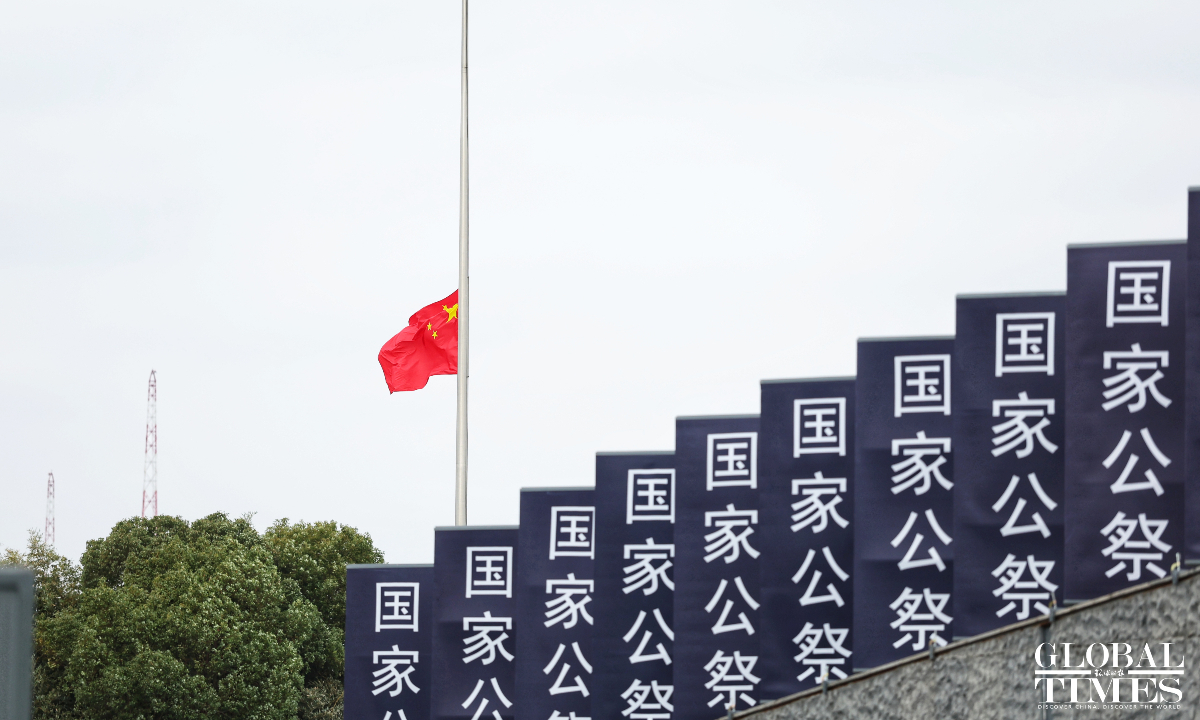
Photo: Cui Meng/GT
A ceremony was held at the Memorial Hall of the Victims in the Nanjing Massacre by Japanese Invaders in Nanjing to remember those killed by Japanese aggressors during World War II on Saturday.At 10:01 am on a chilly Saturday, Nanjing paused once more. For one minute, air-raid sirens echoed across the city as pedestrians stopped, removed their hats, and bowed their heads in silence. The city began observances marking the National Memorial Day for Nanjing Massacre Victims — observed each year on the anniversary of December 13, 1937, when Japanese troops captured Nanjing, then the capital of China.
What followed that day remains one of the darkest chapters of World War II. Over the ensuing six weeks, approximately 300,000 Chinese civilians and unarmed soldiers were killed in the massacre. Today, commemorative ceremonies unfolded across the city, from the Memorial Hall of the Victims in the Nanjing Massacre by Japanese Invaders to mass-burial memorial sites scattered throughout Nanjing, as the city remembered its dead and reflected on a history that must not be forgotten.
As the main commemorative activities were held at the Memorial Hall of the Victims in the Nanjing Massacre by Japanese Invaders, nearby roads were under temporary traffic control. High above the main building of the Memorial Hall, rows of large black plaques bearing the stark white characters "National Memorial" stood in solemn silence, each measuring approximately 1.3 meters by 3 meters.
Along the surrounding streets, blue banners with white lettering swayed softly beneath the streetlamps. One side read: "Remember History, Honor the Martyrs; Cherish Peace, Shape the Future." The other reads: "Safeguard World Peace, Promote Common Development."
Along the Yangtze River in Xiaguan, near Zhongshan Wharf, a memorial stands in silence beside Jiangbian Road, its stone form austere in the winter wind. The inscription reads: "Memorial to the Victims of the Nanjing Massacre at Zhongshan Wharf by the Japanese Invaders."
This is Zhongshan Wharf's mass burial site. During the Nanjing Massacre, more than 10,000 refugees—many of whom had sought shelter in the International Safety Zone—were killed here. Today, the monument remains, bearing witness to lives extinguished and to a history etched into the riverbank itself.
On the site, the Global Times reporters saw over 100 people, dressed in black, bowed before a monument surrounded by flowers.
Similar scenes unfolded at other mass-burial sites across the city. According to a release on the national memorial website, Nanjing has established 25 memorials commemorating the victims of the Nanjing Massacre, including 17 mass burial sites. These sites stand as stark testimony to the atrocities committed in the city—places of mourning and remembrance, and enduring reminders of the cost of forgetting history and the value of peace.
On Saturday, Xia Tianxing, a Nanjing resident, and his wife, Xu Hong, stayed at home to watch the livestream of the national commemorative ceremony. Xia said the sound of the sirens invariably brings a deep sense of sadness, reminding him of what his mother-in-law endured during the Nanjing Massacre.
His mother-in-law, Wang Suming, a survivor of the massacre, passed away in 2022. Xia is not only her son-in-law but also one of the first officially recognized inheritors of the massacre's historical memory. He said this sense of responsibility has grown more pressing amid heightened vigilance over far-right forces in Japan and renewed concerns about the revival of militarist thinking. He noted that families like his have the clearest understanding of the historical truth. The massacre, he said, destroyed countless families in an instant—loved ones were brutally killed, children were driven onto the streets, separated from their families, and left struggling even for basic survival.
Xia added that attempts by Japan's right wing to deny the Nanjing Massacre are unacceptable to the Chinese people, especially to the families of the victims. The deaths of 300,000 people, he stressed, are not open to interpretation; they are a historical conclusion supported by irrefutable evidence and cannot be overturned.
Some residents also gathered at the Nanjing Civilian Anti-Japanese War Museum on Saturday to mourn the victims of the Nanjing Massacre.
Shao Haiping, a staff member of the museum, told the Global Times that in recent years, growing attention has been paid to the National Memorial Day and related commemorative activities, with more members of the public actively asking to participate. Due to limited space, however, not everyone is able to attend.
She said this trend reflects a rising public awareness of history. Remembering history, she noted, is about becoming stronger and ensuring that such suffering is never repeated. It is also important for people to understand how the wounds of the past were inflicted.
A local resident surnamed Zhang, who visited the museum ahead of the Saturday ceremony, told the Global Times that the atrocities committed by Japanese militarism must never be forgotten, adding that he cannot forgive such acts on behalf of those who perished. Remembering the past, he noted, also carries a responsibility to share the history with others, especially younger generations.
Zhang said that the Chinese people love peace, but Japan's invasion brought immense suffering to the nation. The war to resist Japanese invaders was long and painful, and as young people today, we cannot truly experience the despair felt by those who lived through it. That is why remembering history and cherishing today's hard-won peace is so important, said Zhang.
Although the Memorial Hall of the Victims in the Nanjing Massacre by Japanese Invaders was closed this week for Saturday's ceremony, many people still came—some to pay tribute and others intending to visit.
Brian Bartolini, a visitor from the US, went to the Memorial Hall of the Victims in Nanjing Massacre by Japanese Invaders with his mother, but it was closed that day for the national memorial day. "We wanted to pay respects to the people who lost their lives as a result of the massacre in Nanjing," said Bartolini.
Bartolini said he had read about the Nanjing Massacre and found the history deeply tragic. Having visited other sites of past atrocities, he felt it was important to visit the museum in Nanjing. He noted that awareness of what happened in Nanjing appears to be growing, particularly in the US as more people turn to social media and online videos to learn about the history of the massacre.
The importance of remembering this history, he said, lies in preventing similar atrocities from happening again.
Aside from Nanjing, many museums and memorial halls across China also held ceremonies to commemorate victims of the Nanjing massacre.
The significance of this year's national commemoration is amplified by the fact that certain Japanese politicians and right-wing forces have shown no reflection on Japan's wartime crimes. Instead, they have repeatedly made provocative remarks toward China — particularly on the Taiwan question — while increasingly denying Japan's aggression against China, constituting a direct challenge to historical truth, which is unacceptable to the Chinese people, Lü Chao, an expert at the Liaoning Academy of Social Sciences, told the Global Times on Saturday.
National memorial activities are intended not only to awaken historical consciousness, but also to remind the international community to remain vigilant against the resurgence of Japanese militarism. Exposing and criticizing Japan's refusal to acknowledge its past is essential for regional stability and historical justice, said the expert.
In response to a media inquiry about how China will carry out commemorative activities, especially amid the current tensions between China and Japan caused by Japanese Prime Minister Sanae Takaichi's erroneous remarks on Taiwan, Chinese Foreign Ministry spokesperson Guo Jiakun said that this year marks the 88th anniversary of the Nanjing Massacre.
"The massacre in Nanjing is a horrendous crime committed by Japanese militarists. There is no room for denial," Guo said. China will never allow Japan's right-wing forces to turn back the wheel of history, never allow external forces to lay their hands on China's Taiwan region, and never allow the resurgence of Japan's militarism, said Guo.
By stressing that Japanese militarism is the common foe of all peoples around the world, Guo added that China will work with all peace-loving countries and people to jointly safeguard the outcomes of World War II victory and the post-war international order.
RELATED ARTICLES