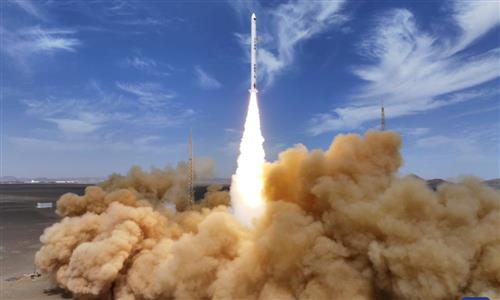
China launched Kuaizhou-11 Y8 carrier rocket, marking new stage of commercial operations for private cargo spacecraft
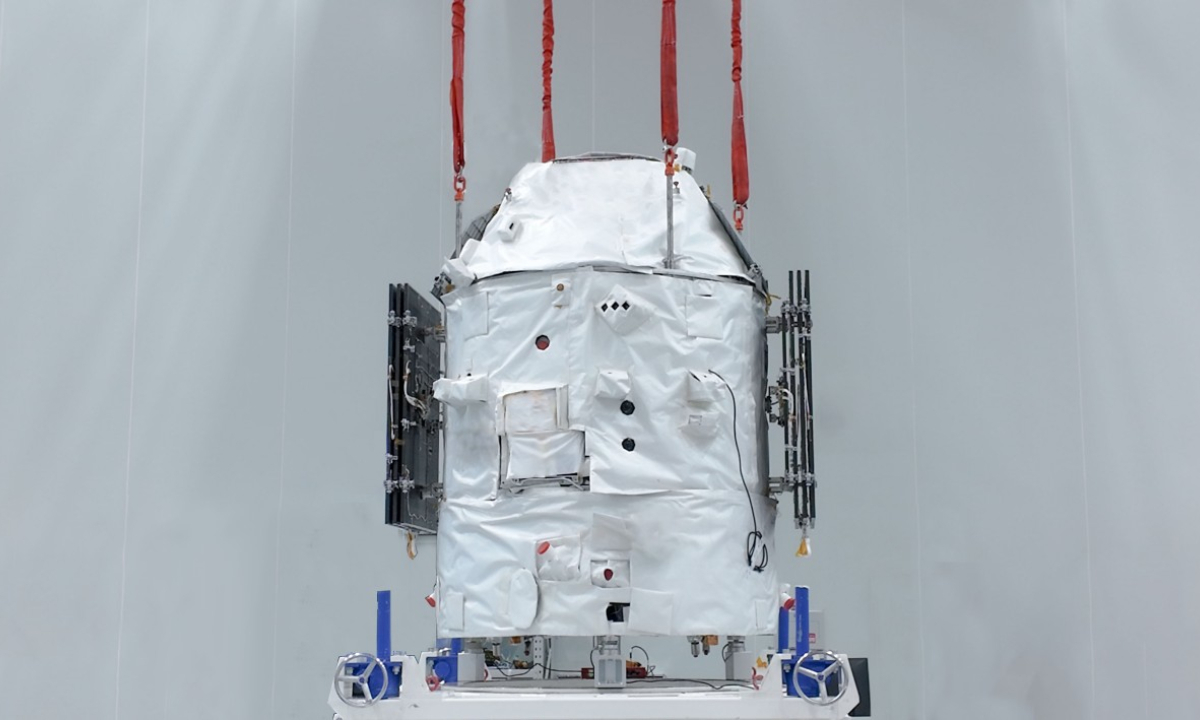
Di'er-5 space experimental spacecraft, developed by private firm AZ Space Technologies Photo: Courtesy of AZ Space Technologies
China launched the Kuaizhou-11 Y8 carrier rocket on Saturday morning, carrying a commercial space experimental spacecraft and a secondary satellite. The rocket blasted off at 9:08 am (Beijing time) from the Jiuquan Satellite Launch Center in Northwest China's Gansu Province and successfully sent the payloads into the planned orbit, Xinhua News Agency reported on Saturday.The successful launch marks the spacecraft's entry into commercial operations and represents a new stage in the development of China's private space sector. It also lays the foundation for broader space science research, technology verification, application development and cargo transport.
Developed by the state-owned space giant China Aerospace Science and Industry Corporation, the rocket offers a sun-synchronous-orbit payload capability of about one ton to a 700 km orbit. Saturday's mission was the fourth flight of the Kuaizhou-11 Y8 and the 37th flight in the Kuaizhou rocket series, according to a report by the Science and Technology Daily.
Onboard were the Di'er-5 space experimental spacecraft, developed by private firm AZ Space Technologies (AZSPACE), and the Hope-5 Phase II satellite, according to the Science and Technology Daily.
Di'er-5 is a small cargo spacecraft in-orbit variant composed of a service module and a payload module. It has a cargo capacity of more than 300 kilograms and an internal payload volume of roughly 1.8 cubic meters. The spacecraft is equipped with an intelligent cargo-bay management system capable of managing over 100 individual payloads and supports rapid integration and joint testing of complex experiments, including power, communications, thermal control and environmental monitoring services, according to the Science and Technology Daily.
For this mission, Di'er-5 carried 34 experimental payloads from research institutes, universities and commercial customers, along with several mini space laboratories designed for professional scientific experiments and public outreach activities in orbit, an AZSPACE representative said.
Next, the spacecraft will operate for an extended period in a near-circular low-Earth orbit at about 343 kilometers altitude with an inclination of 41.5 degrees, supporting microgravity science, space life sciences, materials science, aerospace medicine and technology demonstrations, according to AZSPACE.
Analysts said the mission is a prime example of how China's commercial space industry is accelerating. The sector is now entering a phase of rapid growth, driven by technological breakthroughs, expanding launch capabilities, and the accelerated construction of space-based infrastructure.
To date, the number of commercial space companies in China has surged to more than 500, with the number of satellites in orbit continuing to rise steadily. According to projections, the scale of China's commercial space market is expected to exceed 2.5 trillion yuan ($348 billion) in 2025, according to Xinhua.
The scale of China's commercial space market has maintained rapid growth since 2015 with an average annual growth rate exceeding 20 percent from 2017 to 2024.
Global Times
RELATED ARTICLES