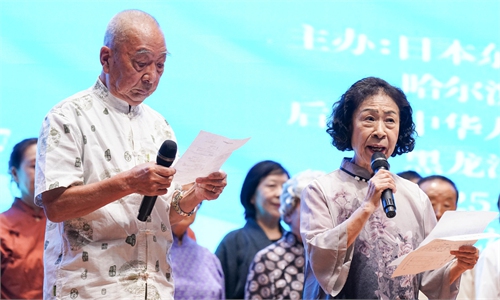

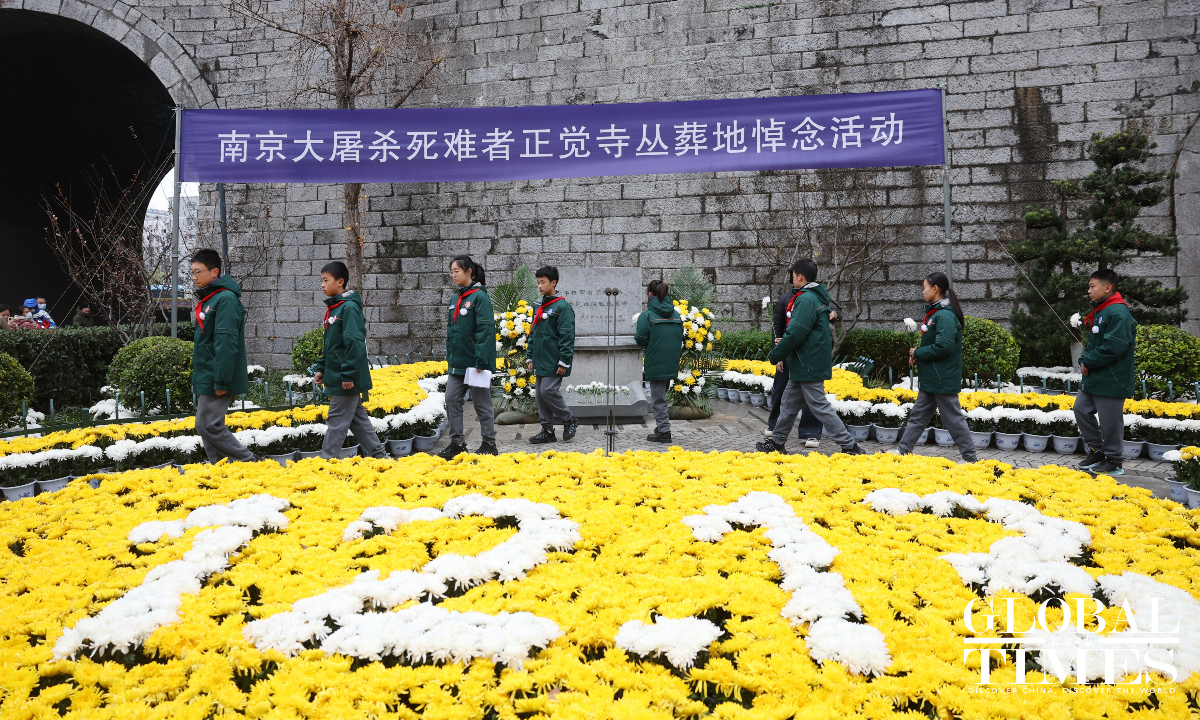
Many residents gather at a mass burial site near Zhengjue Temple in Nanjing, East China's Jiangsu Province on December 13, 2025. Photo: Cui Meng/GT
On Saturday—China's 12th National Memorial Day for Nanjing Massacre Victims, many residents gathered at a mass burial site near Zhengjue Temple in Nanjing, East China's Jiangsu Province. Among them was Evan Kail, a Minnesota-based pawnshop owner who gained international attention after donating a rare photo album documenting Japanese war crimes during World War II to China.
Kail, dressed in black, told the Global Times that attending memorial events remains essential to fulfilling a promise he made to help raise international awareness of the Nanjing Massacre. "It's important that I attend these events," he said. "It's important that I continue fulfilling my role — educating the world about what happened, but also to showcase what China is to the West and to make people understand it's not what it was. It's where it's going."
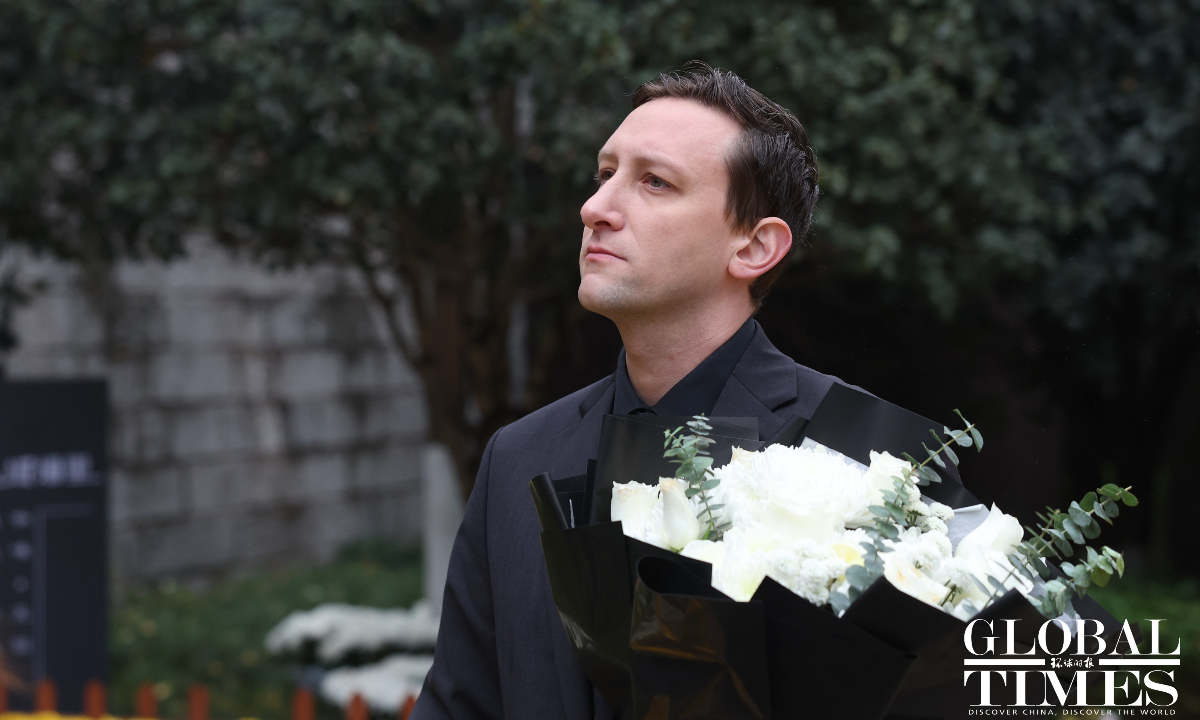
Evan Kail, a Minnesota-based pawnshop owner who gained international attention after donating a rare photo album documenting Japanese war crimes during World War II to China, attends commemorating activities at a mass burial site near Zhengjue Temple in Nanjing, East China's Jiangsu Province on December 13, 2025. Photo: Cui Meng/GT
Asked how he understands the significance of China's annual National Memorial Day, Kail said it is a tribute to those who lost their lives and keeps their memories alive. "It keeps the memories of the dead alive. It also reminds us of the horrors of genocide and the depravity of war," said Kail.
Kail added that he had studied Japan's wartime history extensively while majoring in Japanese studies in college and was familiar with the Nanjing Massacre through academic readings. However, visiting the Memorial Hall of the Victims in the Nanjing Massacre by Japanese Invaders last year profoundly deepened his understanding.
He recalled being struck by the fact that the memorial was built over a mass grave—something he had never encountered in textbooks. "That's not in any textbook," Kail said, describing one section of the memorial, where victims' remains are preserved, as "unworldly" and "haunting." He said it added another layer to his understanding of just how terrible the tragedy was.
Kail described the Nanjing Massacre as a lesson for human history. "It's a lesson in war crimes. It's a lesson in genocide studies," he said. It's a terrible lesson for which people paid with their blood, but, Kail said, it is still not widely acknowledged or remembered.
Kail cited Chinese-American historian Iris Chang, author of The Rape of Nanking, who referred to the atrocity as a "forgotten Holocaust."
You'd be hard-pressed to find someone that doesn't know about the Holocaust in Germany, yet many people are unaware of the Nanjing Massacre, said Kail, noting that "it's still not mainstream knowledge, and I hope to change that."
Kail also stressed the importance of acknowledging historical wrongdoing as a foundation for peace. He noted that the Nanjing Massacre was as brutal as the German Holocaust — a darkest chapter in human history. Japan has never formally apologized, and the wounds still resonate today.
He said many people, including in Japan, do not fully understand how deeply this history continues to affect China, and that lasting peace and mutual understanding require acknowledging the sins of the past.
"I've seen how China has risen from the ashes like a phoenix," he said. Where it started, where it came from, and where it's going—it's truly remarkable. China is a story of picking itself up and becoming something genuinely impressive, said Kail.
Commenting on Japanese Prime Minister Sanae Takaichi's erroneous remarks on Taiwan, Kail said he is concerned by what he sees as a broader global rise in nationalism, including in Japan. He noted that Japan is spending more on military, a trend he described as "pretty scary" given the country's wartime history.
He warned that in an interconnected world shaped by post-World War II treaties, even a localized conflict could quickly spiral out of control. "You suddenly can have World War III over something that started as a very small regional conflict," he said.
Kail said he was "pretty horrified" with Takaichi's remarks, which he described as nationalist rhetoric and "saber-rattling."
He said it is Takaichi's responsibility to secure peace and do the right thing, make amends, apologize, and promote diplomacy rather than destruction. However, "she doesn't understand that," said Kail.