China's Central Archives releases Russia-transferred Japanese Unit 731 atrocity evidence, reinforcing WWII germ warfare as premeditated state crime
By and Li Xundian Published: Dec 13, 2025 02:13 PM

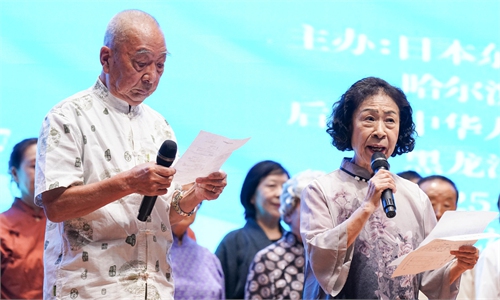
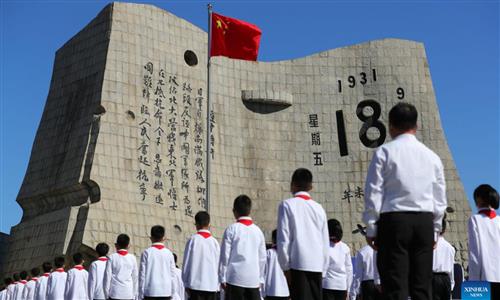
On China's 12th National Memorial Day for Nanjing Massacre Victims on Saturday, China's Central Archives published a batch of declassified archives transferred from Russia, containing Soviet interrogations of members of the Japanese Unit 731, the Japanese Imperial Army's notorious germ-warfare unit during World War II.
These archives, comprising interrogation records of Unit 731 members, investigation reports on the unit's crimes, and internal Soviet official correspondence dated from May 11, 1939, to December 25, 1950, provide ironclad evidence of Japan's germ warfare during its invasion of China, once again proving it was a premeditated, organized, top-down and systematic state crime.
Unit 731 was the codename for a covert Japanese military medical unit active from 1932 to 1945, responsible for bacterial warfare and human experiments that killed more than 3,000 Chinese, Korean, Soviet and Western prisoners of war in brutal tests. The Japanese militarists secretly designated an area of 6.1 square kilometers in the Pingfang district of Harbin in 1936 to establish the world's largest biological warfare base, according to the Xinhua News Agency.
"The Nanjing Massacre was an atrocity of unspeakable cruelty, and the live human experiments conducted by Japanese Unit 731 were utterly horrifying. Together with countless other atrocities committed by the Japanese military, the crimes perpetrated by Japanese militarism against China and other Asian nations are too numerous to be fully recorded. This year marks the 80th anniversary of the victory of the Chinese People's War of Resistance Against Japanese Aggression and the World Anti-Fascist War. Preventing the resurgence of Japanese militarism represents the shared will of the international community," Zhao Cong, director of the International Cooperation Department of the National Archives Administration of China, told the Global Times.
The archives contain a large number of witness testimonies documenting atrocities such as the forced sexual slavery, live burials, beheadings and cruelty toward pregnant women during the Nanjing Massacre. "The brutality is fully revealed in the Japanese military's own accounts," Zhou Zhenfan, a senior expert from the Conservation Department of China's Central Archives, told the Global Times, noting that the excavation and release of these archival materials once again provide indisputable and ironclad evidence for restoring the truth of history.
The materials, primarily centered on the Khabarovsk War Crimes Trials archives, span three historical phases: pre-trial, trial, and post-trial. They reveal for the first time the Soviet investigation and interrogation process prior to the Khabarovsk trials, uncovering more than 200 individuals linked to Japanese Unit 731's crimes. Key evidence was collected from core war criminals and witnesses, ultimately leading to the public trial of 12 war criminals. Some interrogation records are being publicly disclosed for the first time. These war criminals confessed to crimes that violated international conventions, including the preparation and implementation of germ warfare, according to China's Central Archives.
"From historical archives such as interrogation archives and confessions of Japanese war criminals, we can see detailed accounts of Unit 731's crimes, including human experimentation, field tests and germ warfare," Zhao said.
Zhao added that these Khabarovsk trial archives from Russia, together with historical materials from trials held in 1956 in China's Shenyang and Taiyuan, jointly corroborate the crimes committed during Japan's invasion of China.
Zhou told the Global Times that the interrogation archives published this time are more comprehensive than before, particularly with the addition of materials on medical appraisal. "The Soviet Union invited academicians and experts in fields such as microbiology and parasitology to conduct medical appraisals of the germ warfare. The experts discovered that Japan's bacterial research was not intended to benefit humanity or to eliminate bacteria, but to use bacteria for the large-scale destruction of humans. Its anti-human nature is clearly evident in the evidence," Zhou stressed.
Zhou stated that this batch of materials also discloses confessions of crimes by many high-level war criminals, complementing and cross-verifying with archives held in China.
"For instance, in the evidence chain and related archives obtained by China, most war criminals held in places such as the Fushun War Criminals Management Center were of lower rank. Their confessions did not specifically focus on germ warfare but only sporadically mentioned related content while admitting to crimes like murder and arson. Therefore, they are less systematic and hierarchical than the high-ranking war criminals' confessions disclosed this time. The individuals involved this time are mostly generals, making their confessions of greater historical value," Zhou explained.
Zhou cited the example of Kiyoshi Kawashima, former head of Unit 731's bacterial production department. His confession confirmed that Unit 731 used biological weapons on a large scale in China on three occasions and detailed the monthly production quantities of biological weapons, including specific yields of bacteria such as anthrax, during his tenure as production head.
Zhou also cited another testimony from Kawashima: while serving as head of the general affairs department, he visited Shiro Ishii, the infamous leader and co-founder of Unit 731. Ishii was reading an article published in a 1940 medical journal describing the use of biological weapons in the Chinese city Ningbo that year, which caused a major plague outbreak, and detailing the method of aerial dispersal. According to the archives, Ishii was not only concerned with the delivery method, but also particularly focused on the weapon's actual effects. Upon learning that the biological weapon had been effective, he expressed great satisfaction, believing his research had found practical application and validation, demonstrating his cruelty and loss of humanity.
In 1940, the Chinese People's War of Resistance Against Japanese Aggression was in a stalemate phase. The city of Ningbo was one of the few remaining unblockaded channels for external contact. To cut off external supplies supporting China's resistance, the Japanese army launched fierce attacks on Ningbo. In July 1940, Shiro Ishii personally led germ warfare troops to carry out biological warfare in Ningbo, Jinhua, and other areas of Zhejiang, according to a CCTV report.
"This fact also indicates that Unit 731's crimes extended far beyond cruel human experiments confined to laboratories and resulted in actual large-scale harm inflicted upon Chinese civilians," Zhou noted.
The Global Times also found hand-drawn diagrams in the archives depicting the original site of Unit 731's bacterial laboratories by senior Japanese officers. These diagrams form important mutual verification with the existing evidence and the former headquarters site of Unit 731 in Harbin.
Even though Japan's wartime atrocities against the people of China and other nations during World War II are supported by ironclad evidence, right-wing Japanese politicians in recent years have continued to disregard history, even insisting that there are no data showing the details of Unit 731's activities.
Yang Bojiang, director of the Japan Research Institute at the Chinese Academy of Social Sciences, told the Global Times that, as a spokesperson for Japan's right-wing conservative forces, Japanese Prime Minister Sanae Takaichi's recent erroneous remarks on Taiwan constitute a blatant military threat to China and represent the most provocative and dangerous official rhetoric against China in Japan's history to date.
While pushing East Asia to the brink of military confrontation, these remarks are also leading Japan down an irreversible path toward war once again. Japan's militarist ideology is being developed into a new form of militarism by right-wing conservative politicians, Yang said.
"Looking back on history, the lessons are profound and not far removed. Modern Japan bullied the weak with its strength; treading the old path of militarism will only make it taste the bitter fruit of defeat once more. The warnings from past failures are clear: if Takaichi persists in her willful pursuit of military expansion and recklessly charges down the path of confronting China, she will only drag Japan into the abyss of war again, repeating the mistakes of history," Yang said.
These archives, comprising interrogation records of Unit 731 members, investigation reports on the unit's crimes, and internal Soviet official correspondence dated from May 11, 1939, to December 25, 1950, provide ironclad evidence of Japan's germ warfare during its invasion of China, once again proving it was a premeditated, organized, top-down and systematic state crime.
Unit 731 was the codename for a covert Japanese military medical unit active from 1932 to 1945, responsible for bacterial warfare and human experiments that killed more than 3,000 Chinese, Korean, Soviet and Western prisoners of war in brutal tests. The Japanese militarists secretly designated an area of 6.1 square kilometers in the Pingfang district of Harbin in 1936 to establish the world's largest biological warfare base, according to the Xinhua News Agency.
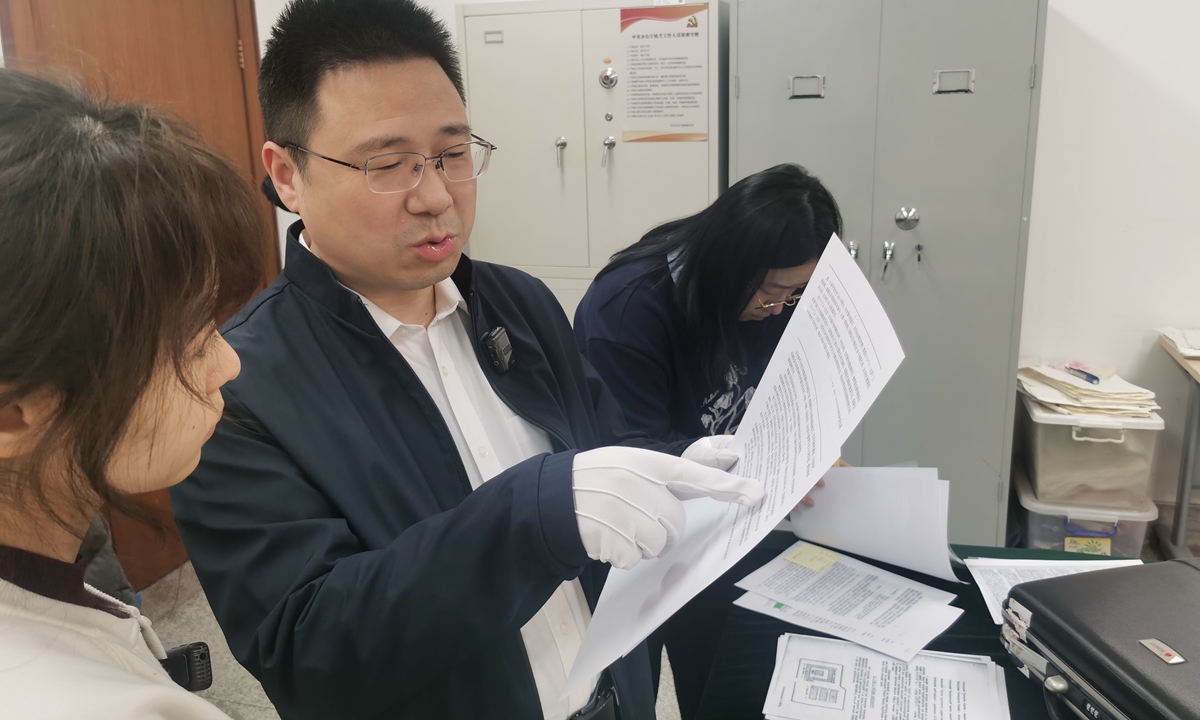
Zhou Zhenfan, senior expert at the Conservation Department of China's Central Archives, presents archives related to the atrocities committed by Japan's Unit 731 to Global Times reporters. Photo: Hu Yuwei/GT
"The Nanjing Massacre was an atrocity of unspeakable cruelty, and the live human experiments conducted by Japanese Unit 731 were utterly horrifying. Together with countless other atrocities committed by the Japanese military, the crimes perpetrated by Japanese militarism against China and other Asian nations are too numerous to be fully recorded. This year marks the 80th anniversary of the victory of the Chinese People's War of Resistance Against Japanese Aggression and the World Anti-Fascist War. Preventing the resurgence of Japanese militarism represents the shared will of the international community," Zhao Cong, director of the International Cooperation Department of the National Archives Administration of China, told the Global Times.
The archives contain a large number of witness testimonies documenting atrocities such as the forced sexual slavery, live burials, beheadings and cruelty toward pregnant women during the Nanjing Massacre. "The brutality is fully revealed in the Japanese military's own accounts," Zhou Zhenfan, a senior expert from the Conservation Department of China's Central Archives, told the Global Times, noting that the excavation and release of these archival materials once again provide indisputable and ironclad evidence for restoring the truth of history.
The materials, primarily centered on the Khabarovsk War Crimes Trials archives, span three historical phases: pre-trial, trial, and post-trial. They reveal for the first time the Soviet investigation and interrogation process prior to the Khabarovsk trials, uncovering more than 200 individuals linked to Japanese Unit 731's crimes. Key evidence was collected from core war criminals and witnesses, ultimately leading to the public trial of 12 war criminals. Some interrogation records are being publicly disclosed for the first time. These war criminals confessed to crimes that violated international conventions, including the preparation and implementation of germ warfare, according to China's Central Archives.
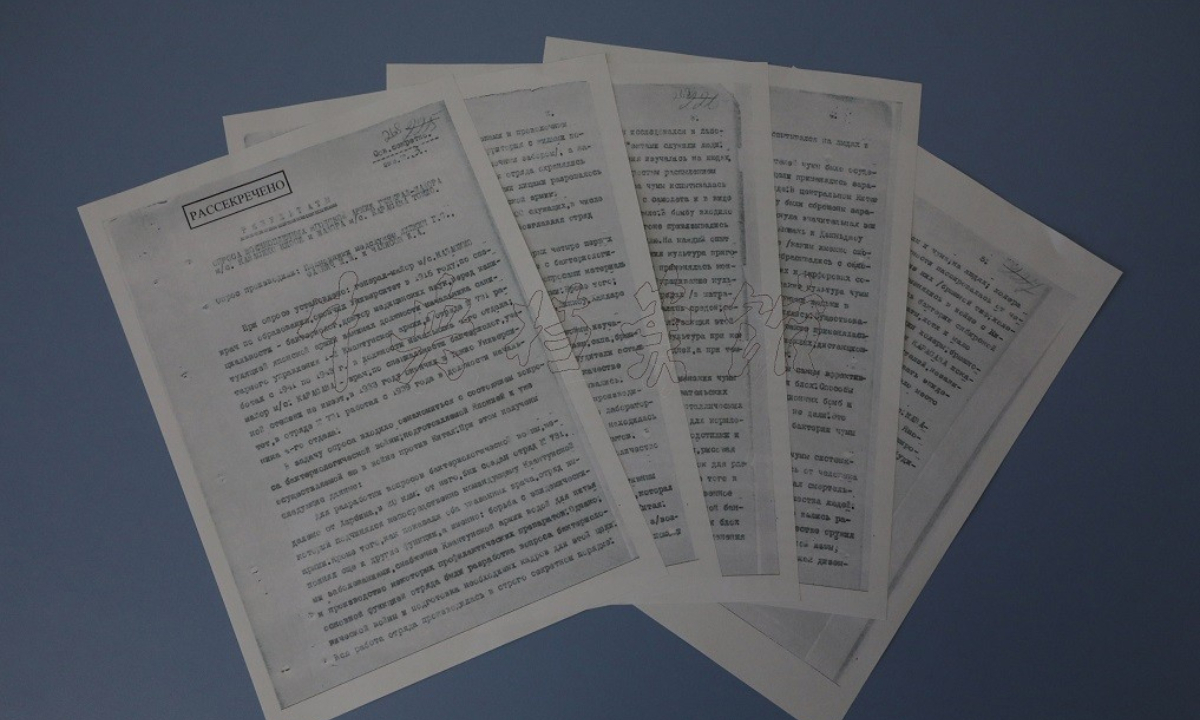
A statement on the interrogation results of Major General Kiyoshi Kawashima, former head of Unit 731's bacterial production department Photo: Courtesy of China's Central Archives
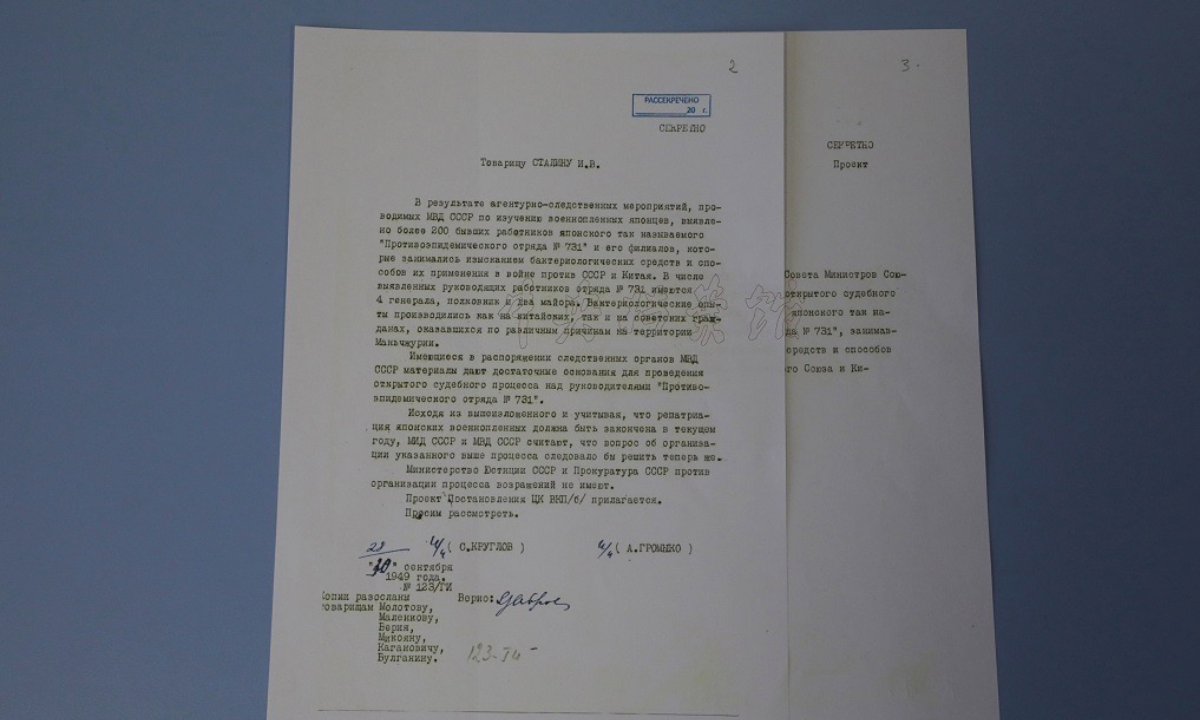
In 1949, 12 members of the Japanese Kwantung Army were tried as war criminals in the Russian Far Eastern city of Khabarovsk for manufacturing and using biological weapons and carrying out inhuman medical experiments during World War II, according to the Xinhua News Agency."From historical archives such as interrogation archives and confessions of Japanese war criminals, we can see detailed accounts of Unit 731's crimes, including human experimentation, field tests and germ warfare," Zhao said.
A request letter to former Soviet leader Joseph Stalin regarding the immediate organization of public trials for Japanese prisoners of war during WWII Photo: Courtesy of China's Central Archives
These archives transferred by Russia complement and mutually verify the archives on Unit 731 crimes and site evidence preserved in China. They provide historical ironclad evidence the crimes of Japan's germ warfare during its invasion of China, once again confirming it was "an organized, premeditated, top-down, and systematic state crime," according to the official.Zhao added that these Khabarovsk trial archives from Russia, together with historical materials from trials held in 1956 in China's Shenyang and Taiyuan, jointly corroborate the crimes committed during Japan's invasion of China.
Zhou told the Global Times that the interrogation archives published this time are more comprehensive than before, particularly with the addition of materials on medical appraisal. "The Soviet Union invited academicians and experts in fields such as microbiology and parasitology to conduct medical appraisals of the germ warfare. The experts discovered that Japan's bacterial research was not intended to benefit humanity or to eliminate bacteria, but to use bacteria for the large-scale destruction of humans. Its anti-human nature is clearly evident in the evidence," Zhou stressed.
Zhou stated that this batch of materials also discloses confessions of crimes by many high-level war criminals, complementing and cross-verifying with archives held in China.
"For instance, in the evidence chain and related archives obtained by China, most war criminals held in places such as the Fushun War Criminals Management Center were of lower rank. Their confessions did not specifically focus on germ warfare but only sporadically mentioned related content while admitting to crimes like murder and arson. Therefore, they are less systematic and hierarchical than the high-ranking war criminals' confessions disclosed this time. The individuals involved this time are mostly generals, making their confessions of greater historical value," Zhou explained.
Zhou cited the example of Kiyoshi Kawashima, former head of Unit 731's bacterial production department. His confession confirmed that Unit 731 used biological weapons on a large scale in China on three occasions and detailed the monthly production quantities of biological weapons, including specific yields of bacteria such as anthrax, during his tenure as production head.
Zhou also cited another testimony from Kawashima: while serving as head of the general affairs department, he visited Shiro Ishii, the infamous leader and co-founder of Unit 731. Ishii was reading an article published in a 1940 medical journal describing the use of biological weapons in the Chinese city Ningbo that year, which caused a major plague outbreak, and detailing the method of aerial dispersal. According to the archives, Ishii was not only concerned with the delivery method, but also particularly focused on the weapon's actual effects. Upon learning that the biological weapon had been effective, he expressed great satisfaction, believing his research had found practical application and validation, demonstrating his cruelty and loss of humanity.
In 1940, the Chinese People's War of Resistance Against Japanese Aggression was in a stalemate phase. The city of Ningbo was one of the few remaining unblockaded channels for external contact. To cut off external supplies supporting China's resistance, the Japanese army launched fierce attacks on Ningbo. In July 1940, Shiro Ishii personally led germ warfare troops to carry out biological warfare in Ningbo, Jinhua, and other areas of Zhejiang, according to a CCTV report.
"This fact also indicates that Unit 731's crimes extended far beyond cruel human experiments confined to laboratories and resulted in actual large-scale harm inflicted upon Chinese civilians," Zhou noted.
The Global Times also found hand-drawn diagrams in the archives depicting the original site of Unit 731's bacterial laboratories by senior Japanese officers. These diagrams form important mutual verification with the existing evidence and the former headquarters site of Unit 731 in Harbin.
Even though Japan's wartime atrocities against the people of China and other nations during World War II are supported by ironclad evidence, right-wing Japanese politicians in recent years have continued to disregard history, even insisting that there are no data showing the details of Unit 731's activities.
Yang Bojiang, director of the Japan Research Institute at the Chinese Academy of Social Sciences, told the Global Times that, as a spokesperson for Japan's right-wing conservative forces, Japanese Prime Minister Sanae Takaichi's recent erroneous remarks on Taiwan constitute a blatant military threat to China and represent the most provocative and dangerous official rhetoric against China in Japan's history to date.
While pushing East Asia to the brink of military confrontation, these remarks are also leading Japan down an irreversible path toward war once again. Japan's militarist ideology is being developed into a new form of militarism by right-wing conservative politicians, Yang said.
"Looking back on history, the lessons are profound and not far removed. Modern Japan bullied the weak with its strength; treading the old path of militarism will only make it taste the bitter fruit of defeat once more. The warnings from past failures are clear: if Takaichi persists in her willful pursuit of military expansion and recklessly charges down the path of confronting China, she will only drag Japan into the abyss of war again, repeating the mistakes of history," Yang said.
RELATED ARTICLES