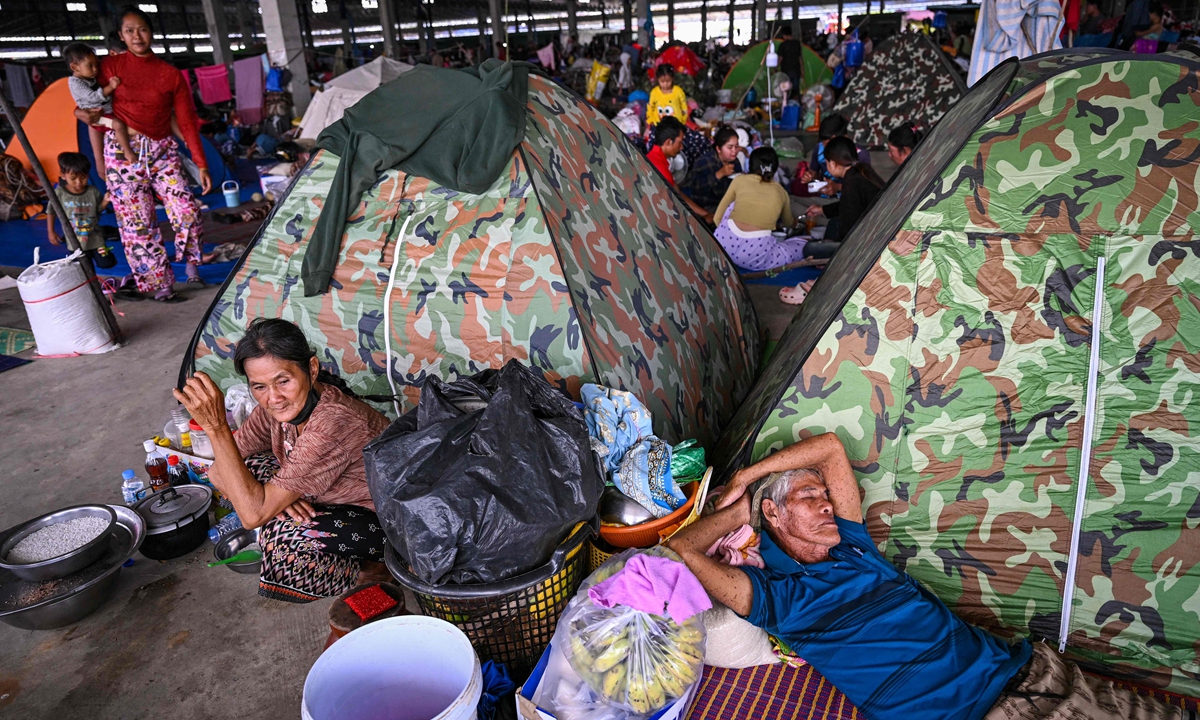
Displaced residents rest at a temporary camp in Cambodia's Banteay Meanchey province on December 14, 2025, amid clashes along Cambodia-Thailand border. Renewed border clashes between Cambodia and Thailand entered their second week on December 14. Photo: VCG
Thailand's military announced on Sunday the imposition of a curfew in parts of Trat Province, citing the ongoing situation along the border areas. This is the second province to impose a curfew since the latest round of the Thailand-Cambodia border clash erupted, according to Xinhua News Agency.Experts said that due to unresolved territorial disputes, the risk of conflict in border areas remains persistent, and without a settlement, bilateral frictions are likely to continue escalating. They called on ASEAN to play a greater role in promoting reconciliation.
In an official order, the Thai military said that a curfew was immediately enforced in five districts of its Trat Province - namely Khlong Yai, Bo Rai, Laem Ngop, Khao Saming and Mueang Trat. Residents in these areas are prohibited from leaving their homes from 7 pm to 5 am the following day, according to Xinhua.
Developments on Sunday suggested the confrontation may continue. The Royal Thai Army said it "never mentioned or had any plans" for a ceasefire and that "there is no plan" to stop fighting. "The Royal Thai Army confirms that this operation will continue until Cambodia ceases its hostilities and attacks against Thai troops and civilians in the border area," the army said, according to Al Jazeera.
Cambodia, meanwhile, accused Thai forces of ongoing attacks. Agence Kampuchea Presse (AKP), Cambodia's official state news agency, reported that the Cambodian Ministry of National Defense said that Thai military forces continued attacks against Cambodian forces along the border under Military Region 5 between 8 am and 1 pm on Sunday.
Long-standing mutual distrust between Thailand and Cambodia has contributed to repeated flare-ups, with frontline troops in border areas failing to fully implement agreements already reached by the two sides, Gu Xiaosong, dean of the ASEAN Research Institute of Hainan Tropical Ocean University, told the Global Times. Any movement on the ground can easily trigger suspicion and lead to escalation, Gu said.
Yu Haiqiu, director of the Institute of Thailand Studies at the Chinese Academy of South and Southeast Asian Studies (Kunming), Yunnan Academy of Social Sciences, told the Global Times that disputes over contested border territories mean Thailand-Cambodia relations will remain delicate for some time, trapped in a cycle of "conflict-mediation-renewed conflict."
US president Donald Trump had claimed that he had spoken to both the Cambodian and Thailand prime ministers and the two countries had agreed to "cease shooting effective this evening" and go back to the agreement they signed in front of the US president in October, according to the BBC, citing his social media post wrote on Friday night. "Both countries are ready for peace," he wrote.
But in their comments after speaking to the US president, neither side mentioned an imminent ceasefire. Thai Prime Minister Anutin Charnvirakul said he told Trump that Thailand was not the aggressor, and that Cambodia must show that it had withdrawn its forces and removed landmines from the border before a ceasefire was possible. "They must show us first," he said. While the Cambodian leadership said they must fight on to protect their country's sovereignty, according to the BBC.
The clashes have resulted in casualties on both sides. Xinhua reported that Surasant Kongsiri, spokesperson for Thailand's Ministry of Defence, said on Saturday that the latest round of clashes had left 15 Thai soldiers dead.
AKP, citing a Saturday night press release from Cambodia's Ministry of Interior, said that as of 6 pm Sunday, the total number of Cambodian civilians killed had reached 11, with 59 injured, the same as the previous day, while 117,120 families had been displaced, an increase of 3,014 families, equivalent to 394,706 people displaced, up 10,605 from the day before.
ASEAN's role is crucial in creating a conducive international environment for de-escalation, Gu noted, stressing that the situation affects not only the two countries' development but also regional stability, and that ASEAN should continue to promote reconciliation and peace among its members.
Despite the ongoing fighting, some cross-border links remain intact. Xinhua reported on Saturday, citing a Cambodian civil aviation spokesperson, that flights between Phnom Penh and Bangkok, as well as those between Siem Reap and Thailand, are operating as normal.
In a bid to de-escalate tensions and enhance transparency, Malaysia has requested the deployment of an ASEAN Observer Team, led by the Malaysian Chief of Defense Forces, to monitor the on-site situation. Findings from the monitoring will be submitted to the ASEAN Foreign Ministers' Meeting scheduled for December 16, according to Xinhua.
RELATED ARTICLES