Twin pandas in Tokyo to return to China, potentially leaving Japan without pandas; Ueno Zoo declines to comment on matters related to China-Japan ties
By Published: Dec 15, 2025 03:49 PM

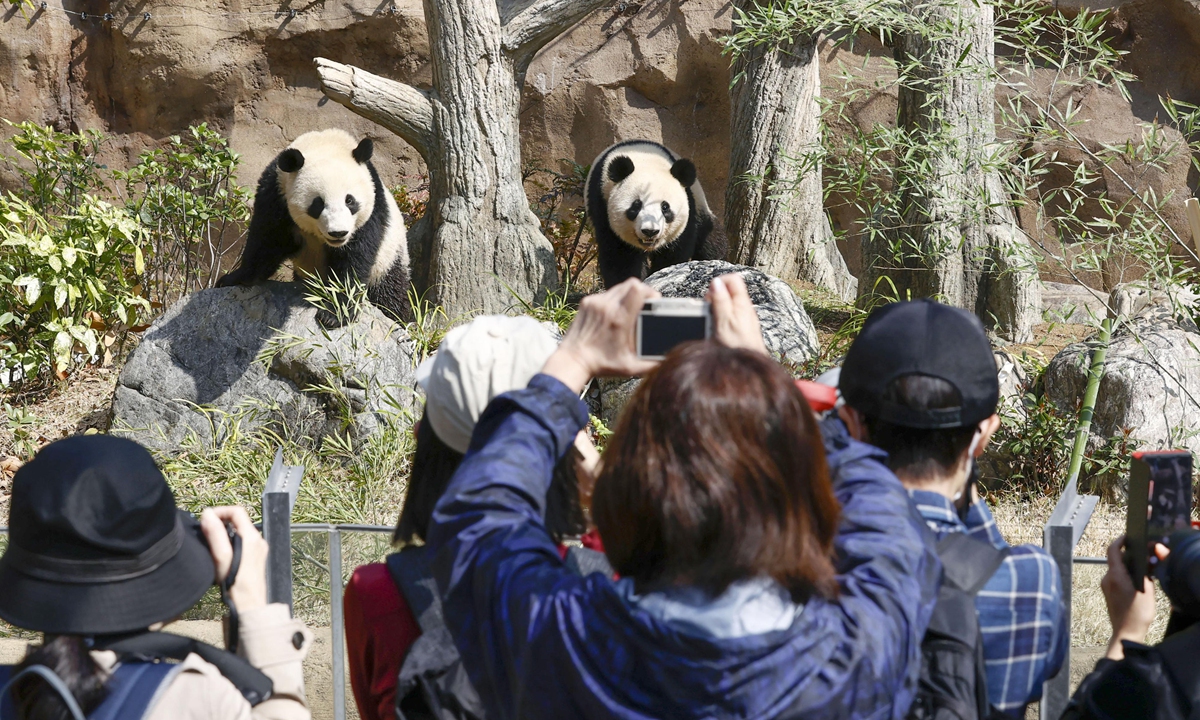
Visitors snap photos of twin giant pandas Xiao Xiao (L) and Lei Lei. File Photo: VCG
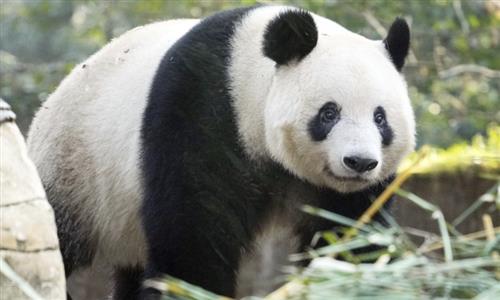
Multiple Japanese media outlets including Asahi Shimbun reported that the twin giant pandas at Ueno Zoo in Tokyo — male Xiao Xiao and female Lei Lei, which currently are the only giant pandas in Japan — will be returned to China in late January next year, potentially resulting in a "panda-less" situation in Japan for the first time in approximately 50 years.
Takako Akikawa, chief of the education and outreach section of Ueno Zoo, recently responded to an inquiry from the Global Times on the issue via email that the cooperation agreement between the China Wildlife Conservation Association and the Tokyo metropolitan authority for the implementation of giant panda conservation research, was originally a 10-year agreement effective from 2011. In 2021, the agreement was extended for another 5 years, with a validity period until February 20, 2026.
In response to whether such giant panda-related programs and exchanges have been impacted amid China-Japan tensions, the zoo declined to make any comments on matters related to China-Japan ties, according to Akikawa.
In response to whether China has plans to carry out international cooperation with Japan on giant panda conservation since the twin pandas at the zoo are scheduled to return to China in late January, and Japan will be left without any giant pandas; Japanese people love giant pandas very much and hope to continue renting them from China in the future, Guo Jiakun, a spokesperson for the Chinese Foreign Ministry, stated Monday at a regular press conference that "Regarding the specific question you raised, it is recommended that you refer the matter to the competent Chinese authorities for inquiry."
Asahi Shimbun reported that originally scheduled to be returned in February 2026, Xiao Xiao and Lei Lei will be sent back one month ahead of schedule following continuous negotiations between the Tokyo metropolitan authority and Chinese authorities.
According to Yomiuri Shimbun, the Tokyo metropolitan authority and the Tokyo Zoological Park Society officially announced on Monday that the twin giant pandas at Ueno Zoo will be returned to China in late January next year.
The report noted, Ueno Zoo stated that starting from the zoo's reopening on Tuesday, the viewing area for the two pandas will be sectioned off, with each visitor's viewing time limited to approximately one minute. From the December 23 onward, visitor access will be subject to an advance reservation system. The final day for viewing the pandas will be January 25 next year.
Asahi Shimbun reported Monday that while Japan has requested the loan of new giant pandas from China, there is no clear prospect of realization, meaning Japan may face a "panda-less" situation domestically for the first time in approximately 50 years.
After Japanese Prime Minister Sanae Takaichi made Taiwan-related remarks at Diet, which met with intensified opposition from the Chinese authorities, Asahi Shimbun, citing sources, reported that "Under the current circumstances, a new loan is impossible."
Xiao Xiao and Lei Lei were born at Ueno Zoo in 2021. They are the cubs of Li Li and Xin Xin, who were returned to China in September last year, and Xiang Xiang — returned in February 2023 — is their elder sister, Asahi Shimbun reported.
Some Japanese netizens have expressed their reluctance to bid farewell to the giant pandas soon leaving Japan.
A Japanese netizen @kouji183 pointed out Monday on X that Japan will be possibly left without giant pandas "due to Sanae Takaichi's blunders."
Commenting on the issue, a netizen @fandango7jp said on X on Monday this shows that Takaichi really needs to apologize (over her erroneous remarks on Taiwan).
Another Japanese netizen @peperon0853 commented on X that "It is utterly shameless to militarily provoke China while still expecting to lease pandas. How embarrassing." The netizen called Takaichi to first retract her Taiwan-related claims and cease military activities on the recent radar irradiation incident, alongside offering a formal apology.
"The potential first 'panda-less' situation in Japan in 50 years could be linked to the current difficulties in China-Japan relations caused by Japanese side's erroneous words and deeds, for which Takaichi bears undeniable responsibility," Xiang Haoyu, a distinguished research fellow at the China Institute of International Studies, told the Global Times on Monday.
Panda loan programs are originally joint research initiatives between China and Japan in the field of conservation, and more importantly, they serve as a warm bond between the two countries, said Xiang, emphasizing that "their continuation relies on a sound bilateral political atmosphere."
Japanese Prime Minister Sanae Takaichi claimed at a Diet meeting on November 7 that a "Taiwan contingency" could constitute a "survival-threatening situation" for Japan.
"This provocative act has seriously undermined China's interests and inevitably disrupted the atmosphere for bilateral cooperation," the expert noted.
Also, Tokyo should take concrete actions to enhance political and security mutual trust between China and Japan, thus creating the necessary conditions and atmosphere for the resumption of panda-related scientific research cooperation between the two sides.
Before Takaichi took office and soon made provocative remarks that deteriorated China-Japan ties, Guo Jiakun, spokesperson for the Chinese Foreign Ministry, on April 29 this year when responding to the inquiry regarding that the Japan-China Friendship Parliamentarians' Union expressed their hope that China will lease giant pandas to Japan again, stated that "As far as I know, the two countries maintain close communication on relevant cooperation."
RELATED ARTICLES