‘I am concerned Japanese right-wing politicians continue to downplay Nanjing Massacre’
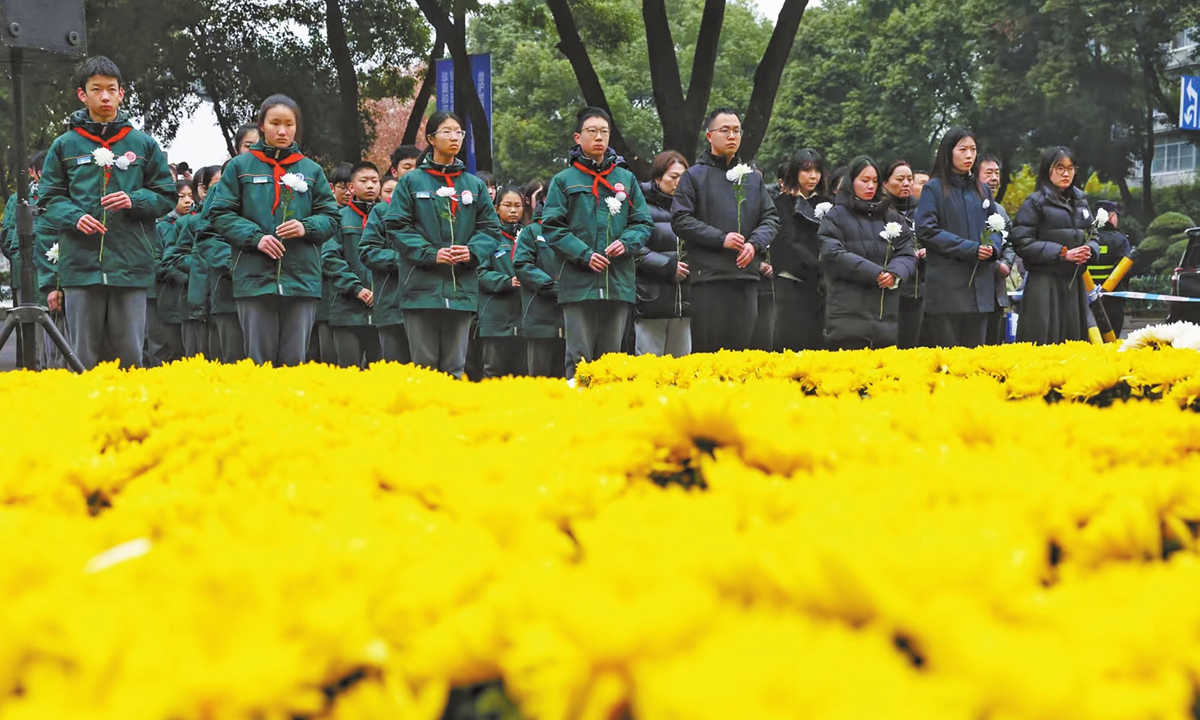
Nanjing citizens gather to mourn at the mass burial site near Zhengjue Temple in Nanjing, East China's Jiangsu Province on December 13, 2025, the country's 12th National Memorial Day for Nanjing Massacre Victims. Photo: Cui Meng/GT
Editor's Note:
December 13 marked China's 12th National Memorial Day for Nanjing Massacre Victims. On this day in 1937, the invading Japanese army captured Nanjing and the atrocities began. Over the next six weeks, more than 300,000 Chinese civilians and unarmed soldiers were killed by the Japanese invaders. Emily Matson (Matson), a researcher and lecturer of modern Chinese and East Asian history who has visited the Memorial Hall of the Victims in Nanjing Massacre by Japanese Invaders twice, spoke with Global Times (GT) reporter Zhang Ao in an interview, sharing her feelings about this national trauma and how she thinks historical truth of World War II should be safeguarded.
GT: Could you share your experience of your two visits to the Memorial Hall?
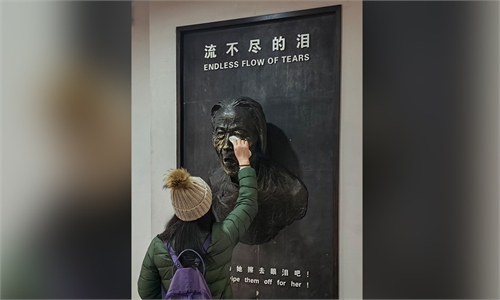
Matson: I visited the Memorial Hall in the spring of 2011 and the fall of 2017. During my first visit, I was an undergraduate student studying at Peking University. It was shortly after reading Iris Chang's book The Rape of Nanking. I felt a bit overwhelmed and cried during my visit.
During my second visit there, I was a PhD candidate conducting field research for my dissertation (I was a fellow at Fudan University in Shanghai). What impressed me was the new exhibition hall with the "Three Vs" that emphasized the 14-year war starting with the September 18 Incident - I have done a lot of research on the shifting emphasis from the eight-year war to the 14-year war of resistance after 2017, and even wrote a book, China's Date Debate: How Manchurian Scholars Rewrote World War II about it.
During the visits, the giant statue of a mother holding her dead child conveyed such raw and intense emotion and grief for me, particularly as a woman.
I was also moved by the statues of refugees and victims leading up to the front entrance of the Memorial Hall - they were so vivid in their depictions of raw human suffering. The "graveyard" with the bones of the victims was also jarring to see. Lastly, I was deeply moved by the testimonies of the survivors. As a Westerner, it was also heartwarming to see stories of foreign individuals who bravely stood up to Japanese aggression to protect Chinese victims - for example, Minnie Vautrin, a US missionary considered the "Goddess of Nanking," and John Rabe, the German "Schindler of Nanking."
GT: In your view, what is the general level of understanding among the international academic community and broader society regarding the history of the Nanjing Massacre? Has this understanding changed in recent years?
Matson: There is a greater understanding among the international academic community regarding the Nanjing Massacre, along with a growing appreciation of how traumatic Japanese military aggression in China was for the Chinese people and how this influences Chinese national identity today. Many recent monographs on global World War II have included significant sections on the Nanjing Massacre and the Chinese people's War of Resistance Against Japanese Aggression.
Regarding the public, there is still a relative lack of knowledge about the Nanjing Massacre. Speaking for my own country, the average American probably has not heard of the Nanjing Massacre. However, this is improving among younger generations, especially in states with large Asian American populations such as California, where the Nanjing Massacre is taught in-depth in the curriculum.
GT: What is your perspective on certain revisionist actions by Japan, such as downplaying the Nanjing Massacre? How might such tendencies impact regional relations and historical research?
Matson: I am concerned that certain right-wing historians and politicians in Japan continue to downplay the Nanjing Massacre. It is always worrisome when politicians and others distort history for political gain.
However, I am encouraged that many Japanese academics and grassroots activists are aware of the Nanjing Massacre and push back against the right-wing revisionist narrative.
GT: How should the international community collectively safeguard the historical truth of World War II? And how can we prevent history from being distorted or instrumentalized?
Matson: It is important to examine World War II from an international lens. To paraphrase historian Carol Gluck, it often seems like now we have "World War II narratives without the world." To prevent history from being distorted, we should continue to have international symposiums for scholars to meet and collaborate in joint efforts to produce historical research.
It is also important to study historical memory to understand how subsequent historical developments have led to different interpretations of World War II across time and space. This way, we can inch closer to a more objective perspective on the actual events.
GT: You published a research paper titled "Complicity and Cold War Politics: The Long Shadow of Unit 731 in Sino-US Relations." Why did you choose to study this period of history? What impact do you believe this history has had on current China-US relations or mutual perceptions?
Matson: I chose to study this period of history because it is so understudied in the US. When I visited the Exhibition Hall of Crime Evidence of Japanese Army Unit 731 in Harbin, I was struck by the exhibit on the US efforts to exclude Shiro Ishii and other Japanese scientists from the Tokyo Trials in light of emerging Cold War tensions. I wrote a paper on how this history still impacts how some Chinese view the US. I believe that this, combined with the subsequent conflict between China and the US in the Korean War, led to a lot of distrust of the US in China.
GT: Understanding China involves multiple pathways, with memory and the inheritance of historical trauma constituting a crucial dimension. Through your research examining how China confronts historical traumas like the Nanjing Massacre and the atrocities of Unit 731, as well as how China holds memorials and national commemorative days to preserve collective memory, what characteristics of China do you see?
Matson: As I emphasize to my students, China is a multi-faceted place to study. It has undergone so much transformation in the past several hundred years. Chinese people have suffered so much - there have been civil wars and instances of foreign aggression. When I look at where China historically was even 100 years ago versus today, it is astounding how much progress there has been in the life expectancy, education levels, per capita GDP and the overall quality of life for the average Chinese citizen. Particularly in light of so much historical hardship it has suffered, this shows me that the Chinese people are extremely resilient, and strive to take history as a mirror in order to build a better future.
RELATED ARTICLES