US urged to stop interfering in South China Sea issues as Philippine personnel threaten CCG officers with knives at Xianbin Jiao: FM

Illustration: Chen Xia/GT
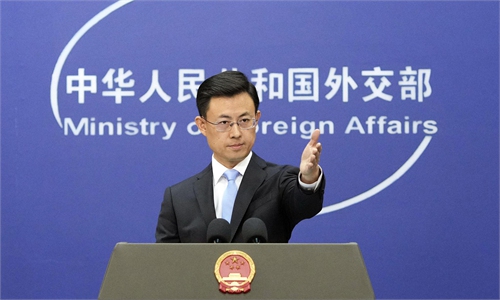
China's Foreign Ministry on Monday urged the US to stop interfering in South China Sea issues, with the ministry's spokesperson Guo Jiakun stressing that the US is not a party to the South China Sea issue and has no right to interfere in the maritime issues between parties concerned.The remarks were made in response to media inquiries about the US State Department's recent claim that China's alleged use of water cannons and cutting of anchor lines in the South China Sea had "endangered Philippine livelihoods," as well as its statement that the US will stand with the Philippines to confront "China's provocative actions and increasingly dangerous tactics against its neighbors."
A Chinese expert said such statements by the US disregard facts and follow a long-standing pattern of hype. The Philippines' move aimed to deliberately escalate tensions, and create conditions for a new round of international hype to draw sympathy.
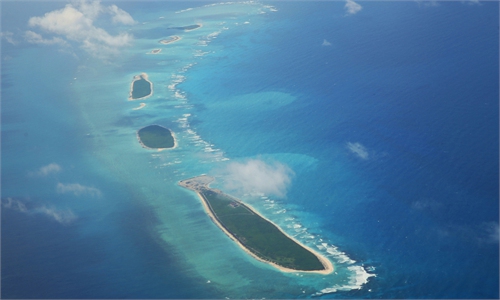
At the Monday regular press briefing, Guo said that Xianbin Jiao is part of China's Nansha Qundao. China has indisputable sovereignty over Nansha Qundao, which include Xianbin Jiao, and their adjacent waters. On December 12, the Philippines organized and orchestrated moves to send a large number of ships to make provocations and create trouble in the waters off Xianbin Jiao and intruded into its lagoon.
The Philippines' so-called fishing ships, despite China's repeated dissuasion and warning, deliberately anchored in the lagoon of Xianbin Jiao and repeatedly conducted dangerous maneuvers, including veering suddenly off course, Guo said.
He specifically noted that "the Philippine personnel even threatened China Coast Guard officers with knives who were carrying out rights-defending law enforcement activities."
Regarding the incidents at Xianbin Jiao, both the Chinese People's Liberation Army Southern Theater Command and the China Coast Guard (CCG) issued statements on Friday, announcing that they had they had taken necessary measures to expel Philippine small aircraft and vessels that recently illegally intruded into the airspace of China's Huangyan Dao and the waters off Xianbin Jiao, respectively.
In the CCG statement, Liu Dejun, a CCG spokesperson, said that the Philippine vessels deliberately intruded into the waters adjacent to Xianbin Jiao of China's Nansha Qundao under the pretext of fishing, despite repeated dissuasion and stern warnings from the CCG. CCG took necessary control measures, including issuing verbal warnings and expelling by external means, in accordance with laws and regulations against multiple batches of Philippine vessels, he said.
Against this backdrop, the US State Department and Canada's ambassador issued separate statements claiming that the incident endangered civilians and added to concerns over what they described as China's increasingly "aggressive behavior" in disputed waters, Philippine media outlet Philippine Star reported.
Since 2016, the US State Department has issued statements on almost every South China Sea-related hotspot, consistently backing its allies and accusing China without addressing the facts or the rights and wrongs of specific incidents, Yang Xiao, a maritime issues expert at the China Institutes of Contemporary International Relations, told the Global Times on Monday.
Citing the Xianbin Jiao incident as an example, Yang said the operation was planned from the outset. There was no need for Philippine fishermen to travel collectively to the waters near Xianbin Jiao, let alone remain there for an extended period, which clearly points to an organized and premeditated action, Yang said.
During the operation, as disclosed by the Chinese Foreign Ministry, multiple excessive provocations occurred on site, even threatening the safety of CCG law enforcement personnel, Yang said.
Yang further noted that since 2023, the Philippines has openly recruited so-called maritime militia as a quasi-military force in coastal provinces facing the South China Sea. Some of the personnel involved in the Xianbin Jiao incident may have effectively participated in the capacity of "militia".
At the same time, the Philippine side has hired ordinary fishermen who lack the capability for distant-sea operations to go to Xianbin Jiao, portraying them in public opinion as a "weak and injured party", while deliberately portraying China as a so-called "bully" by emphasizing narratives such as "water cannons" and "threats to personnel safety," he said.
Previously, the Philippines had announced plans to deploy its own maritime militia to "defend its sovereignty." "We want our fisherfolk to become reservists and teach them how to help in defending the country," Philippine armed forces chief Gen. Romeo Brawner Jr. said on August 10, 2023, during a visit to an island on the frontline of the maritime dispute, according to Benar News.
Guo stressed that the Philippines' moves seriously infringe upon China's sovereignty and rights and interests, violate international law and the Declaration on the Conduct of Parties in the South China Sea, and sabotage maritime peace and stability. It is legitimate, lawful, professional, restrained and beyond reproach for China to do what is necessary to safeguard our territorial sovereignty and maritime rights and interests, he said.
The US needs to stop making fact-distorting and provocative remarks, and stop abetting and supporting the Philippines' attempt of creating troubles in the South China Sea, Guo noted.
RELATED ARTICLES