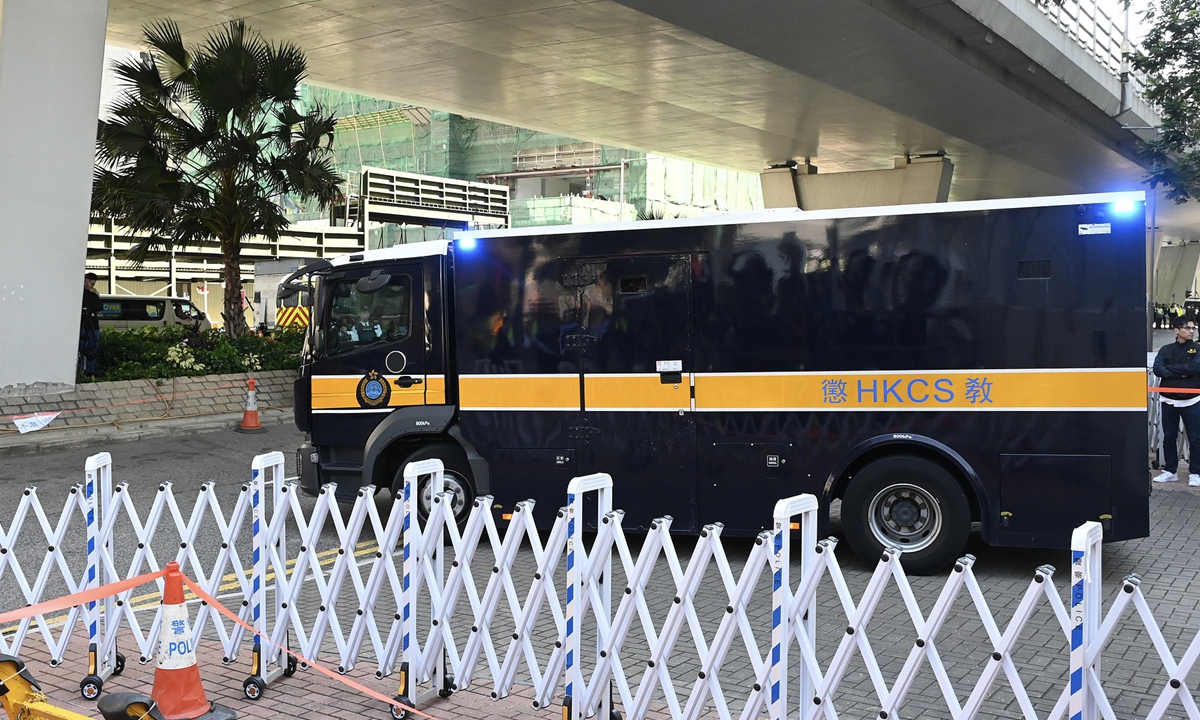
On December 15, 2025, the High Court of the HKSAR delivered its verdict, finding Jimmy Lai guilty on two charges of conspiring to collude with external forces and a charge of conspiracy to publish seditious materials, The photo shows Lai being escorted away in a vehicle of the Correctional Services Department after the court's ruling. Photo: VCG
The High Court of the Hong Kong Special Administrative Region (HKSAR) ruled that Jimmy Lai was guilty of conspiracy to collude with external forces to endanger national security, conspiracy to publish seditious materials on Monday. The ruling firmly upholds national security and powerfully safeguards the authority of the rule of law in HKSAR. By sentencing Jimmy Lai - an agent of hostile Western forces and a leading figure in anti-China destabilization - the court has delivered a verdict that truly satisfies the public sense of justice.
From the outset, Lai chose a path of confrontation against the country and HKSAR residents. Through the media outlets he founded, including Next Digital and Apple Daily, Lai relentlessly incited citizen's hatred toward the central authorities and the HKSAR government. At critical moments, these platforms spread political rumors and openly backed anti-China forces.
For years, Lai funneled illicit political funds to groups such as the Democratic Party in HKSAR, financed Benny Tai Yiu-ting's so-called "Operation ThunderGo" and "Project Storm," and was inextricably linked to the illegal "2020 Hong Kong pro-democracy primaries" scheme that has since been ruled unlawful. During the disturbance related to an amendment bill in HKSAR in 2019, Lai frequently traveled abroad to "petition foreign powers," lobbying for US legislation targeting HKSAR and even shouting slogans such as "fight for the US."
Lai's rascality exacted a heavy toll on HKSAR. With Lai fanning the flames, the city plunged into an unprecedented crisis, falling into the abyss of violent unrest and mutual destruction. Many young people, poisoned by toxic contents from Apple Daily, were led onto the path of illegality and crime. As members of the public have pointed out, Lai's damage to HKSAR had reached the point where "without removing this scourge, there can be no peace," prompting sustained calls from community groups for severe punishment.
As the saying goes, "Those whom the gods wish to destroy they first make mad." After the HKSAR national security law came into force, Lai not only failed to rein in his behavior but intensified his efforts, openly urging foreign politicians to impose sanctions on HKSAR. The facts and evidence presented during the trial make his violations of the law unmistakably clear.
For example, on his Live Chat program, Lai brazenly proposed that the US sanction China in order to cripple its economy. His so-called "four-step international lobbying strategy," proposed to figures such as Andy Li Yu-hin, sought to persuade foreign politicians to condemn the HKSAR government, use foreign viewpoints to boost the morale of "protesters," shape overseas perceptions of China, and ultimately push for sanctions. If this is not collusion, what is? Those who dare to challenge the law will inevitably face severe punishment.
HKSAR's courts have remained steadfast in upholding the rule of law despite intense external pressure. This is the second cause for public satisfaction. Since Lai's arrest, external forces have never ceased their accusations, smears, and even threats of sanctions. According to the author's tally, since 2023 the US has attempted no fewer than three times to place HKSAR judges on sanctions lists. In March 2025, the US further imposed crude sanctions on six HKSAR officials including Paul Lam Ting-kwok, the Secretary for Justice of the HKSAR, blatantly interfering in HKSAR's judicial system. Consular personnel from the US and other Western countries routinely appeared in court under the pretext of "monitoring" the trial.
Lai's so-called "overseas legal team" fabricated claims that he was "mistreated," held under "poor detention conditions," or "running out of time," spreading such falsehoods on international platforms in an all-out attempt to pressure HKSAR's courts. The pressure faced by the judiciary in the Jimmy Lai case was unprecedented.
What is truly admirable is that, despite unwarranted external sanctions, law enforcement, prosecution, and trial proceedings in this case were conducted strictly in accordance with the law, with hearings fully open to the media and the public. The prosecution and defense presented hundreds of pieces of evidence and engaged in thorough examination and cross-examination of both factual and legal issues. The court fully respected the defendant's right to speak, granting Jimmy Lai a full 52 days for argument. The Correctional Services Department provided Lai and other defendants with a safe, humane, appropriate, and healthy custodial environment, ensuring access to medical care, religious services, and other needs.
These arrangements fully comply with international standards, including the International Covenant on Civil and Political Rights and the International Covenant on Economic, Social and Cultural Rights, and may be regarded as exemplary. The 156-day trial not only laid bare Lai's wrongdoing before society but also demonstrated to the world HKSAR's high-caliber rule-of-law environment and its fearless, impartial, and principled commitment to justice.
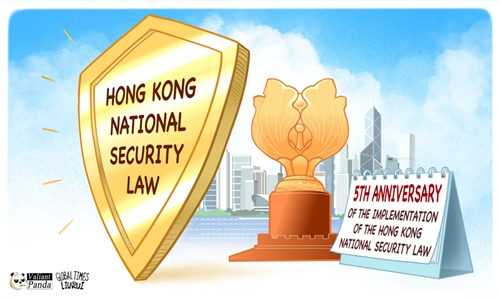
The growing authority of the HKSAR national security law, and the irreversible end of an era in which anti-China forces ran rampant, is the third cause for public satisfaction. In the past, shortcomings in HKSAR's legal framework and enforcement mechanisms for safeguarding national security allowed figures like Lai to exploit loopholes. Without the national security law, HKSAR residents might never have seen the day when Lai was brought to justice.
The case of Lai is not merely an ordinary judicial proceeding; it is a major milestone in the history of HKSAR's rule of law. His conviction sends a clear message that no one can again treat the destruction of HKSAR as a means of cashing in political capital, marking a definitive farewell to the dark era of rampant violent unrest.
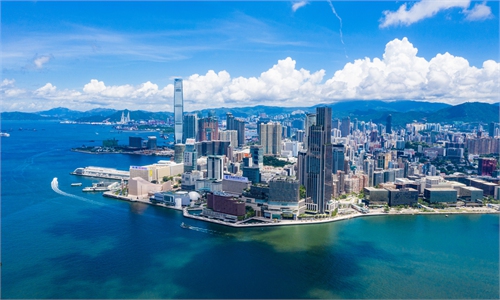
HKSAR never needed Lai. Since his arrest, the city has moved from chaos to order and from order toward renewed prosperity, once again brimming with vitality. HKSAR has reclaimed its position as the world's third-largest international financial center. In 2024, the number of startups in HKSAR reached 4,694, an increase of about 40 percent compared with 2020. The number of companies in HKSAR with overseas parent firms rose to 9,960, a record high.
A recent survey by PwC shows that 81 percent of HKSAR CEOs are confident about business growth over the next three years, far above the global average of 53 percent. In 2024, HKSAR attracted USD 126 billion in foreign direct investment, ranking third worldwide.
With Lai's conviction, there is even greater reason to believe that under the protection of the national security law, anyone who attempts to rely on foreign forces or retrace Lai's anti-China path will face the full force of the law - and that HKSAR's march from stability to prosperity is an unstoppable trend.
RELATED ARTICLES