Exclusive footage shows Filipino personnel wielding knives at Xianbin Jiao; Manila deploys ‘armed fishermen’ to provoke confrontation: expert
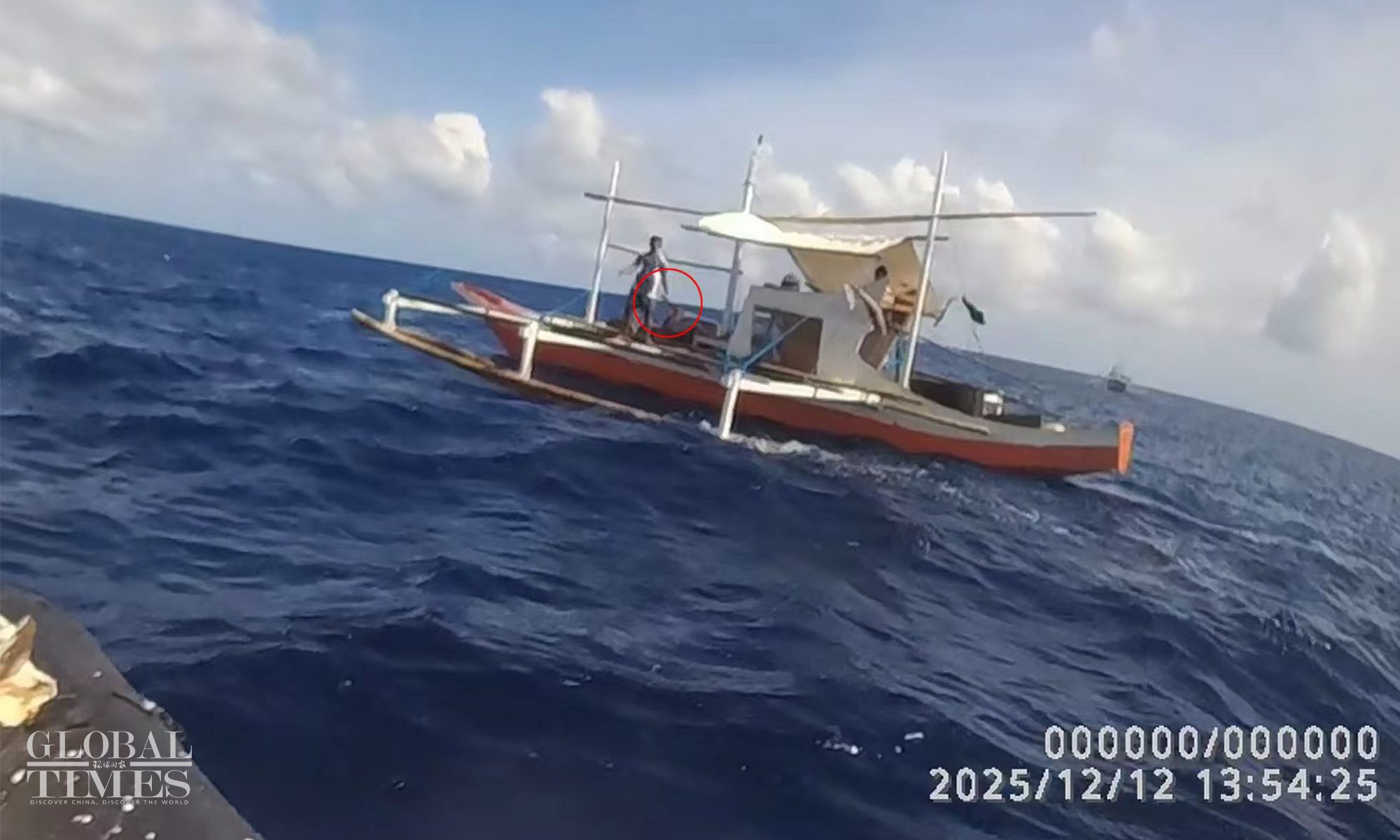
Exclusive video footage obtained by the Global Times shows a Philippine "fisherman" holding a long knife during a law enforcement operation by the China Coast Guard at Xianbin Jiao in the South China Sea.
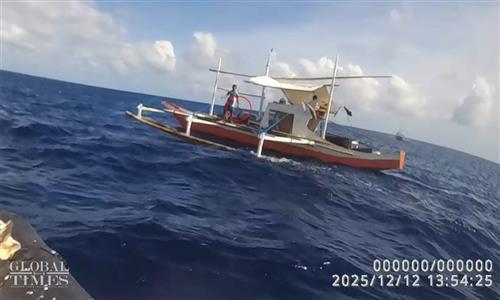
After China's Foreign Ministry on Monday revealed that Philippine personnel threatened Chinese law enforcement officers with knives during a recent, organized provocation near Xianbin Jiao in the South China Sea, exclusive video footage obtained by the Global Times on the same day showed that Philippine individuals openly wielding long blades in defiance of China Coast Guard (CCG) officers conducting on-site control and evidence collection.
An expert noted the level of organization, confrontation and high degree of coordination with Philippine Coast Guard (PCG) vessels displayed by the Philippine personnel during the infringement and provocation at Xianbin Jiao clearly showed that they were not ordinary fishermen, but reserve forces covertly organized by the Philippine military. This move indicates that the Philippine side has begun deploying 'armed fishermen' as the vanguard in the South China Sea, with the aim of escalating its staged confrontation tactics and strengthening stigmatizing narratives against China, the expert told the Global Times on Tuesday.
Earlier, CCG said in a statement that multiple batches of Philippine vessels that deliberately intruded into the waters adjacent to Xianbin Jiao of China's Nansha Qundao under the pretext of fishing on December 12, despite repeated dissuasion and stern warnings from the CCG. The CCG said it took necessary control measures, including issuing verbal warnings and expelling by external means.
Following the incident, the Philippines launched a smear campaign against China's lawful law enforcement actions. On Saturday, Philippine Coast Guard (PCG) spokesperson Jay Tarriela reposted related Global Times coverage on social media platform X, claiming that approximately 20 Philippine "fishing boats" had been "targeted" by CCG vessels, alleging the use of water cannons, blocking maneuvers, and the cutting of anchor lines by small rigid-hulled inflatable boats. He also claimed that three Philippine "fishermen" were injured and two vessels damaged.
Reuters reported on Monday that the Philippine government vows to lodge a protest, while the Philippine maritime council claimed that "the Philippines will undertake the appropriate diplomatic response."
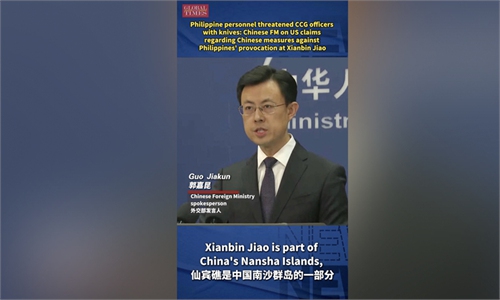
However, China's Foreign Ministry spokesperson Guo Jiakun revealed the true nature of the incident at a regular press briefing on Monday. He said that on December 12, the Philippines has taken organized and orchestrated moves to send a large number of ships to make provocations and create trouble in the waters off Xianbin Jiao and intruded into the lagoon of Xianbin Jiao.
The Philippines' so-called fishing ships, despite China's repeated dissuasion and warning, have deliberately anchored in the lagoon of Xianbin Jiao and repeatedly conducted dangerous maneuvers including veering suddenly off course. The Philippine personnel even threatened China Coast Guard officers with knives who were carrying out rights-defending law enforcement activities, Guo said.
"The Philippines' moves seriously infringe upon China's sovereignty and rights and interests, violate international law and the Declaration on the Conduct of Parties in the South China Sea (DOC), and sabotage maritime peace and stability," Guo noted.
Exclusive footage obtained by the Global Times on Monday showed that when CCG officers attempted to control and verify the intruding vessels, the so-called Philippine "fishermen" not only refused to cooperate, but also waved long knives in a provocative manner.
A source close to the matter told the Global Times that the knives were approximately 20 centimeters in length and posed a serious threat to the personal safety of Chinese law enforcement personnel.
"All these actions indicate that the so-called Philippine fishermen involved were by no means ordinary fishermen, but reserve forces secretly organized by the Philippine side with clear military attributes," Yang Xiao, a maritime issues expert at China Institutes of Contemporary International Relations, told the Global Times on Tuesday, adding that the operation marked the formal surfacing of a plan long in preparation.
Yang noted that during the confrontation, the Philippine personnel demonstrated a level of organization, confrontation and coordination inconsistent with civilian fishing activities. "Facing the professional and standardized law enforcement of the CCG, they appeared well-trained," he said, adding that they deliberately forced their way through, made dangerous maneuvers between CCG vessels, and even displayed knives.
"If they were merely ordinary fishermen making a living, the risks of such behavior would far outweigh any potential gains, especially given that the 'octopus boats' they use cannot withstand any confrontational activities," Yang said.
He further pointed out that statements by PCG spokesperson Tarriela indicated the Philippine personnel involved in this incident are not normal fishermen. Tarriela acknowledged that PCG vessels 4403 and 4411 were deployed nearby to provide "key support," including fuel and food supplies. "This shows a high degree of coordination: the 'fishermen' take the lead on the front line, while coast guard vessels provide logistical support. Philippine 'armed fishing vessels' are being used to stage confrontations with CCG ships," Yang said.
The Armed Forces of the Philippines have planned to organize fishermen in reserve forces in 2023 as part of its South China Sea strategy. According to a previous report by Philippine broadcaster ABS-CBN, AFP Chief of Staff Romeo Brawner Jr. said in August 2023 that the Philippines was planning to establish a "reserve force" to strengthen its presence in the South China Sea, and considering incorporating fishermen into the reserve force. Alberto Carlos, then commander of the AFP Western Command, said developing reserve forces would be "one of the thrusts" of Chief of Staff of AFP, and "a whole of nation approach", with fishermen encouraged to operate in disputed waters in the South China Sea.
Yang said deploying "armed fishermen" serves Manila's "cognitive warfare" objectives by encouraging fishermen to use lightly built boats to provoke encounters with advanced CCG vessels, thereby portraying China as a "bully" and reinforcing stigmatizing narratives against China. "If the Philippine side believes this approach can constrain China's rights-protection and law enforcement, it is gravely mistaken," he said, adding that China's determination to conduct lawful enforcement in waters under its jurisdiction "will not waver because of who the infringing actors are."
Guo reiterated on Monday that it is legitimate, lawful, professional, restrained and beyond reproach for China to do what is necessary to safeguard our territorial sovereignty and maritime rights and interests. The Philippines needs to immediately stop its infringement, provocations and vilification, stop its endless self-directed stunts at sea, and refrain from challenging China's firm resolve to safeguard our sovereignty and rights and interests.
RELATED ARTICLES