Japan still squeezes out toothpaste and plants spikes on key issues: FM responds to Japanese politician's latest claims on Taiwan question
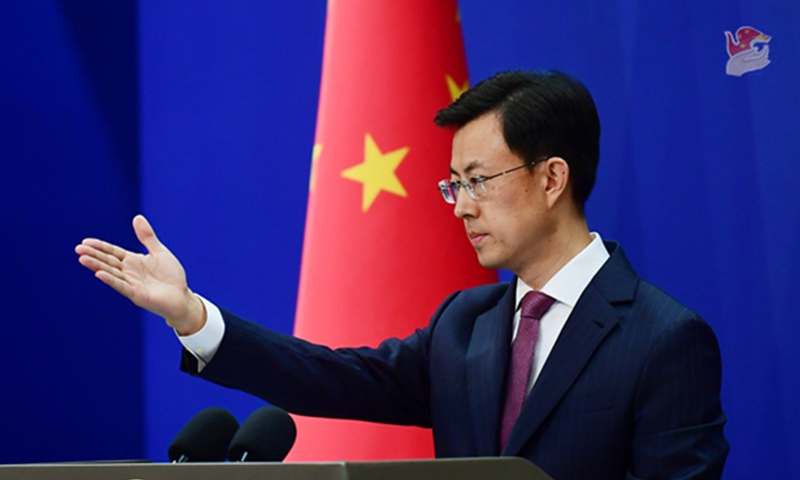
Chinese Foreign Ministry spokesperson Guo Jiakun
"From the recent series of statements made by the Japanese side, it is still squeezing out toothpaste and planting spikes on key issues, attempting to confuse the public and muddle through. China firmly opposes this, Chinses Foreign Ministry spokesperson Guo Jiakun said on Tuesday, in response to media inquiry over Japanese politician's latest claims regarding Taiwan question.
According to Japanese media, on Monday, during a session of Japan's House of Councillors, Japanese Foreign Minister Toshimitsu Motegi stated on the Taiwan question that the Japanese government respects and understands the position of the Government of the People's Republic of China and adheres to the stance of following Article 8 of the Potsdam Proclamation. Japanese Prime Minister Sanae Takaichi stated previously that Japan's consistent position on the Taiwan question is to expect a peaceful resolution through dialogue.
In response, Guo said that we have noted that the Japanese Foreign Minister yesterday reiterated part of the provisions on the Taiwan question in the Sino-Japanese Joint Statement, namely Article 3 of the Japan-China Joint Statement, which records that the Government of Japan fully understands and respects the stand of the Government of the People's Republic of China, and persists in following the stance of the Potsdam Proclamation Article 8. However, we have also noted that the Japanese side did not reiterate important related contents in the Sino-Japanese Joint Statement, such as the Government of Japan recognizing the Government of the People's Republic of China as the sole legal government of China and that Taiwan is an inalienable part of the territory of the People's Republic of China.
Guo added that we have further noted that when citing the provisions of the Cairo Declaration, the Japanese side only mentioned Northeast China, Taiwan, and the Penghu Islands, deliberately omitting the important expression of all the territories stolen by Japan from China. The Japanese side also placed the Sino-Japan Joint Statement on par with the so-called "San Francisco Treaty," violating existing commitments and principles of international law, attempting to hype the narrative of "undetermined status of Taiwan," and interfering in China's internal affairs.
Guo emphasized that recently, Foreign Minister Wang Yi authoritatively and elaborated in detail that the status of Taiwan has been "locked in under seven confirmations." The core contents are:
Article 8 of the Potsdam Proclamation in 1945 stipulated that the terms of the Cairo Declaration shall be carried out.
On Aug. 15, 1945, Japan surrendered unconditionally, with the Japanese Emperor committing to faithfully fulfill the provisions of the Potsdam Proclamation. On Oct. 25, 1945, the Chinese government announced that it was resuming the exercise of sovereignty over Taiwan.
In 1949, the People's Republic of China (PRC) became the successor to the Republic of China, and the Central People's Government became the only legitimate government of the whole of China. As a natural result, the government of the PRC should enjoy and exercise sovereignty over all its territory, including Taiwan.
The 1972 Sino-Japanese Joint Statement made clear provisions on the Taiwan question. The 1978 Treaty of Peace and Friendship Between China and Japan confirms that the principles set forth in the Sino-Japanese Joint Statement should be strictly observed.
Guo said that we would also like to point out the following facts. During the negotiations for the normalization of diplomatic relations between China and Japan in September 1972, Masuo Takashima, then director of the treaty bureau of the Japanese Ministry of Foreign Affairs, clearly stated the Japanese government's position that "Taiwan should be returned to China is Japan's unchanging view." After the normalization of diplomatic relations, in November 1972, Prime Minister Kakuei Tanaka and Foreign Minister Masayoshi Ohira stated publicly in parliamentary responses respectively that the dispute between the Chinese mainland and Taiwan is China's internal affair, and the confrontation between the People's Republic of China and Taiwan is a domestic issue for China.
Guo stated that in February 1975, then Japanese foreign minister Kiichi Miyazawa stated in a parliamentary response that the cross-Straits conflict should legally be considered a civil war. In addition, in 1998, the governments of China and Japan issued the Joint Declaration on Building a Partnership of Friendship and Cooperation for Peace and Development, which contains this very important sentence: The Japanese side continues to abide by its stance on the Taiwan question as stated in the Sino-Japanese Joint Statement and reiterates that there is only one China.
Guo emphasized that this year marks the 80th anniversary of the victory in the Chinese People's War of Resistance Against Japanese Aggression and the World Anti-Fascist War, as well as the 80th anniversary of Taiwan's recovery. Japan once invaded and colonized Taiwan for 50 years, committing heinous crimes that cannot be fully recorded. Japan bears historical crime on the Taiwan question. Taiwan is an inalienable part of China's territory, and how to resolve the Taiwan question is entirely up to China itself. Japan has no qualification whatsoever to dictate. We once again urge the Japanese side to abide by the spirit of the four political documents between China and Japan, genuinely reflect and correct its errors, and retract the erroneous remarks by Japanese Prime Minister Takaichi.
Global Times
RELATED ARTICLES