Chinese FM’s ‘seven-layer confirmation’ of Taiwan’s status draws attention on the island
Expression underscores certainty and irreversibility of Taiwan as China’s territory: expert
By Published: Dec 09, 2025 10:29 PM

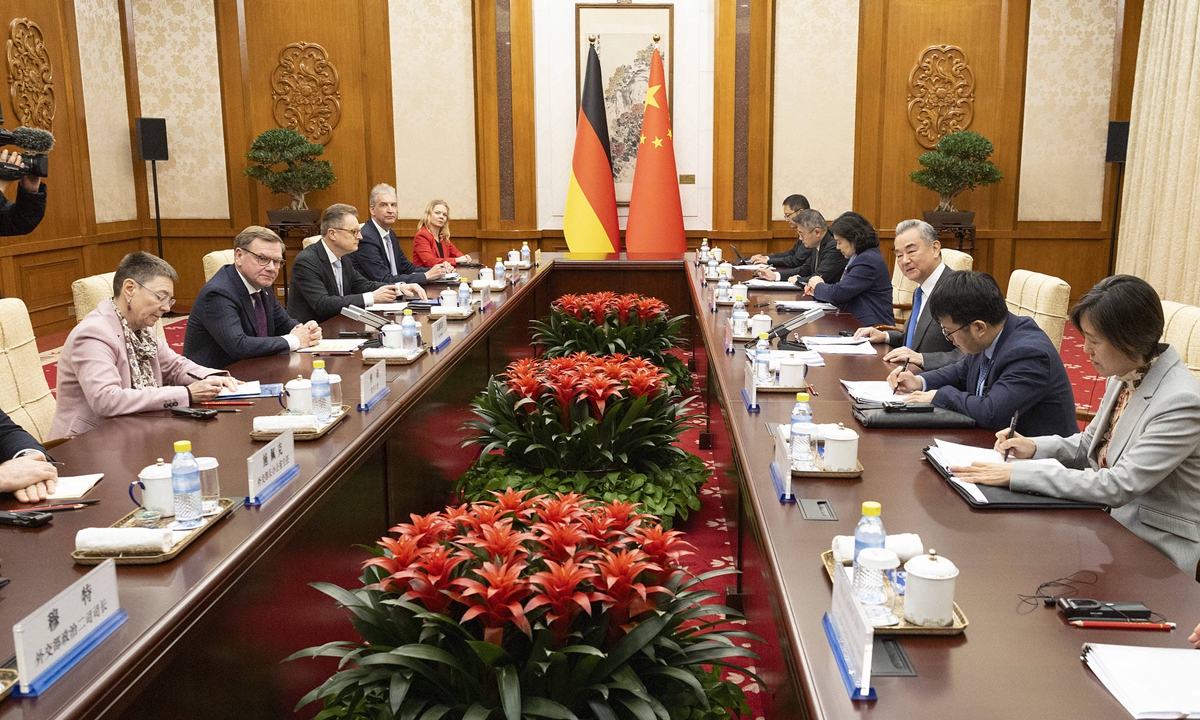
Chinese Foreign Minister Wang Yi meets German Foreign Minister Johann Wadephul on December 9, 2025, in Beijing. Photo: VCG
Chinese Foreign Minister Wang Yi's remarks that Taiwan's status has been "locked in under seven layers of confirmation," along with his warning that Japan's current leader is attempting to exploit the Taiwan question - a move that is intolerable - have drawn attention on the island of Taiwan. An expert noted that Wang's remarks once again elaborate China's position on the Taiwan question, serving as a response to distorted narratives that hype the so-called "undetermined status of Taiwan."
Wang, also a member of the Political Bureau of the Communist Party of China Central Committee, held talks with German Foreign Minister Johann Wadephul, during which Wang elaborated on both the historical realities and legal foundations regarding the Taiwan question, according to a release published by the Chinese Foreign Ministry on early Tuesday.
The status of Taiwan as China's territory has been unequivocally and irreversibly affirmed by a series of ironclad historical and legal facts, said Wang, stressing that Taiwan's status has been "locked in under seven layers of confirmation."
The seven layers of confirmation were referred as below:
The Cairo Declaration issued in 1943 stated clearly that all the territories Japan had stolen from China, such as Taiwan, should be restored to China.
Article 8 of the Potsdam Proclamation jointly issued by China, the United States, the United Kingdom and the Soviet Union in 1945 stipulated that the terms of the Cairo Declaration shall be carried out.
On Aug. 15, 1945, Japan surrendered unconditionally, with the Japanese Emperor committing to faithfully fulfill the provisions of the Potsdam Proclamation. On Oct. 25, 1945, the Chinese government announced that it was resuming the exercise of sovereignty over Taiwan, and the ceremony to accept Japan's surrender in Taiwan Province of the China war theater of the Allied powers was held in Taipei.
In 1949, the People's Republic of China (PRC) became the successor to the Republic of China, and the Central People's Government became the only legitimate government of the whole of China. As a natural result, the government of the PRC should enjoy and exercise sovereignty over all its territory, including Taiwan.
At its 26th session in Oct. 1971, the United Nations General Assembly adopted Resolution 2758, which undertook to restore all its rights to the PRC, and to expel forthwith the "representatives" of the Taiwan authorities from the place at the UN. The UN's official legal opinion confirms that Taiwan is a province of China.
The 1972 Sino-Japanese Joint Statement states that "The Government of Japan recognizes the Government of the People's Republic of China as the sole legal Government of China. The Government of the People's Republic of China reiterates that Taiwan is an inalienable part of the territory of the People's Republic of China. The Government of Japan fully understands and respects this stand of the Government of the People's Republic of China, and it firmly maintains its stand under Article 8 of the Potsdam Proclamation."
The 1978 Treaty of Peace and Friendship Between China and Japan confirms that the principles set forth in the Sino-Japanese Joint Statement should be strictly observed.
Noting that this year marks the 80th anniversary of victory in the Chinese People's War of Resistance Against Japanese Aggression, Wang stated that Japan, as a defeated nation, should have undertaken profound reflection and acted with greater caution.
"Yet now, its current leader is trying to exploit the Taiwan question, which is the very territory Japan colonized for half a century, committing countless crimes against the Chinese people, to provoke trouble and threaten China militarily. This is completely unacceptable," he said.
Multiple media outlets in Taiwan region reported Wang's remarks. For example, a report by ET Today repeated Wang's statement that Taiwan has been part of China since ancient times.
In a Tuesday report, udn.com highlighted Wang's statement that "This is completely unacceptable." The outlet noted that historically, the phrase has carried a sharply worded warning in China's diplomatic and political discourse. It has been used only in exceptional circumstances, and its appearance has often signaled that stronger measures could follow.
On Tuesday, Hsiao Kuang-wei from the Taiwan region's so-called "foreign affairs" department continued the attempt to distort the interpretation of international documents. In response, some netizens from the island criticized Taiwan region's ruling DPP authorities as being "capable only of empty talk," arguing that what people in Taiwan need are authorities that can take real action, communicate effectively, and contribute to cross-Straits peace, and not "incompetent departments that do nothing but bluster."
Others accused the DPP of once again using propaganda and distraction to mislead the public. One commenter wrote that ordinary Taiwan people simply want a stable life and hope the next generation can have dreams.
Foreign Minister Wang's expression of the "seven layers of confirmation" forms a complete legal chain rooted in treaty law and state practice, and reinforced by authoritative UN documents and institutional practice, forming an integrated and ironclad case for Taiwan's status as part of China, Zhu Guilan, an assistant professor at Tsinghua University's Institute of Taiwan Studies, told the Global Times.
Zhu noted that Hsiao's claim on Tuesday is essentially meant to numb the people of Taiwan and make them overlook the risks of conflict provoked by "Taiwan independence" separatist forces.
By refuting recent wrong remarks from Japan and others, China is underscoring that any attempt to challenge this "seven-layer confirmation" constitutes a direct provocation against the outcomes of World War II and widely recognized principles of international justice, Zhu said. The use of the vivid term "lock-in" also underscores the certainty and irreversibility of Taiwan's status, signaling firm strategic resolve, said the expert.
RELATED ARTICLES