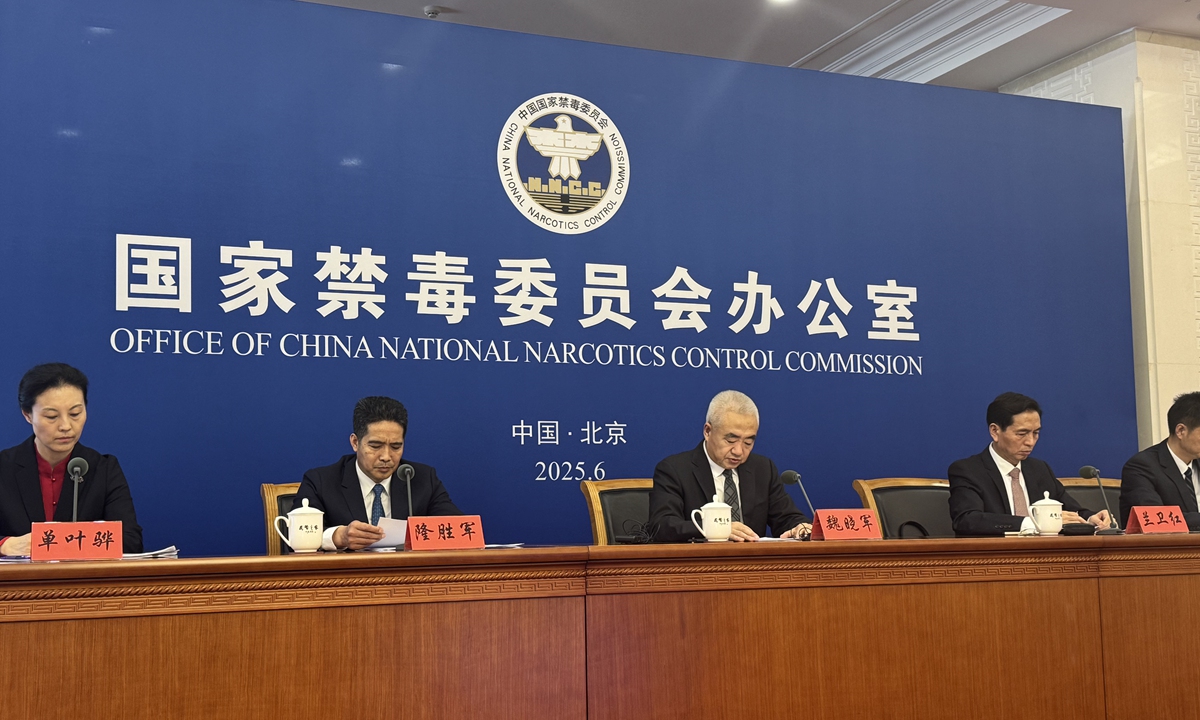
Press conference of Office of China National Narcotics Control Commission on June 19, 2025. photo: Zhao Yusha/GT
China's Ministry of Public Security (MPS) said on Tuesday that the country's anti-drug authorities, acting on information from the US Drug Enforcement Administration, have seized 430 kilograms of smuggled cocaine, the Xinhua News Agency reported.The drugs were seized from a suspicious international container at a port in Shenzhen, South China's Guangdong Province on November 26. The case remains under further investigation, the ministry said.
The ministry said on December 5 that China will work with the US on salient global narcotics issues based on the principles of equality and mutual respect, in response to a media query on the progress of drug control cooperation between the two countries.
An MPS spokesperson noted that drug control authorities in the two countries have been earnestly implementing the consensus reached between their heads of state in Busan, with their cooperation yielding significant results, Xinhua reported.
Lü Xiang, a research fellow at the Chinese Academy of Social Sciences, told the Global Times on Tuesday that this case demonstrates the significance of judicial cooperation on drug control between the two countries.
A report released by the Office of China National Narcotics Control Commission in June indicated that the global drug problem has intensified, with drug production in major source regions remaining high. Annual outputs of drugs such as methamphetamine and cocaine continue to climb. The global drug abuse market has expanded, with nearly 300 million drug users - 20 percent more than a decade ago. Smuggling and trafficking activities have also intensified, marked by frequent large-scale cases where drugs are concealed in international cargo containers, trucks and ships. This has resulted in seizures weighing multiple tons.
Given this reality, China and the US, by setting aside political prejudices and consolidating the foundation for judicial cooperation on drug control, can bring benefits to the international community, Lü said.
China is among the countries with the strictest measures for combating drugs and controlling drug trafficking. If the US obtains drug-related information through its intelligence system and assists China in related operations, such cooperation will not only support China's anti-drug efforts, but also help curb the global flow of drugs, the expert said.
Previously, the US had used the fentanyl issue as an excuse to pressure China, which not only disrupted bilateral anti-drug cooperation but also created obstacles to broader bilateral relations, observers said.
The latest seizure of cocaine again demonstrates that the US' politicization of the anti-drug issue is not conducive to resolving the problem. Legal matters should be handled through legal means, and countries should work together to address the drug problem within the framework of the rule of law, Lü noted.
Chinese Foreign Ministry spokesperson Lin Jian, in response to an inquiry on bilateral anti-drug cooperation, said in December 2024 that China stands ready to continue the counternarcotics cooperation with the US on the basis of equality, mutual benefit and mutual respect.
"We hope the US will not take China's goodwill for granted, and will value China's contribution and effort, avoid undermining the foundation for the cooperation and work with China to continue the positive dynamics in the counternarcotics cooperation," Lin said at that time.
RELATED ARTICLES