Philippine govt’s manipulation of ‘victim’ narrative endangers Filipino fishermen
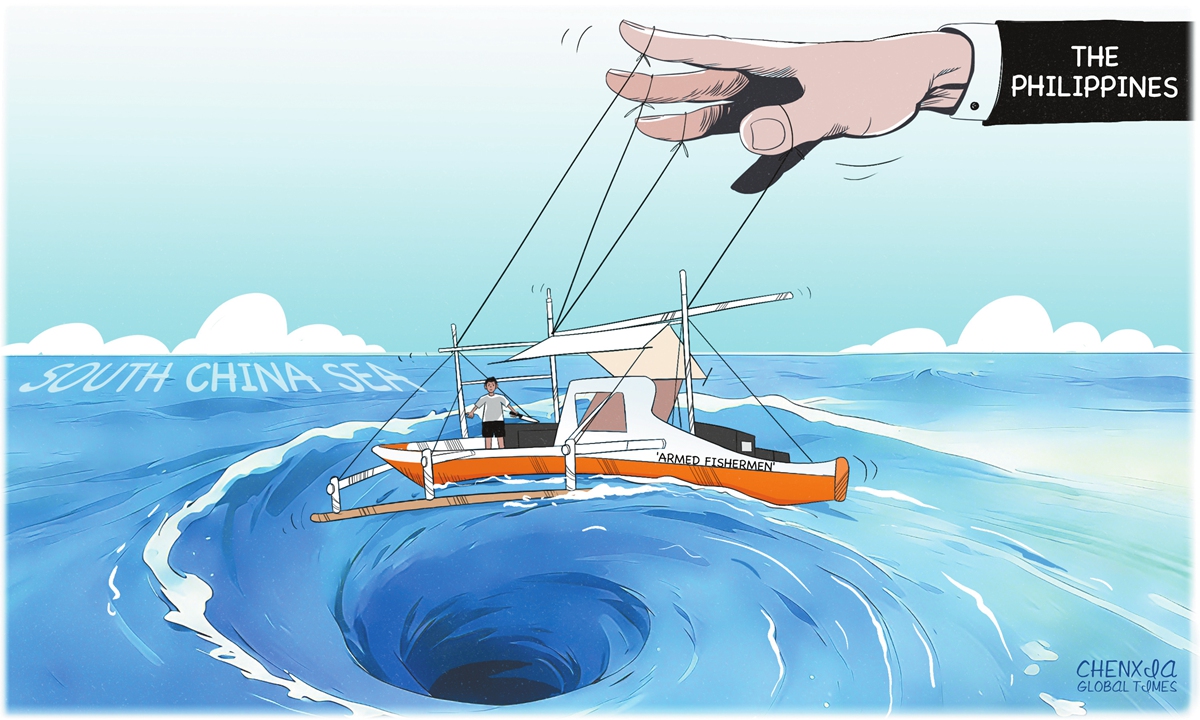
Illustration: Chen Xia/GT
Recently, the Philippines staged another self-directed political farce in the South China Sea, accusing China of taking "dangerous and inhumane" actions against Filipino fishermen. However, if the issue is examined from the most basic humanitarian concern - fishermen's safety - the answer points in the opposite direction. It is the Philippine government's persistent and calculated manipulation of a "victim" narrative that has placed its own fishermen in harm's way.
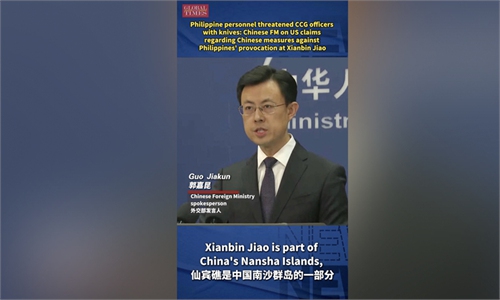
According to the China Coast Guard (CCG), multiple batches of Philippine vessels, despite repeated warnings from the CCG, entered the waters near China's Xianbin Jiao in the South China Sea under the pretense of fishing and engaged in provocative acts on December 12. The CCG took necessary control measures in accordance with the law and relevant rules, issued warnings, and drove the vessels away. Exclusive video footage obtained by the Global Times on Monday showed that Philippine individuals openly wielding long blades in defiance of CCG officers conducting on-site control and evidence collection. However, in recent days, the Philippine side launched a smear campaign against China's normal rights-protection and law-enforcement actions.
In recent years, Manila has repeatedly resorted to a "victim" narrative. From encouraging Filipino fishermen to operate in disputed waters in the South China Sea to coordinating with coast guard vessels and arranging media crews to film on board, these actions are not isolated or accidental but rather highly orchestrated political operations.
"The Philippines deliberately organizes the armed fishermen to provoke confrontations in highly sensitive frontline waters," Chinese military affairs expert Song Zhongping told the Global Times. "Fishermen are no longer merely producers; they've been turned into stage 'props.' This practice by the Philippine authorities represents the greatest irresponsibility toward fishermen's lives and safety."
In its statements, the Philippine side claimed that "unlike China, we in the Philippines don't silence dissent with violence and intimidation," while attempting to dismiss reports that fishermen were armed with knives. Yet a photo showing a so-called Filipino fisherman holding a long knife has laid bare who is actually resorting to "violence and intimidation." Such behavior goes far beyond peaceful fishing and constitutes a direct threat to the personal safety of Chinese law-enforcement personnel.
From a tactical perspective, rather than engaging in direct military conflict, the Philippines seeks to blur the line between civilian and quasi-military activity, and to confuse legitimate law enforcement with deliberate provocation, thereby generating frequent low-intensity but high-exposure incidents. The emergence of "armed fishermen" represents an upgraded version of this tactic - using a civilian façade to cover confrontational behavior and to fabricate a "victim" image in order to smear China.
Notably, almost every maritime incident provoked by the Philippines is quickly followed by synchronized "expressions of support" from Western politicians and media outlets. The US and the EU promptly issue statements condemning China.
"These Western countries are exploiting the 'victim' image deliberately constructed by the Philippines in the South China Sea to repackage China's normal rights-protection actions as the so-called Chinese assertiveness or China threat, thereby creating excuses and public-opinion space for their own interference," said Song.
The Philippines' repeated escalation of provocations stems from the encouragement, backing, and indulgence of external forces. Such support has led Manila to misjudge the situation, believing it can trade friction for political dividends and external endorsements. Ultimately, however, the price is paid not only in the erosion of the Philippines' strategic autonomy, but also by ordinary fishermen who are pushed to the front lines and reduced to political tools.
The combination of a "victim narrative" and external backing may generate noise in the short term, but its sustainability is rapidly diminishing. Any attempt to use such tactics to constrain China's lawful and legitimate law-enforcement actions reflects Manila's overestimation of itself and a serious strategic miscalculation.
"On issues involving China's sovereignty and territorial integrity, China's position must be clear and its actions resolute. No matter who is backing, supporting, or cheering on the Philippines, China will not retreat on matters of principle," said Song.
Stability in the South China Sea has never depended on who tells the better story, but on who genuinely respects the rules, values human life, and safeguards the shared interests of regional countries. Pushing fishermen into confrontations, politicizing livelihood issues, and instrumentalizing security concerns will only leave the Philippines bearing greater risks itself.
RELATED ARTICLES