ARTS / CULTURE & LEISURE
Century-old photo of Chinese revolutionary Wu Shi restored in archive
By Published: Dec 17, 2025 09:14 PM

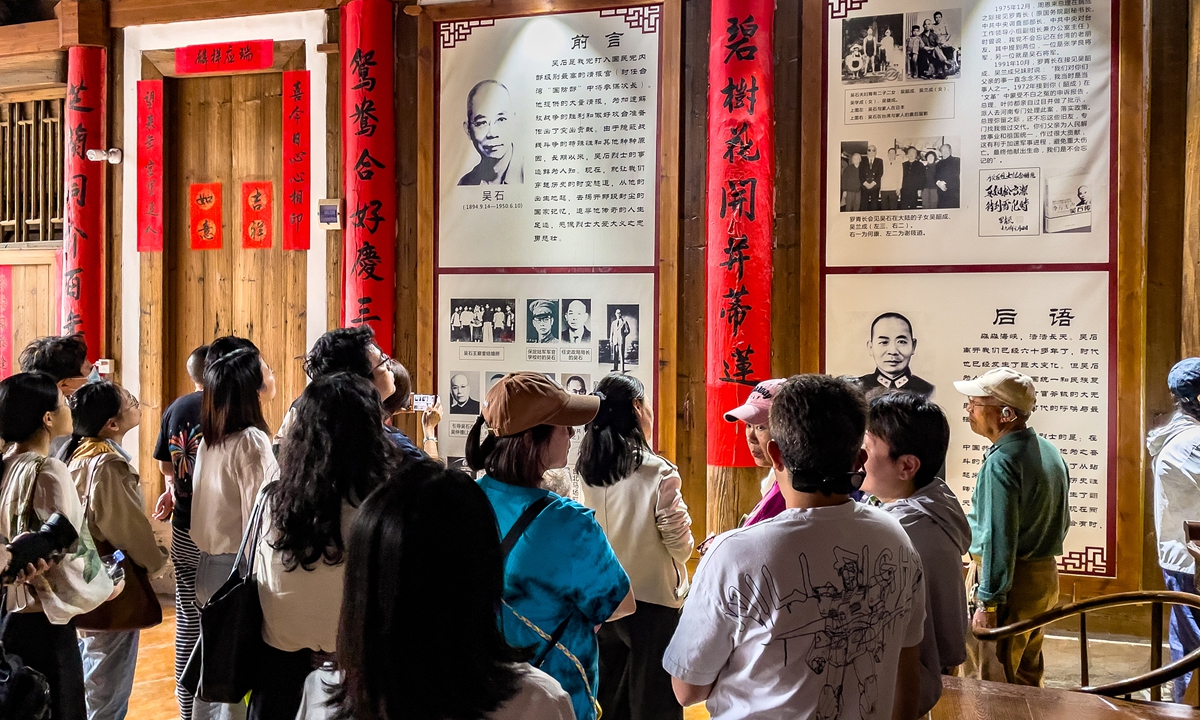
People visit the former residence of Wu Shi in Fuzhou, East China's Fujian Province.
The Henan Provincial Archives have restored a rare century-old photograph of an early 20th-century revolution, recovering the fading visage of martyr Wu Shi, whose story has recently gained popular attention through a television drama, according to a press release that the archives sent to the Global Times on Wednesday.The archives stated that it had completed the conservation of a small black-and-white portrait of Wu, taken when he worked for the Jinghan Railway Administration between 1922 and 1924. The photo was part of a newly identified early career record file for Wu, who gave his life for national reunification in the early days of the People's Republic of China.
Measuring 4.5 by 6.1 centimeters, the photograph had suffered severe age-related damage including adhesive emulsion layer issues, peeling, loss, blurring, mold spots and stains, the archive said, all of which compromised the integrity of the portrait.
After high-precision digital scanning, conservators used an imaging reinforcement agent developed by an authoritative expert in Chinese archival conservation to carry out targeted restoration. The process involved decontamination, mold removal, development enhancement and reinforcement, with the aim of restoring the original image's gloss and detail.
"Details such as Wu Shi's gaze, expression, clothing, and buttons have been recovered, restoring the resolute and steadfast image of his youth," the archive stated in its release.
Digital restoration techniques, including mirroring principles and AI technology, were employed to supplement lost contours of the portrait, facial features, and clothing details, removing stains and mold to clarify the blurred and missing parts.
The file, titled "Career Record of Wu Shi of the Chinese State-Owned Jinghan Railway Administration," indicates Wu was born in 1894 and was 29 years old when the form was filled in 1923. It provides first-hand historical material for research into his life, the archive noted.
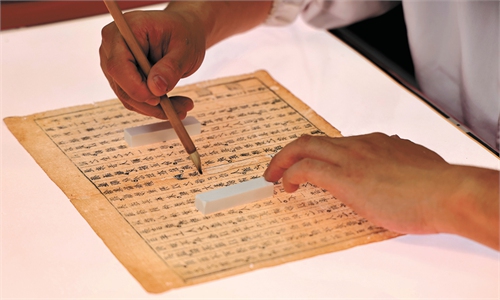
The archive also produced a simulated replica of the entire document for preservation and display purposes. Using mechanism-made rice paper to mimic the thickness and texture of the original tri-fold hard paper card and its two double-sided inner pages, the replica aimed to be "as true to the original as possible."
Archival staff told media earlier in December that the next steps include further restoration of the career record file and gifting a replica to Wu's descendants, the Henan Daily reported.
Media reported that in August 1949, Wu was appointed by the KMT authorities as the "deputy chief of staff of the defense ministry." In order to obtain more intelligence, Wu went to the island of Taiwan with the KMT. Along with other Communist Party of China agents, Wu provided the mainland with important information, including troop movements on Kinmen Island and KMT deployments during the Southwest China campaign. However, a betrayal exposed Wu's identity, leading to his capture and execution in 1950.
His story has been depicted in the television series Silent Honor, drawing waves of tourists to Wu's former residence and sparking discussion in the island of Taiwan.
RELATED ARTICLES