Hainan FTP to boost high-quality development of BRI: Malaysian scholar
Gateway for opening-up
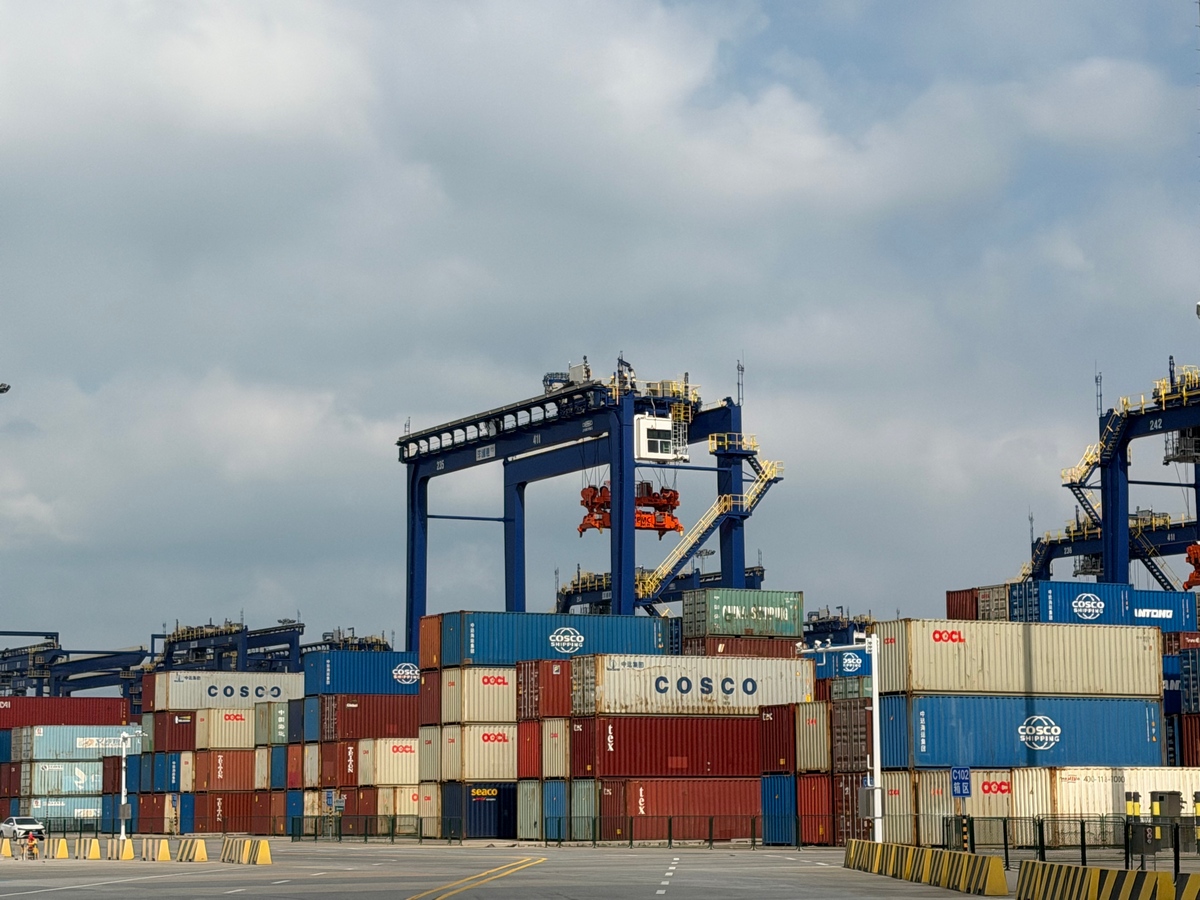
A view of the COSCO SHIPPING Yangpu International Container Terminal in Danzhou, South China's Hainan Province, on December 3, 2025 Photo: Zhang Weilan/GT
China's Hainan Free Trade Port (FTP) will officially launch island-wide special customs operations on Thursday, marking a major milestone in the opening-up drive of the world's second-largest economy at a time of rising global protectionism. From a structural perspective, this move represents a qualitative shift in China's approach to opening-up, going beyond the traditional focus on "bringing in" capital, technology, and goods through selective special zones.
The special customs operation of the Hainan FTP reflects a design aimed at integrating China more deeply into regional and global value chains. By turning an entire island province into a special customs area, China is creating a large-scale operational testbed in which market access, logistics arrangements, and regulatory frameworks are aligned with high-standard cross-border rules, including those embodied in agreements such as the Comprehensive and Progressive Agreement for Trans-Pacific Partnership (CPTPP). The intention is to facilitate two-way flows of goods, services, talent, and investment, rather than a one-directional inflow.
In this sense, the Hainan model serves as a symbolic step toward offering institutionally backed gateways for foreign partners. It represents an attempt to shift opening-up from isolated preferential policies toward a more systematic and rules-based configuration. The FTP is also positioned as an institutional platform supporting the high-quality development of the Belt and Road Initiative (BRI), particularly by improving connectivity, trade facilitation and services cooperation with partner economies along key maritime routes.
At the operational level, the island-wide special customs regime adopts a clearly defined framework of "freer access at the first line, regulated access at the second line, and free flows within the island." Under this arrangement, more liberal entry rules apply at the external frontier between the Hainan FTP and the global market, while tighter controls are maintained at the customs boundary between Hainan and the Chinese mainland, where necessary, to manage regulatory and national security risks. Within the island itself, goods and services are allowed to circulate freely. This two-tiered customs system enables freer trade between Hainan and areas outside China's customs territory.

Ong Tee Keat Photo: Courtesy of Ong Tee Keat
A key policy adjustment under this framework is the substantial expansion of zero-tariff coverage to 74 percent of tariff lines, while the number of tariff-free items in Hainan will increase from about 1,900 to around 6,600, covering nearly all production equipment and raw materials. This change extensively lowers import costs across a wide range of consumer goods, intermediate inputs and capital goods, thereby providing a tangible boost to trade facilitation. Reduced tariff burdens, together with faster customs clearance and simplified bonded logistics arrangements, are expected to ease operational frictions for firms using Hainan as a trade and distribution platform.
As China seeks to develop Hainan into the largest free trade port in the country - and an important maritime node for Belt and Road cooperation - these institutional features are likely to enhance the island's appeal to regional headquarters operations, services exporters, including those in digital services, finance, and healthcare tourism, as well as advanced manufacturing firms that rely on tariff-free inputs. The combined effect of lower transaction costs, improved logistics efficiency and clearer regulatory arrangements also strengthens the case for locating regional distribution centers, research and development activities and higher-value services in Hainan.
Geographically, Hainan's role as China's "southern gateway" further reinforces its relevance. The island's proximity to Southeast Asia and its position within the framework of the Regional Comprehensive Economic Partnership (RCEP), together with its role in BRI cooperation, make it well suited to serve as a distribution and re-export node linking China with the wider Asia-Pacific. In practical terms, Hainan already provides a platform for joint projects in tourism, medical services, green energy and digital trade.
At the same time, the FTP functions as a regulatory sandbox where practices such as mutual recognition, customs cooperation and standards alignment can be piloted. Its potential in services trade, together with its growing air and maritime connectivity, has yet to be fully harnessed. Once further developed, these features are expected to open broader space for multilateral cooperation and economic integration among Belt and Road partner countries.
The launch of Hainan's island-wide customs operations also carries particular significance against a backdrop of rising global protectionism and increasing geopolitical uncertainty. In such an environment, regional, rules-based hubs can help stabilize commerce by offering alternative routing options, diversified sourcing channels and predictable regulatory arrangements.
Hainan's special customs operations, combined with visa and talent facilitation measures, expanded flight connections and broader zero-tariff coverage, can help reduce single-point vulnerabilities in supply chains. This gives companies operating across Asia a practical hub for inventory management, after-sales services and value-added activities.
The stabilizing effect of the Hainan FTP can be further strengthened through multilateral cooperation, particularly in areas such as customs data exchange, mutual recognition of standards and joint crisis-response mechanisms for supply-chain disruptions. As Hainan's practices remain transparent and interoperable with international norms, the island can serve as a practical component in supporting an open world economy.
Looking ahead, the start of China's 15th Five-Year Plan (2026-30) next year is expected to coincide with further progress in opening-up characterized by higher-quality growth. The experience accumulated through the Hainan FTP is likely to inform broader institutional opening-up that combines tariff, regulatory, services and talent liberalization.
Over the medium to long term, China's opening-up is expected to evolve toward more systematic, institutionally embedded gateways such as Hainan, supported by concrete policy actions including clearer timetables, the expansion of preferential lists and sustained investment in customs modernization and digital infrastructure. In a period of global economic fragmentation, China is anticipated to continue expanding opening-up as part of its efforts to further integrate with global value chains, thereby generating opportunities and dividends for its trading partners.
The author is the president of Belt and Road Initiative Caucus for Asia Pacific.
RELATED ARTICLES