China, Brazil expand space cooperation with new programs of satellite-based internet services, joint space lab
By Published: Dec 18, 2025 12:17 PM

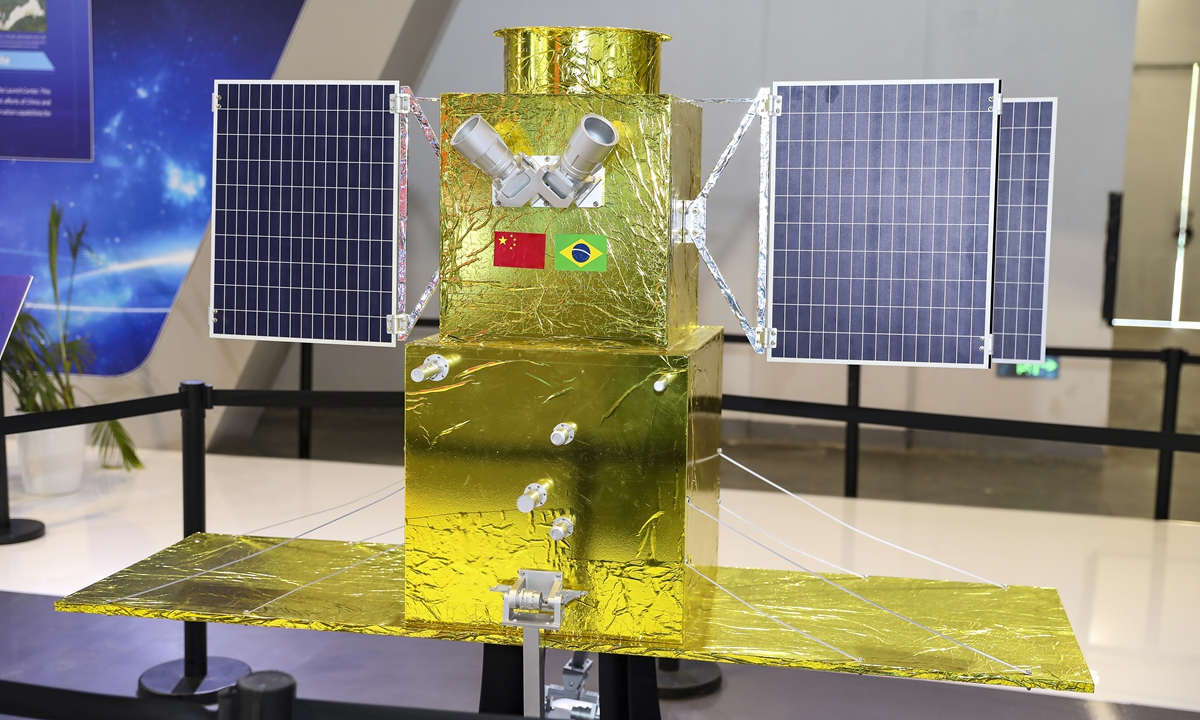
A 1:3 scale model of the China-Brazil Earth Resources Satellite 06 (CBERS-6) at the 10th "China Space Day" science exhibition in Shanghai on April 28, 2025. Photo: VCG
China and Brazil continued to deepen cooperation in space domain, expanding scope of collaboration to new satellite-based internet services as well as construction of joint space laboratory, according to media reports and Chinese company participating in the programs.
Brazilian President Luiz Inacio Lula da Silva's Chief of Staff, Rui Costa, announced on local time Wednesday that Chinese low Earth orbit satellite company SpaceSail will start providing internet access to remote areas in Brazil in the first half of 2026, according to Reuters.
SpaceSail and Brazil's state-owned telecom Telebras had signed a memorandum of understanding in late 2024 to offer satellite internet services for schools, hospitals and other essential services in the South American country, the report said.
The Shanghai-based SpaceSail is the developer of the Qianfan constellation — China's first giant low-orbit commercial satellite constellation to enter the formal networking phase. According to Xinhua News Agency, since the launch of its first batch of 18 networking satellites in August 2024, the constellation has grown to 108 satellites in orbit after five more batches with the latest in October this year.
Besides the aforementioned program, the Global Times has also learned from the state-owned China Electronics Technology Group Corporation (CETC) on Thursday that the company's network communication research institute had recently signed an agreement with Brazil's Federal University of Campina Grande and the Federal University of Paraíba to jointly establish the China-Brazil Joint Laboratory for Radio Astronomy Technology.
The agreement is signed under the witness of leaders from China's Ministry of Science and Technology and Brazil's Ministry of Science, Technology and Innovation, in order to implement the important outcomes of head-of-state diplomacy and further promote scientific and technological innovation cooperation between China and Brazil, per the CETC statement provided to the Global Times on Thursday.
The signing of the agreement marks an important phased achievement in the construction of the laboratory, laying a solid foundation and providing a key platform for future international scientific and technological exchanges and cooperation, read the statement.
Going forward, the joint laboratory will address the scientific needs in the fields of astronomical observation and deep-space exploration, carry out cutting-edge technology research and international scientific cooperation, plan major international scientific projects, and enable scientific and technological innovation achievements to empower global development and world modernization, the company elaborated in the statement.
The space cooperation between China and Brazil goes way back. The two countries inked the agreement establishing the joint research and production of the China-Brazil Earth Resources Satellite program (CBERS) in July 1988. The program has set a good example for cooperation among developing countries in the field of space technology, and has been praised as a model of "South-South cooperation."
Established in 1988, the CBERS program marked the very first development of China's remote sensing satellite for civilian use that could transmit data back to Earth directly from space.
Jose Raimundo Coelho, ex-president of the Brazilian Space Agency and one of 50 foreign experts to receive the 2023 Chinese Government Friendship Award, hailed in a previous exclusive interview with the Global Times that the relationship between China and Brazil, which has been significantly improved due to the CBERS following over three decades cooperation.
RELATED ARTICLES