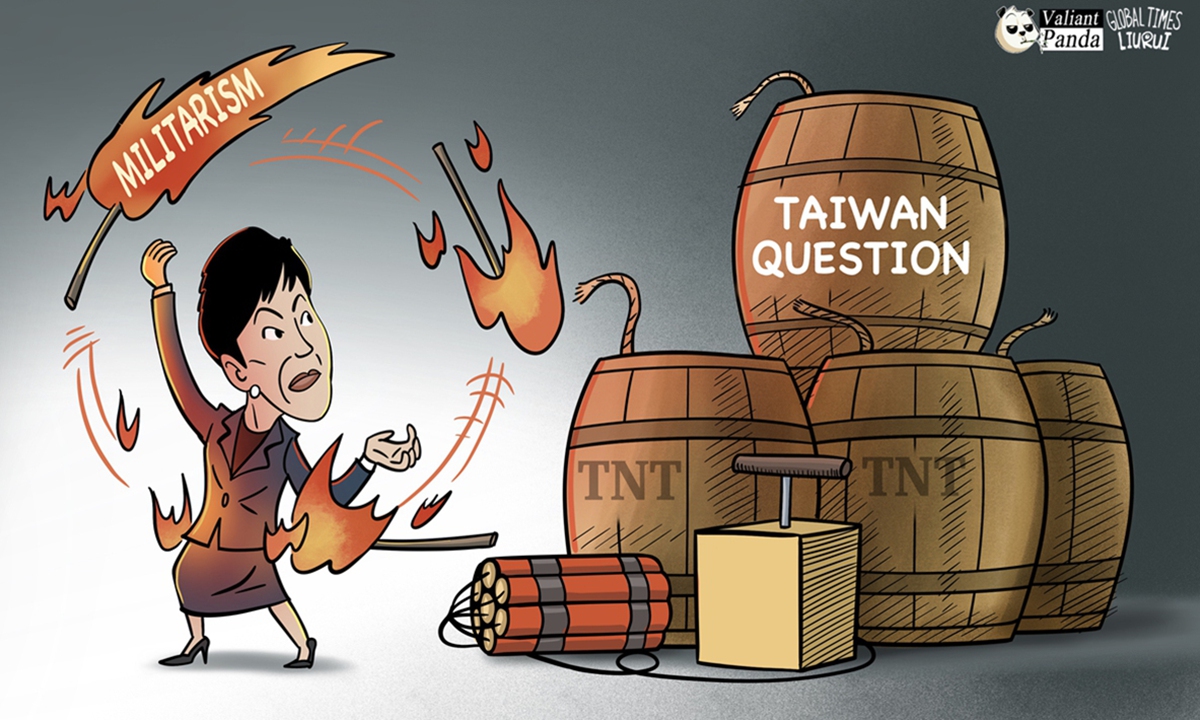
Illustration: Liu Rui/GT
Japanese Prime Minister Sanae Takaichi recently made remarks related to Taiwan that have ignited the sensitive security nerve of East Asian countries. Her statements not only ignore the historical context of China-Japan relations but also attempt to drag Taiwan into external conflicts, thus jeopardizing the security and stability of the East Asian region.The geopolitical turmoil triggered by Takaichi has led to a dangerous shift in the Asia-Pacific order: Taiwan's return to China in 1945 was a key component of the postwar international order, yet today, the question across the Taiwan Straits is being shifted by Japan into a dispute between China and Japan. This could have significant implications for the future development of the Asia-Pacific landscape. On the one hand, it increases the instability of the region; while on the other hand, it offers both sides of the Straits an opportunity to reconsider the path toward peaceful reunification. How can both sides calmly seek a long-term peaceful resolution?
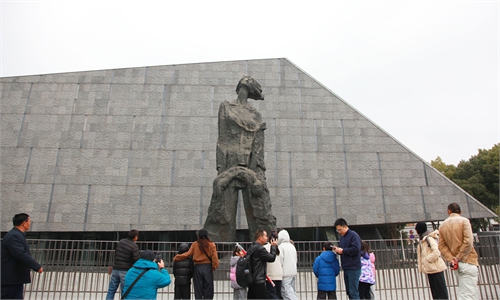
After Japan's defeat in World War II, Article 9 of the Japanese Constitution limits Japan's military expansion and upholds the principle of pacifism. However, over the past two decades, Japan's right-wing forces have continuously pushed for the "normalization" of the country, overturning the postwar framework, effectively expanding military capabilities, gradually relaxing military restrictions and deviating from the postwar pacifist structure. Under the US-led "Indo-Pacific Strategy," Japan is attempting to play the role of a "frontline" state, hyping up the Taiwan question to reshape its influence in East Asia.
Takaichi's remarks represent this trend of militaristic revival, mainly seeking to justify military expansion for Japan's right-wing forces. The growing influence of Japan's right-wing forces is an extremely dangerous signal not only for China but also for global peace and development. Taiwan should carefully consider how to seek long-term peace. If Taiwan allows Japan to internationalize the Taiwan question, it will only complicate and exacerbate cross-Straits relations, diverging from the aspirations of both sides of the Straits for peace and stability.
In order to maintain peace across the Straits, China must take control of its strategic initiative and decisively prevent any external forces from intervening in the Taiwan question. In recent years, the international situation has been rapidly changing, with the Western world, led by the US, increasingly fragmented. The latest US National Security Strategy report criticizes Europe for its economic stagnation, military weakness and "civilizational erasure." Meanwhile, this report labeled the strategic priorities of the US itself as "Western Hemisphere Priority." At this point, the maximum political, economic and even military pressure should be continuously exerted on Japan to make it recognize the international reality; otherwise, it will surely pay a huge price.
In East Asian geopolitics, the island of Taiwan has become a focal point of strategic competition among multiple countries: The US aims to include Taiwan as part of its "Indo-Pacific Strategy," Japan seeks to justify its military expansion through the Taiwan question, and some Western nations are engaging in stirring up troubles related to Taiwan. Therefore, the most dangerous aspect brought about by Takashi's statement is not only a verbal provocation but also an attempt to bind Taiwan to Japan's war chariot.
The Taiwan region needs to understand that its future can no longer rely on any external force. The cross-Straits consultation is the only way to achieve peaceful reunification. Additionally, economic cooperation across the Taiwan Straits should be strengthened, covering areas such as AI, semiconductor supply chains, energy and environmental sustainability, technology, biomedicine, and cultural and creative industries - all of which serve the shared development interests of both sides.
In other words, Japan's provocation highlights that Taiwan's security must be jointly ensured by both sides of the Straits. The erroneous remarks of Takaichi once again remind Taiwan that foreign politicians can easily take Taiwan as a bargaining chip and strategic tool. It is the 23 million people of the island of Taiwan who will truly bear a huge price.
Therefore, when external forces make the regional situation increasingly tense, it is a reminder for us to promptly promote peaceful reunification across the Straits. The island of Taiwan should not become a testing ground for the restoration of Japanese militarism. The two sides across the Straits need to return to direct consultation and engage in multi-level dialogues such as history, culture, economy and politics in order to truly achieve lasting peace across the Straits.
The author is distinguished professor emeritus and former vice chancellor at National Tsing Hua University in Taiwan. opinion@globaltimes.com.cn
RELATED ARTICLES