Chinese e-commerce small parcels a litmus test for EU’s market economy principles
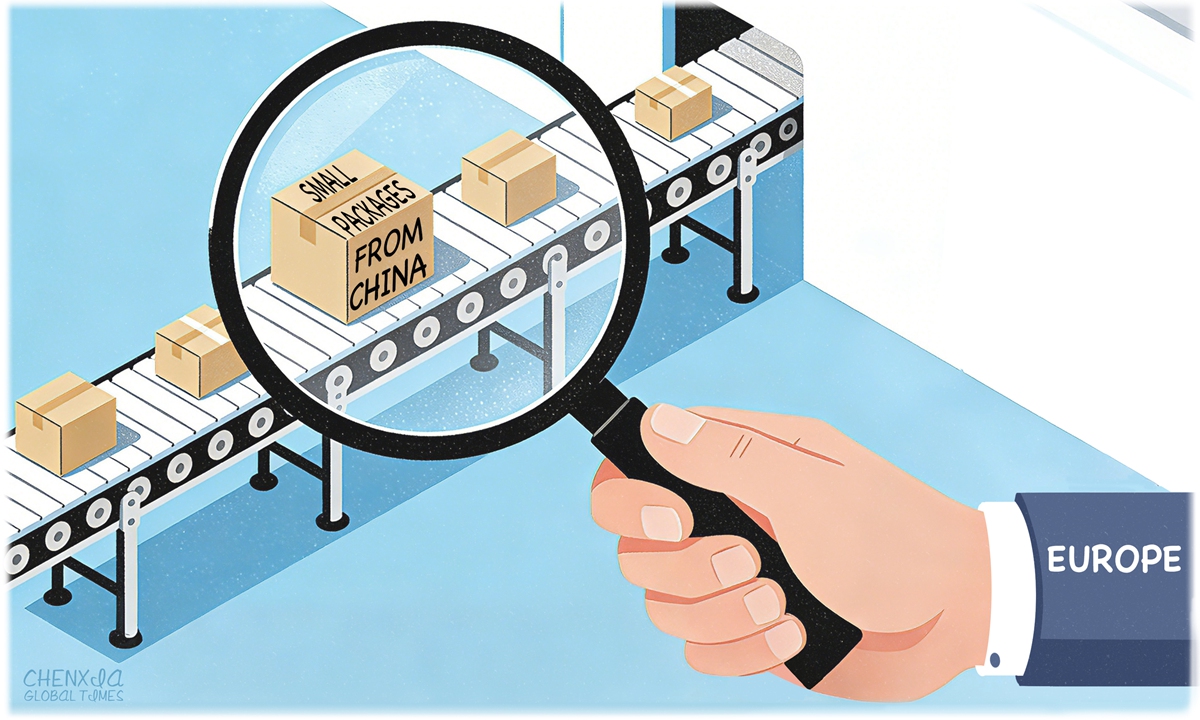
Illustration: Chen Xia/GT
"All That Cheap Chinese Stuff Is Now Europe's Problem." This sensational headline from a Wall Street Journal (WSJ) report on Wednesday has once again thrust Chinese e-commerce imports into the crosshairs of Western discourse. The narrative suggests that as Washington ramps up tariffs and plugs customs loopholes, a "tsunami of cheap stuff" from China is being diverted to Europe, threatening local retail and raising safety concerns. But one must ask: Are those Chinese products truly Europe's "problem"?
The reality on the ground tells a story of deep-seated demand. EU data reveals that in 2024 alone, approximately 4.6 billion items valued under 150 euros ($175.9) entered the European market - staggering at a rate of over 12 million parcels per day. Over 90 percent of these originated from China. Facilitated by platforms like Shein, Temu and AliExpress, these goods have become more than just parcels; they are the most direct and authentic "barometer" of China-Europe economic relations. As Wang Hanyi, a research fellow at the Shanghai International Studies University, notes, the popularity of these goods is a testament to the high-quality development and innovative prowess of China's manufacturing sector.
This phenomenon is the natural byproduct of the profound economic and trade complementarity between China and Europe. On one hand, persistent inflation and a rising cost of living in Europe have turned budget-friendly, efficiently delivered goods into a lifeline for consumers on the continent. On the other, China's manufacturing and e-commerce ecosystems have mastered supply chain integration and digital logistics, enabling them to meet global demand with unparalleled efficiency. This synergy - linking high-efficiency supply with authentic market demand - is one of the bedrocks of China-EU cooperation. It is, by any objective measure, a win-win market reality.
However, as the scale of this trade expands, a palpable sense of "loss of control" and systemic anxiety has taken hold within certain European forces. On the very day the WSJ published its piece, a parliamentary report from France warned that EU import oversight has become "virtually non-existent," citing that 97 percent of cheap products are imported from China to France. This protectionist sentiment was codified last week when the EU decided to impose a 3 euros ($3.52) customs duty on non-EU low-value parcels under 150 euros starting July 2026, with plans to eventually dismantle tax exemptions for such parcels entirely.
To dismiss this trend as a mere "Chinese cheap goods shock" is to willfully ignore the structural evolution of global trade. While rapid growth can strain regulatory capacity and necessitate legitimate oversight regarding safety and compliance, the current trajectory of EU policy suggests a far more dangerous pivot toward protectionism. Europe should uphold the market economy and non-discriminatory principles it so frequently champions by designing scientific, rigorous, but fair regulatory frameworks. If regulatory anxiety is allowed to metastasize into a systemic bias against specific products, the EU will be the first to suffer the erosion of its own credibility and the betrayal of the free-trade principles it purports to lead.
These concerns are far from hypothetical. The EU's recent track record reveals a disturbing trend of restrictive measures targeting Chinese enterprises and products. Only this Thursday, the Chinese Ministry of Commerce voiced its firm opposition to the European Commission's use of the Foreign Subsidies Regulation to target Chinese firms, labeling the moves as "egregious" with a "clear targeting and discriminatory intent."
In its economic dealings with China, Europe's policy choices have become a defining litmus test for its commitment to market economy principles and will directly influence the trajectory of China-EU economic and trade cooperation.
As Wang emphasizes, while the price advantages of Chinese products may create local competitive pressures for some European manufacturers, the essence of this phenomenon is a healthy, mutually beneficial economic reality in the digital age. "The complementary nature of China and Europe's industrial chains far outweighs their competitive aspects. Only by properly addressing short-term adjustments and deepening mutually beneficial cooperation can we achieve long-term common development," said the scholar.
RELATED ARTICLES