Building a key gateway for China’s high-standard opening-up
Hainan FTP’s special customs operation drives deeper reform, regional economic integration
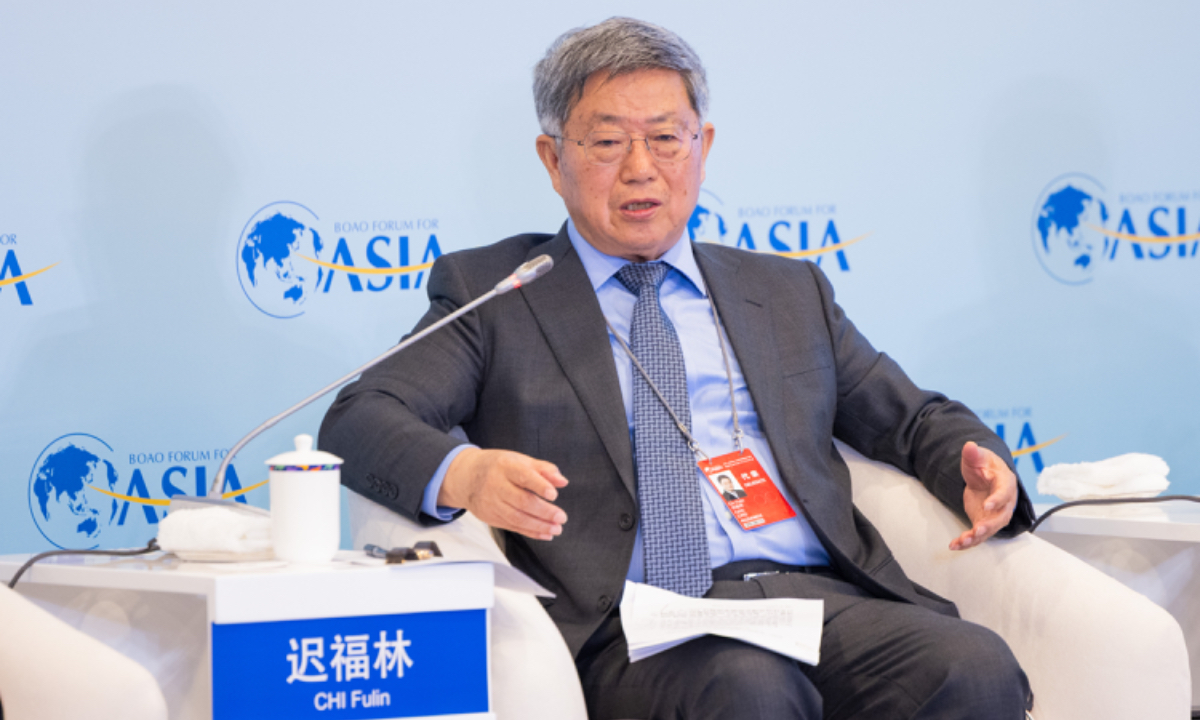
Chi Fulin Photo: VCG
As China advances toward high-standard opening-up, building a key gateway to drive the country's opening up in the new era, is central to the Hainan Free Trade Port (FTP) strategy. It is not only a major national initiative but also Hainan's historical responsibility. The launch of island-wide special customs operations on December 18 this year serves as a landmark move by China to unwaveringly expand high-standard opening up and promote the development of an open global economy.
The launch of the island-wide special customs operations represents the Hainan FTP's full transition from its initial start-up phase to substantive operation, marks its shift from policy piloting to full institutional implementation, and marks the transition from experimenting with innovative customs supervision models to establishing a special customs supervision zone - opening a new chapter in building the highest-standard form of opening-up.
Today, China is promoting Chinese modernization through a new round of comprehensive reform. Against this background, Hainan's special customs operations reflect China's determination to push forward reform and opening-up from a higher starting point, using high-standard opening-up to shape a renewed landscape for deepened reform.
As global markets become increasingly fragmented, strengthening the Hainan FTP's role in market connectivity, rule alignment and industrial coordination has become essential. Leveraging its position as a hub, Hainan can help advance regional free trade and safeguard stable and secure industrial and supply chains. In a global economy undergoing accelerated restructuring, the advancement of special customs operations - together with more liberalized and facilitative trade and investment policies - enables Hainan to promote cooperation through opening-up, deepen regional integration, and evolve into a critical intersection linking domestic and international markets, regulatory systems, and industrial networks.
China now possesses the world's largest and most dynamic market, with a population of over 1.4 billion and more than 400 million middle-income earners. By steadily expanding self-directed and unilateral opening-up, China aims to share the opportunities from its domestic market with the world. In this context, the Hainan FTP's launch of island-wide special customs operations enables global investors to access China's vast market more conveniently and share more fully in China's development opportunities, while also helping to attract high-quality production factors and enhance the efficiency of domestic circulation.
Gateway for opening-up
Hainan lies along major international shipping and aviation routes and serves as one of the most important maritime corridors linking the Asia-Pacific with other regions. More than 94 percent of China's foreign trade and over 60 percent of ASEAN's trade rely on maritime transport, with around 65 percent of China-ASEAN trade moving by sea. The Hainan FTP is well placed to become a strategic hub for advancing China-ASEAN blue economy cooperation, contributing to regional development needs and supporting the security and stability of industrial and supply chains.
With special customs operations now in effect, the Hainan FTP will refine a special customs supervision regime featuring "freer access at the first line, regulated access at the second line, and free circulation within the island." It will take the lead in implementing unilateral opening measures toward ASEAN and develop into a key platform for strengthening economic, trade and cultural ties, playing a demonstrative role in advancing China-ASEAN cooperation.
As global free trade momentum weakens and regional integration accelerates, the Asia-Pacific -driven by the Regional Comprehensive Economic Partnership (RCEP) - has emerged as a bright spot in regional cooperation. In line with this trend, strengthening trade and investment arrangements under RCEP will be crucial for China to maintain strategic initiative. Leveraging the combined effect of the FTP's zero-tariff policy and RCEP's tariff reductions will expand scope for goods trade with RCEP economies. Meanwhile, using the FTP's high-standard opening-up as a pressure test can promote closer alignment of rules and service systems, creating the conditions for smoother customs clearance, freer flows of production factors, and deeper integration across sectors including agriculture, tourism, healthcare, finance, cultural services, logistics, duty-free retail and high-tech industries.
Hainan will further strengthen its role as a strategic regional hub in two major dimensions. It will become a regional center for high-quality production factors - capital, talent, and technology - supporting China's industrial and supply chain security and enabling the island to seize opportunities from global technological transformation. It will also act as a key connector of a China-ASEAN blue economy common market, supported by enhanced maritime infrastructure connectivity, marine industrial integration, and development of a pan-South China Sea free trade network.
Advancing high-standard development
Building the Hainan FTP to a high standard requires accelerating the development of a modern industrial system. Addressing the island's longstanding weakness in industrial foundations will demand a services-led approach, a strong focus on cultivating industrial chains, and a clear orientation toward internationalization. By fully leveraging policy advantages and resource endowments, Hainan aims to establish by 2030 a modern industrial system featuring distinctive local strengths and strong international competitiveness, oriented toward ASEAN markets while serving the mainland.
A second priority in advancing high-standard development is making substantive progress in port-bay integrated development. Financial cooperation between Hainan and the Guangdong-Hong Kong-Macao Greater Bay Area will serve as a key breakthrough, driving industrial integration and strengthening regional synergy in building a major gateway for opening-up. Early gains from financial liberalization are expected to support closer integration between the Hainan FTP and the Pearl River Delta in areas such as tropical agriculture, the marine economy and high-tech industries, while fostering a number of port-bay cooperation demonstration platforms.
A third key task is to develop a market system built around two "headquarters bases": one for Chinese enterprises targeting ASEAN markets, and the other for international - particularly ASEAN - companies using Hainan as a base to enter China. The clustering of headquarters generates strong cooperation demand, efficient networks and internationalized service systems. Leveraging its special customs operations, the Hainan FTP is accelerating the creation of a highly liberalized and convenient financial environment and a competitive tax regime, laying the foundation for a robust headquarters economy.
The author is the President of Hainan Institute for Free Trade Port Studies (HIFTPS).
RELATED ARTICLES