'A forward-looking China offers more than growth; it provides a sense of tomorrow': Brazilian scholar at Global Times Annual Conference
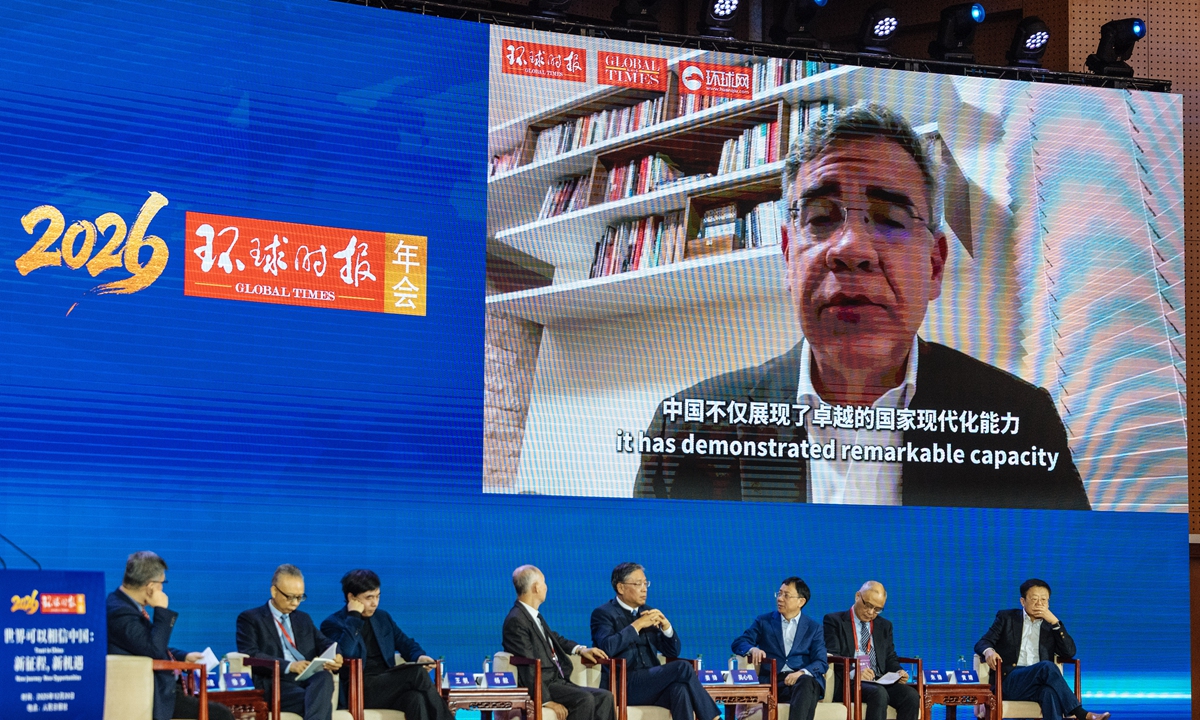
Brazilian scholar Evandro Menezes de Carvalho delivers a video address at the Global Times Annual Conference 2026 on December 20, 2025, in Beijing. Photo: Li Hao/GT
The Global Times Annual Conference 2026 took place in Beijing on Saturday, under the theme of "Trust in China: New Journey, New Opportunities." During the discussion on the topic "A forward-looking country: how important is 'predictability' to the world," Evandro Menezes de Carvalho, International Law Professor at Fluminense Federal University, Brazil and recipient of the Chinese Government Friendship Award, stated that for the world, China's predictability is transformative, enabling international partners to plan, align strategies, invest in infrastructure, and collaborate on technology without fear of abrupt policy reversals.
The following is the full text of Carvalho's remarks:
In times of growing geopolitical fragmentation, global anxiety, and uncertainty about the future, few countries have been able to articulate a coherent vision of development, stability, and long-term planning. China stands among them. In the past four decades, it has demonstrated remarkable capacity not only to pursue national modernization, but also to do so in a way that resonates globally - especially with developing nations seeking alternative development paths. The question, then, is not merely why China is a forward-looking country, but why its certainty and predictability matter so much for the world today.
To understand this, we must first recognize that China's development has not been accidental or improvised. It has been the result of strategic planning, institutional continuity, and a civilizational mind-set that looks beyond electoral cycles and short-term political fluctuations. The five-year plans - coming to their 15th cycle - are perhaps the most visible expressions of this forward-looking approach. They offer society a long-term compass, combining economic priorities, technological innovation, social goals, and environmental commitments. While many countries struggle to articulate development agendas for the next five years, China is often discussing those for the next 30.
This long-range horizon is not unique to contemporary China; it is embedded in its history. Chinese civilization has always valued continuity, balance, and the dialectical capacity to adapt tradition to modernity. The reforms launched in 1978, the concept of socialism with Chinese characteristics and the ongoing modernization drive reveal something deeper: China moves forward not by denying the past, but by building on it. In a world marked by the volatility of populist politics, China's governance model stands out as a source of consistency and reliability.
The global importance of this stability becomes even more evident when one considers the pressures affecting the current international system. Economic nationalism is rising. Protectionism is returning. Multilateral organizations created after World War II face a legitimacy crisis. The world's largest economies face strategic competition amid increasing tensions. Under such circumstances, the ability of a major global actor to maintain clarity of purpose is not merely desirable; it is essential.
Where others see crises, China often sees opportunities for restructuring cooperation. While some countries resort to sanctions, decoupling, and containment strategies, China promotes initiatives such as the Global Development Initiative, the Global Security Initiative, the Global Civilization Initiative, and, recently, the Global Governance Initiative. These proposals are not isolated programs; they reflect an integrated vision of development, security, and cultural coexistence aiming to reform the international order. All of them are based on a vision that seeks mutual benefit rather than hegemony. As global governance transforms, China helps build new platforms, not walls.
For the world, China's predictability is transformative, enabling international partners to plan, align strategies, invest in infrastructure, and collaborate on technology without fear of abrupt policy reversals. This is why the world watches China not with passive interest, but with expectation. A forward-looking China offers more than growth; it provides a sense of tomorrow. And in a world desperate for hope, confidence, and direction, China's long-range vision is a global public good.
RELATED ARTICLES