China's resolve comes from strength and confidence: Chinese scholar Jiang Feng at Global Times Annual Conference
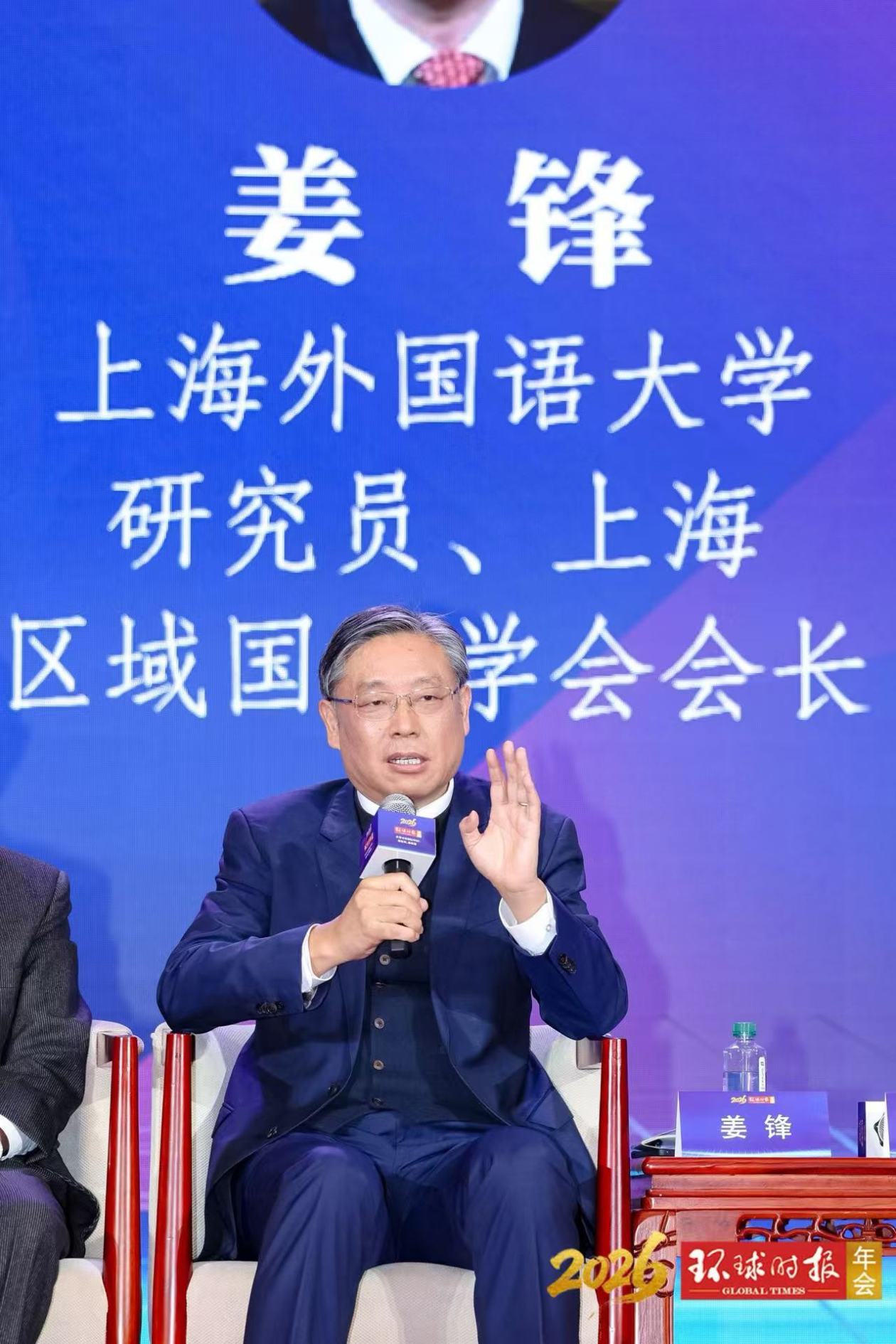
Jiang Feng, researcher at Shanghai International Studies University and president of the Shanghai Regional Studies Association. Photo: Global Times
On Saturday, the Global Times Annual Conference 2026, themed "Trust in China: New Journey, New Opportunities," was held in Beijing. During a discussion on the topic "A forward-looking country: how important is 'predictability' to the world," Jiang Feng, a researcher at Shanghai International Studies University and president of the Shanghai Regional Studies Association, said that China's resolve comes from its strength and confidence, and the world can trust China.
Some European countries have adopted a so-called "de-risking" strategy toward China, but in the process, China still views Europe as a very important strategic partner, believing that the cooperation between the two sides outweighs the challenges. "I believe China's resolve comes from its strength, and this is very important," he said.
In 2025, Jiang conducted field research in several European countries, engaging with people from various sectors. He observed that Europe generally lacked confidence. "When there is a lack of confidence, it becomes difficult for Europe to trust other countries, and this is reflected in their foreign relations," he explained. Jiang also mentioned that Europe had once believed that China lacked innovation, seeing it only as imitating European countries in producing cars, with no "originality." However, now China not only produces "original" cars but the quality of its electric vehicles even surpasses those of Europe. He pointed out that Europeans have realized that their previous judgment about China's innovation and competitiveness was a strategic miscalculation, and now they are reeling from this realization. Currently, resolving issues of shared interests between China and Europe, as well as addressing the decreasing complementarity and increasing competition between them, are of strategic significance and form the essential foundation for the "new journey, new opportunities" between China and Europe.
Jiang also mentioned that some European media outlets have proposed learning from China in the second half of this year. In the early 21st century, when China's economy was rapidly developing, countries like Germany suggested that "learning from China means learning success." Now, however, "learning from China" means change — for example, reducing bureaucratic governance models. Philosopher Jürgen Habermas believes that Europe's governance model is no longer suitable for the times and fails to solve global issues, with China potentially serving as a model for Europe to learn from. "The world can trust China, and one key reason is China's confidence. China can transmit this confidence to Europe and the world, bringing confidence to others," he said. "To do this, we need to better and more systematically understand the world. Believing in China means having mutual confidence and trust," he added.
RELATED ARTICLES