'China's stability and predictable policy trajectory serve as an important anchor for global economy and intl collaboration': Malaysian scholar at Global Times Annual Conference
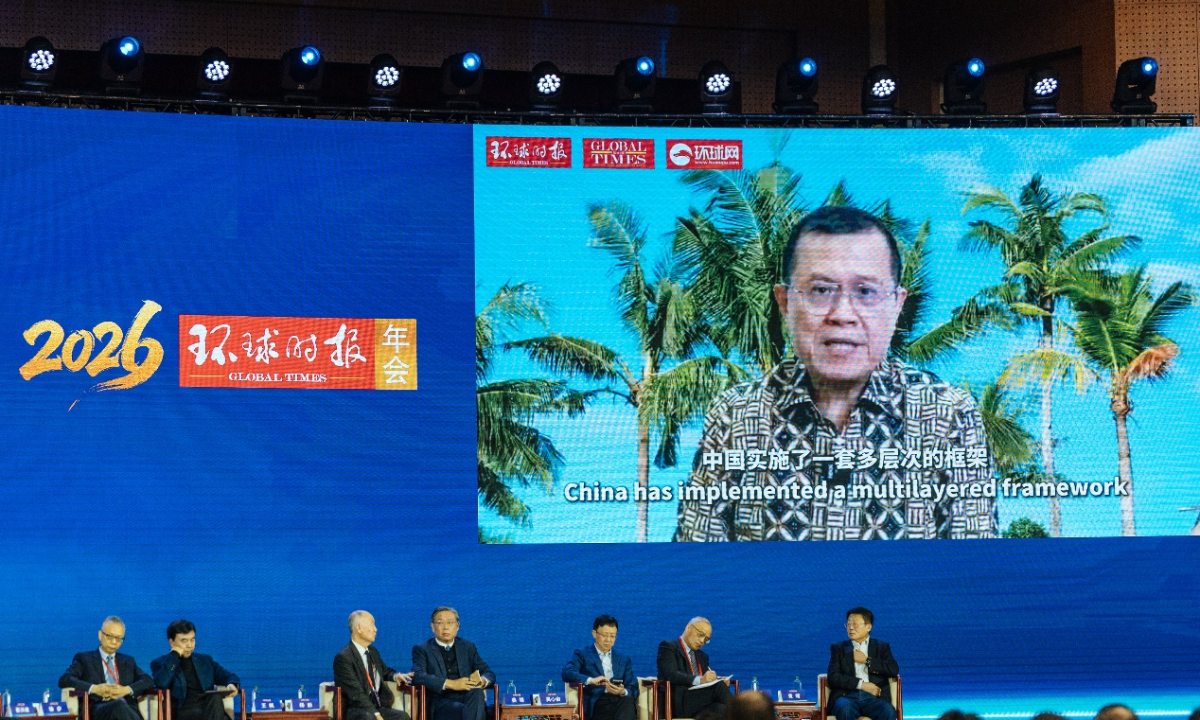
Former Malaysian minister of transport Ong Tee Keat delivers a video address at the Global Times Annual Conference 2026 on December 20, 2025, in Beijing. Photo: Li Hao/GT
The Global Times Annual Conference 2026 took place in Beijing on Saturday, under the theme of "Trust in China: New Journey, New Opportunities." During the discussion on the topic "A forward-looking country: how important is 'predictability' to the world," Ong Tee Keat (OTK), president of the Belt & Road Initiative Caucus for Asia Pacific and former Malaysian minister of transport, stated that China's forward-looking approach to statecraft has become a critical source of certainty and predictability in a world marked by increasing volatility.
The following is the full text of OTK's remarks:
China's forward-looking approach to statecraft has become a critical source of certainty and predictability in a world marked by increasing volatility. This resilience stems from a distinctive governance model, rooted in long-term development planning.
For decades, China has implemented a multilayered framework that enables efficient resource allocation, clearly defined development priorities, and consistent policy continuity. A notable example is the articulation of the two centenary goals: building a moderately prosperous society by 2021 and transforming China into a modern socialist country by 2049.
China's long-term sustainability is anchored in the continuity of its five-year plans, which together form an interlinked chain of accumulation, refinement, and strategy upgrades. This continuity has played a central role in driving the nation steadily toward its overarching developmental and strategic objectives.
While each five-year plan identifies priorities tailored to contemporary national needs, and increasingly to future challenges, the planning mechanism remains agile. It can respond to near-term issues with solutions that remain aligned with long-horizon goals. Implementation pathways are adaptable and self-correcting, guided in large part by feedback gathered continuously from multiple layers of society in an era of mounting uncertainties.
China's stability and predictable policy trajectory serve as an important anchor for the global economy and international collaboration. As the major trading partner for over 140 countries and regions, China's comprehensive industrial value chains and robust manufacturing capabilities provide reliability in a rapidly shifting global supply chain landscape. Its vast production ecosystem helps cushion global disruptions and offers a dependable platform for trade.
As an industrial power, China's commitment to addressing global challenges, most notably its pledge to achieve carbon neutrality by the year 2060, demonstrates its role as a predictable and constructive partner in climate governance. Its aggressive expansion of renewable energy and clean technologies underscores its long-term dedication to sustainable development.
Furthermore, through infrastructure financing, technological cooperation, and capacity-building initiatives, China continues to extend long-term development support to the Global South. These initiatives contribute to enhanced connectivity, improved industrial capabilities, and broader economic opportunities across much of the developing world.
China's visionary planning thus brings not only domestic stability, but also greater certainty to the international system. At a time when global unpredictability is at historic highs, China's steady governance model and strategic consistency offer a stabilizing force economically, technologically, and geopolitically.
RELATED ARTICLES