China's four global initiatives ‘both a response to and an accelerator of a world seeking a more balanced intl order’: Egyptian expert at Global Times Annual Conference
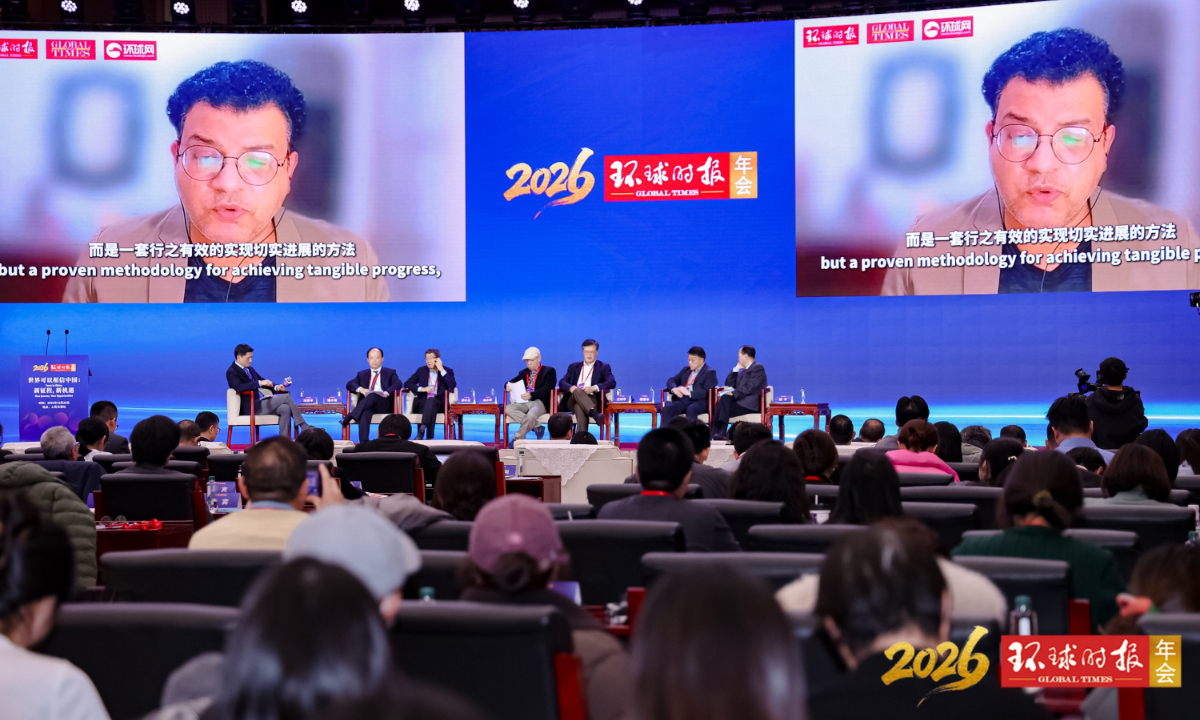
Egyptian expert Ahmed Moustafa delivers a video address at the Global Times Annual Conference 2026 on December 20, 2025, in Beijing. Photo: Global Times
The Global Times Annual Conference 2026 took place in Beijing on Saturday, under the theme of "Trust in China: New Journey, New Opportunities." During the discussion on the topic "A civilizational country: why the Chinese approach is the most implementable," Ahmed Moustafa, director and founder of the Asia Center for Studies & Translation in Egypt, stated that the secret behind the resilience and successful implementation of the four Chinese global initiatives is their alignment with an undeniable global trend, which is multipolarity. Those initiatives are both a response to and an accelerator of a world seeking a more balanced international order, he added.
The following is the full text of Moustafa's remarks:
China's four global initiatives, namely the Global Development Initiative, Global Security Initiative, Global Civilization Initiative, and Global Governance Initiative, aim to meet the development needs of the Global South and offer a "win-win" framework that allows countries to participate based on their own priorities. This adaptable approach encourages broad acceptance and ensures long-term support. By emphasizing consultation and cooperative efforts, China promotes shared benefits and local ownership, which improves the likelihood of successful and sustainable project implementation across various nations.
The four initiatives' philosophical bedrock in win-win cooperation and shared future provides a compelling, inspirational alternative to zero-sum geopolitics. This vision of inclusive globalization, where progress is not a privileged commodity but a shared pursuit, resonates deeply with the Global South, offering a collaborative model of engagement that stands in stark contrast to historical paradigms of dominance and conditionality.
China's own unprecedented developmental success, lifting 800 million people out of poverty, serves as a powerful, empirical case study. This demonstrated capacity for rapid, large-scale modernization lends immense credibility to its proposed global frameworks. Specialists see not just ideology, but a proven methodology for achieving tangible progress, making the initiatives inherently more attractive and implementable.
The strategic integration of the Global Development Initiative, Global Security Initiative, Global Civilization Initiative, and Global Governance Initiative creates a powerful synergistic effect, recognizing that the world's most pressing challenges are inherently interconnected and cannot be addressed in isolation. They form a cohesive framework where the Global Development Initiative, supported by over 100 countries and international organizations, provides the material foundation for lasting security, while security ensures the stable environment necessary for sustainable development. This symbiotic relationship is further elevated by the Global Civilization Initiative, which fosters mutual learning and dialogue to build the cross-cultural understanding essential for cooperative global governance. Instead of operating as siloed endeavors, these initiatives function as mutually reinforcing pillars, collectively offering a comprehensive Chinese vision for a more peaceful, prosperous, and inclusive global community, demonstrating a holistic approach to building a shared future for humanity.
The focus on non-ideological, pragmatic solutions allows for broad-based coalitions. By prioritizing infrastructure connectivity, poverty alleviation, and counter-terrorism - universal challenges that transcend political systems - China's frameworks create a big tent. This pragmatism avoids the divisiveness of values-based conditionality, enabling cooperation between nations with differing domestic policies on a common platform of development and security.
Ultimately, the secret behind the resilience and successful implementation of the four Chinese global initiatives is their alignment with an undeniable global trend: multipolarity. They are both a response to and an accelerator of a world seeking a more balanced international order. By offering a practical architecture for this transition, they empower a wider range of states to shape outcomes, ensuring their relevance and resilience as the foundations of 21st-century global governance are being laid.
RELATED ARTICLES