China is a ‘great enabling power’: Australian scholar at Global Times Annual Conference

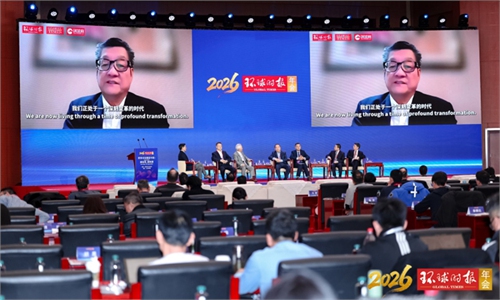
Australian scholar Warwick Powell delivers a video address at the Global Times Annual Conference 2026 on December 20, 2025, in Beijing. Photo: GT
The Global Times Annual Conference 2026 took place in Beijing on Saturday, under the theme of "Trust in China: New Journey, New Opportunities." During the discussion on the topic "A symbiotic country: new explorations in how major countries interact with their neighbors," Warwick Powell, an adjunct professor at the Queensland University of Technology and former advisor to former Australian prime minister Kevin Rudd, stated that China is a "great enabling power," creating conditions in which others can thrive alongside China.
The following is the full text of Powell's remarks:
What if countries didn't see themselves as isolated actors locked in competition with each other? What if they saw themselves as fundamentally connected, where the fate of one is linked to the fate of all? This is how China approaches its relations with its neighbors, a symbiotic perspective, rooted in connection, not separation.
In much of Western thought, international relations are Hobbesian. Countries are imagined as autonomous, self-interested actors constantly weighing gains and losses in a zero-sum game. Rationality, in this view, is an assumption - a starting point.
China takes a different approach. At its core is the idea that nations and the people within them are connected at the root. Security, prosperity, and stability are seen as indivisible. Interests are not pre-given; they emerge through relationships.
This is expressed in the guiding principles of Chinese diplomacy - amity, sincerity, mutual benefit, and inclusiveness. These are not empty slogans. They shape a worldview where cooperation is strategic, long-term, and relational.
Let me give you a few concrete examples. First, the Belt and Road Initiative in Southeast Asia. Projects like transport corridors linking multiple countries are designed not as unilateral investments, but as partnerships. They provide shared economic benefits, create jobs, and improve connectivity. This is mutual benefit in action.
We also see collaboration in areas of health and health services through the provision of health services and technologies and broadly, health cooperation. China helps neighbors tackle urgent public health challenges. These actions demonstrate amity and sincerity. They build trust and practical interdependence, reinforcing the idea that one nation's well-being is linked to that of its neighbors. Even beyond health and infrastructure, China has engaged in humanitarian aid and trade facilitation during regional crises, further showing how relational thinking guides practical policy.
So why does this matter? It matters because China's approach reshapes how we think about power. China conceptualizes its national interests not in isolation, but through its relationships. It avoids forming rigid blocs, preferring stability and cooperative frameworks that benefit multiple countries.
This is what I mean when I describe China as a "great enabling power." It's a persona built on enabling neighbors and regional stability, creating conditions in which others can thrive alongside China.
Let me be clear: symbiosis does not mean weakness. It is strategic, deliberate, and long-term. Power is expressed not only through coercion - which is a typical Western frame - but also through the ability to enable others whilst safeguarding your own interests.
In a world often defined by competition and zero-sum thinking, China's symbiotic approach offers a different lens - one where nations are connected, security is shared, and prosperity emerges through cooperation. Understanding this is essential for engaging with China today, because at the root, China's vision reminds us that our futures are intertwined. And the strongest way forward is often together.
RELATED ARTICLES