Global Times hosts forum on rural revitalization
Gen-Z from rural China aspire to revitalize agricultural civilization
By and Ni Hao Published: Dec 21, 2025 10:34 PM

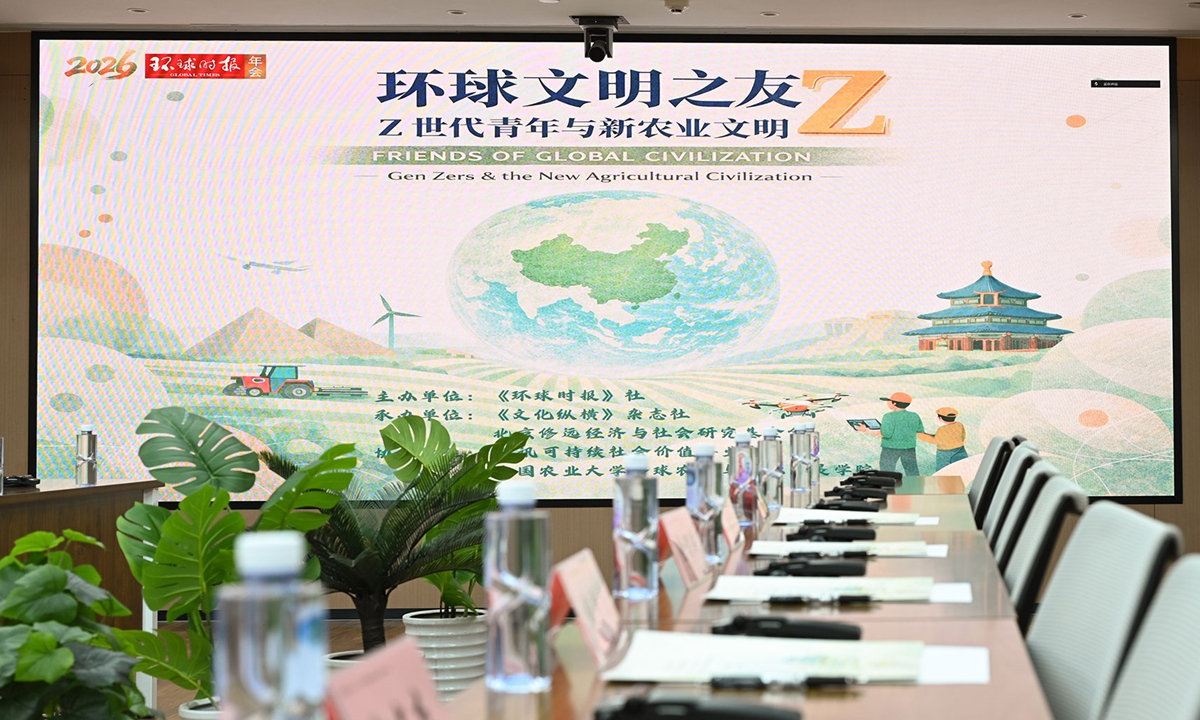
A sub-forum of Global Times Annual Conference 2026 takes place on December 21, 2025 in Beijing under the them of "Friends of Global Civilization: Generation-Z Youth and the New Agricultural Civilization." Photo: Chen Tao/GT
The Global Times Annual Conference 2026 sub-forum, with the theme "Friends of Global Civilization: Generation-Z Youth and the New Agricultural Civilization," took place in Beijing on Sunday.
Hosted by the Global Times and co-organized by Culture Review magazine and the Beijing Xiuyuan Foundation for Economic and Social Research, the forum attracted global participants to discuss "rural revitalization and agricultural civilization from the contemporary youth perspective" as well as "new agricultural practices by young returnees to the countryside."
"When viewed from a longer historical cycle and broader geographical perspective, the story of human civilization largely reflects agricultural evolution. When we talk about agriculture, we are actually talking about civilization. Amid the wave of cutting-edge technologies like the internet, big data, artificial intelligence and biotechnology, a new agricultural civilization characterized by 'intelligent agents' is surging forward," said Bai Long, a deputy editor-in-chief of the Global Times, at the forum.
As a result, "the boundaries of agriculture are being vastly expanded and reshaped: It is no longer just a 'factory' producing food, but also a 'base' generating clean energy; it provides not only biomass and agrivoltaic 'green power,' but also serves as an 'ecological tool' maintaining mountains and waters, while acting as a 'data hub' rich in information. This is a grand scenario of multidimensional integration and multiplied value," he added.
For the innovative and dynamic Generation-Zers, this represents fertile ground for bold endeavors. The new agricultural civilization calls precisely for the creativity, exploratory spirit, and a sense of responsibility from the younger generation, Bai said.
Lian Si, a vice president of the China Youth University for Political Sciences, highlighted at the forum that returning to rural areas to revitalize villages has become a proactive choice for many contemporary young people, and Gen-Z's renewed encounter with agricultural civilization is a key internal link in China's modernization.
"Chinese-style modernization does not simply replicate the Western industrialization path; it emphasizes coordinated urban-rural development, harmony between humans and nature, and balanced material and spiritual progress. In this process, youth are both influenced and active constructors," Lian said.
Scholars attending the forum discussed new rural industry formats and values, showcasing through case studies how cultural sports, wellness, ecology and digital products in rural areas are activating county-level economies.
Zhang Mingtao, dean of the Rongjiang County Village Super League Research Institute, shared how the viral "Village Super League" (Cunchao) brand has created new paths, becoming a vivid model for rural construction in China.
Cunchao in Guizhou is a village football tournament organized and played in by local residents themselves. Since its kick-off on May 13, 2023, the event has become a phenomenal cultural and tourism IP in China. Rongjiang's Cunchao has achieved explosive popularity despite the long, challenging journey of this small county.
In Zhang's view, Cunchao exemplifies the awakening of rural cultural confidence and the reevaluation of rural resource value in the new media era.
On-site young "village CEOs" from various regions also shared stories of their practices, illustrating the fresh sparks ignited by their collision with the modernized countryside.
As one of the 17 new occupations released by China's Ministry of Human Resources and Social Security in August, rural collective economy managers - commonly known as "village CEOs" - are becoming a key path for young people to contribute to rural revitalization.
"From one person's faint light to a group's blazing sparks" is how Jia Youling, one of "village CEOs" trainees from Zhongping village in Liuzhou, Southwest China's Guangxi Zhuang Autonomous Region, described the trend of young people joining as village CEOs and realizing their dreams.
Lian told the Global Times that today's Gen-Zers are different from previous ones; they are not inherently "detached from the land." They may be the first youth cohort in China's modernization to reexamine agricultural civilization's value amid high modernization. This reevaluation is a practical exploration amid pressures of modernity and existential anxiety.
China's youth-driven rural revitalization and poverty alleviation experiences have also inspired many international students who are studying and practicing in China.
Pedro Henrique Pio Nascimento from Spain, who was deeply impressed by his rural inspection in Northwest China's Yunnan Province, said "I've witnessed the living results of China's rural revitalization commitment. In villages like Hebian, coordinated policies, academic support and sustained funding transformed an impoverished community into a model of sustainable prosperity within 15 years, thriving on agriculture and tourism while preserving the minority ethnicity's cultural heritage."
"It powerfully embodied 'common prosperity' as tangible reality, dismantling my preconceptions and showing rural areas as the foundation of a modern, harmonious civilization," he told the Global Times.
The forum's significance lies in exploring the objective laws governing youth participation in rural revitalization in 21st-century China, with the goal of replicating the monumental opportunities of reform and opening-up in rural areas over the next 20-30 years, and where village CEOs are pioneers charting the path, Yang Ping, head and editor-in-chief of the Beijing Cultural Review, concluded at the end of the event. "Through research and interaction, we aim to identify the laws that will guide this new wave."
RELATED ARTICLES