An empowering country: What global dividends will the 15th Five-Year Plan deliver
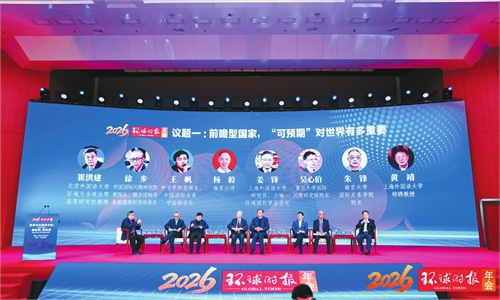
The Global Times Annual Conference 2026 is held in Beijing on December 20, 2025. Photo: GT
Editor's Note:
The Global Times Annual Conference 2026 took place in Beijing on Saturday, under the theme "Trust in China: New Journey, New Opportunities." This year's conference brought together more than 100 authoritative experts and scholars from political, academic and business circles, both domestically and internationally, to decode the logic of China's development and explain why "trust in China" is increasingly becoming an international consensus. This page highlights key points from the experts' speeches and discussions during the second panel of the conference, titled "An empowering country: What global dividends will the 15th Five-Year Plan (2026-30) deliver."
China's opportunities are global dividends
Li Junru, former vice president of the Party School of the Communist Party of China Central Committee
During the 15th Five-Year Plan period, China will continue to advance high-level opening-up and accelerate the cultivation and growth of new quality productive forces.
The first dividend China is releasing comes from opening-up. On December 18, the Hainan Free Trade Port officially launched island-wide special customs operations, representing "the greatest momentum, the greatest opportunity and the greatest dividend" that China will bring to the world during the 15th Five-Year Plan period.
The second dividend lies in China's high-level market economy during the 15th Five-Year Plan period. A series of major policy measures will attract more foreign investment into China, encourage reinvestment in production and operations and generate new drivers of growth.
The third dividend is the development of China's new quality productive forces, which will provide strong momentum for global economic growth.
The fourth dividend is China's social and political stability. At a time of global turbulence, a safe and stable China will attract more capital.
Robert Lawrence Kuhn, chairman of The Kuhn Foundation
The 15th Five-Year Plan sets the goals of "building a modernized industrial system," reinforcing the "real economy," and achieving "Chinese modernization" — all by prioritizing high-quality development, new quality productive forces, strategic industries, and scientific and technological self-reliance. China's ambition is stunning, and it would be a historic error to bet against China.
What are the implications for the international community? China's economic success domestically enables larger investments internationally, especially through its Belt and Road Initiative to build infrastructure in developing countries, and its Global Development Initiative that provides economic and social programs, such as business support, education and healthcare. China places more and more importance on trade being balanced and building local industry. Moreover, China's economy will import more foreign products and services.
John Ross, former director of economic and business policy for the mayor of London
Quantitatively, on IMF projections for the plan's period, China will make the world's largest contribution to global growth.
During the last five-year plan, China moved from being an international technological follower to achieving technological leadership in a major series of industries - EVs, drones, solar energy, wind power, key areas of telecommunications, expanding sectors of pharmaceuticals, batteries, increasingly significant areas of AI and others. Macro-economic fundamentals make clear this range of industries will expand significantly during the 15th Five-Year Plan.
China entered the 14th Five-Year Plan in 2021, primarily as a supplier of medium-technology goods, but it is leaving the period as the technological leader in an increasing number of economic sectors. The same macroeconomic processes mean this will expand further during the 15th Five-Year Plan.
The determination and confidence to expand opening-up remain unwavering
Cui Weijie, vice president of Chinese Academy of International Trade and Economic Cooperation
What the world needs most is certainty in development and opening-up. China, with its advantages in market size, industrial strength, opening-up and human resources, can play a key role in providing that certainty.
China is the main trading partner for more than 150 countries and regions. It has remained the world's largest goods trader for eight consecutive years, and maintains a leading position in outbound investment. These figures demonstrate that China has a solid foundation for staying open. While some countries have adopted deglobalization measures, China has consistently upheld the principle of opening-up.
From the multilateral and regional perspectives, China upholds the multilateral trading system while actively negotiating large-scale free trade agreements. It has unswervingly expanded opening-up on its own initiative, such as by establishing pilot free trade zones. By actively safeguarding multilateral economic and trade rules, China has injected greater certainty into the world. By continuously broadening independent opening-up, China's capacity and level of participation in global open cooperation has been further enhanced.
Zhang Yiwu, a professor in the Department of Chinese Language and Literature at Peking University and director of its cultural and arts committee
Although China's political and economic relations with the Western world have been highly complex, multiple surveys conducted in Western countries in 2025 revealed a notable rise in favorability toward China - particularly in terms of awareness and recognition of Chinese culture - an unprecedented phenomenon.
Behind these contrasts, two positive trends are worth noting: China is driving opening-up with a strong cultural foundation, bringing new development opportunities to the global cultural industry; and the image of "Cool China" is taking shape worldwide.
Since the beginning of this year, the trend of foreign influencers "witnessing China" has allowed more ordinary people in the West to see the real China, breaking down past barriers and distortions in Western perceptions of the country. The image of "Cool China" will influence various aspects of China's politics, economy and more. In the next five years, we are likely to witness a grand cultural wave, bringing immense prospects and opportunities.
Expanding domestic demand is the key to economic development
Zhang Jun, dean of the School of Economics at Fudan University
Examining China's development path from a global perspective reveals a highly distinctive catch-up model — a major country successfully adopting the export-oriented strategy employed by small open economies like the four "Asian Tigers."
By 2035, expanding domestic demand will be key to China's economic development. Currently, both the business community and government departments have shifted their focus to domestic demand issues, particularly enhancing consumption demand, achieving fairer income distribution, and increasing the share of labor compensation, which calls for a necessary adjustment in the development model.
Yuan Xin, professor of the School of Economics at Nankai University and vice president of the China Population Association
As China's population continues to age at an accelerating pace, the entire economic development model, growth drivers and structural framework must undergo a comprehensive and profound "elder-friendly" transformation. As a vital growth engine for high-quality development, the silver economy must extend beyond elder-related industries and elderly care services. In the future, as China's demographic landscape undergoes significant changes, the elderly population will account for 30 percent to 40 percent of the total population, forming a massive potential market.
At the macro level, economic development models, drivers and structures must undergo a comprehensive "elder-friendly" revolution and reform. At the meso level, the development of elder-related industries and services - such as pension, healthcare, elderly care service and long-term care systems within the social public policy framework - requires robust wealth support from sustainable economic growth to better empower elder-related initiatives. At the micro level, every individual must engage in long-term asset allocation and retirement savings during the period in which they can generate wealth to prepare for their later years. This represents a long-term wealth management process.
Liu Hui, director of JD.com's Consumption and Industry Development Research Institute
This year, Chinese companies are broadly facing external challenges, including international decoupling and supply chain localization. Stability has thus become a core priority for many businesses and nations. At the same time, companies are striving to avoid low value price competition, instead aiming to foster collaboration that can enhance efficiency and drive high quality development throughout the industrial chain. In this context, JD.com has introduced the concept of a "super supply chain," which is backed by intelligent supply chain infrastructure and technological innovation. This spans various links in manufacturing, distribution, consumption, services and even finance, creating cost reductions and efficiency gains across the entire industry. In the future, we can also export China's "super supply chain" capabilities, driving high-quality development alongside neighboring countries and partners.
Regarding the complex situations faced by Chinese manufacturing enterprises when expanding overseas or entering emerging markets, JD.com has developed the "accompanying overseas " approach. Through product standardization and the digitalization of the supply chain, capable local enterprises can gradually integrate into the Chinese supply chain system. This process not only promotes the improvement of supply chain levels and the development of industrial ecosystem in developing countries and regions, but also breaks the "zero-sum game" and achieves mutual growth through "future-oriented development."
RELATED ARTICLES