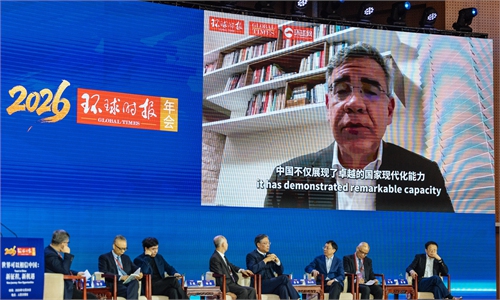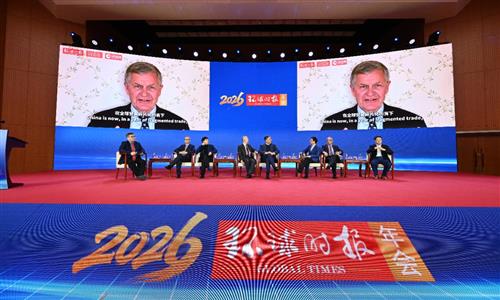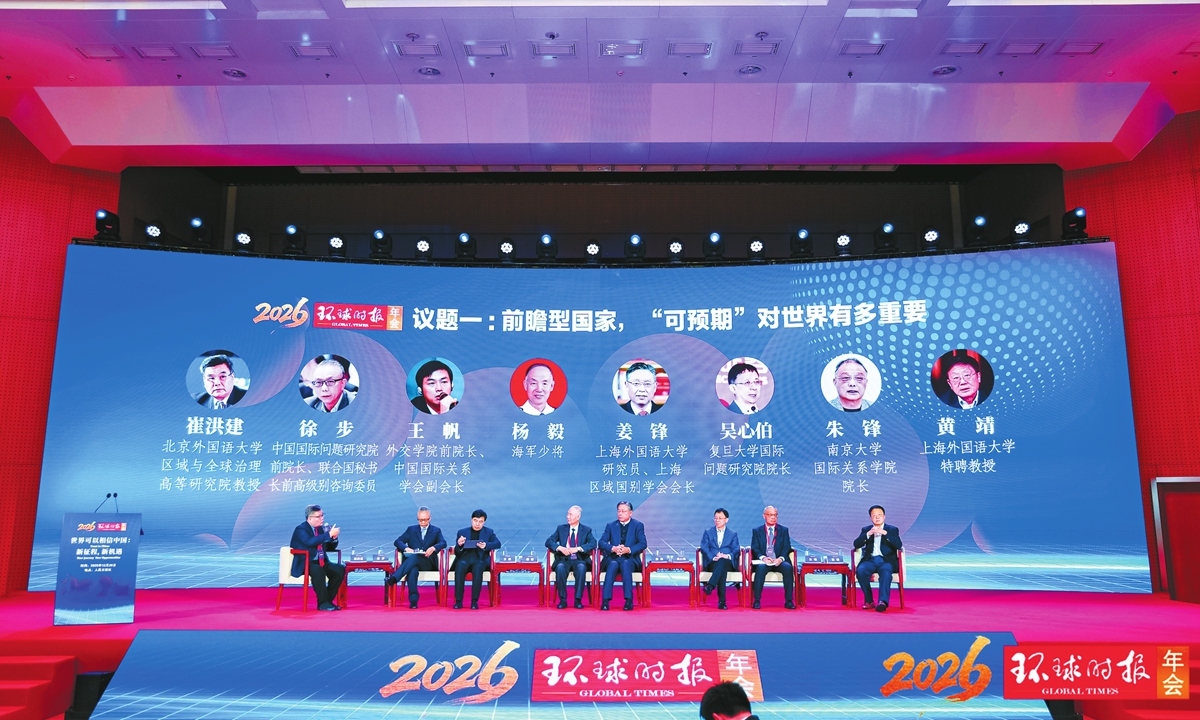
Scholars discuss on the topic "A forward-looking country: how important is 'predictability' to the world" at the Global Times Annual Conference 2026 on December 20, 2025, in Beijing. Photo: Li Hao/GT
Editor's Note:
The Global Times Annual Conference 2026 took place in Beijing on Saturday, under the theme "Trust in China: New Journey, New Opportunities." This year's conference brought together more than 100 authoritative experts and scholars from political, academic, and business circles, both domestically and internationally, to decode the logic of China's development and explain why "trust in China" is increasingly becoming an international consensus. This page highlights key points from the experts' speeches and discussions during the first panel of the conference, titled "A forward-looking country: How important is 'predictability' to the world."
How China has become a typical forward-looking country
Xu Bu, distinguished professor at Jiangsu University and former member of the United Nations Secretary-General's High-Level Advisory Board on Effective Multilateralism
Today's world is marked by three defining features: fragmentation, instability and uncertainty. In this context, the qualities demonstrated by a forward-looking country, along with the predictability inherent to it, are of great significance for world peace, stability and development.
As a representative example of a forward-looking country, China has made active contributions to global peace and development. Chinese modernization has created a new form of human civilization, offering an alternative path for other countries - particularly those in the Global South - and injecting an important stabilizing force into an increasingly turbulent world. China has become a firm defender of world peace, a major contributor to global development and an important leader in global governance.
Evandro Menezes de Carvalho, international law professor at Fluminense Federal University, Brazil, and recipient of the Chinese Government Friendship Award
The five-year plans - coming to their 15th cycle - are perhaps the most visible expressions of forward-looking approach. They offer society a long-term compass, combining economic priorities, technological innovation, social goals and environmental commitments.
This long-range horizon is not unique to contemporary China; it is embedded in its history. Chinese civilization has always valued continuity, balance and the dialectical capacity to adapt tradition to modernity. In a world marked by the volatility of populist politics, China's governance model stands out as a source of consistency and reliability.
Erik Solheim, former under-secretary-general of the UN and former executive director of the UN Environment Programme
In 2025, the world experienced a lot of global turbulence, but over the past year, China has emerged as a force for global stability. China is the total dominant force in the green economy, accounting for 60 percent or more of solar, wind, hydropower, electric cars, electric batteries, metros, high-speed rail. China has launched a number of good global initiatives, such as the Global Governance Initiative, to help foster a more peaceful world.
China is now, in a year of fragmented trade, a stabilizing force in the global trade system. One factor underpinning this stability is the process of making the national plan.
Predictability stems from long-term rational strategic choices
Zhu Feng, dean of School of International Relations at Nanjing University
Since the 18th National Congress of the Communist Party of China, China's strategic choices have gained broad recognition and support at both regional and global political levels. At its core lies the principle of driving shared global peace and prosperity through its own development. China's core response to US strategic suppression is not comprehensive confrontation; rather, it focuses on managing its own affairs while actively upholding the post-WWII international order and rules.
Looking ahead, China's image and voice will exert greater influence and appeal globally, offering the world strategic choices and practical references that differ from traditional international relations theories and historical experience.
Huang Jing, distinguished professor at Shanghai International Studies University
Outlooks and expectations for the future are key to building consensus and advancing together. Once a blueprint is drawn, it must be followed through to the end; once policies are formulated, they must be implemented with unwavering determination. Under this philosophy, trust naturally emerges. When ideas are unified and a consensus is reached, certainty about development goals follows. At the same time, China resolutely safeguards its own interests while fully recognizing that regional peace and stability are indispensable for its own development. To this end, it has adopted a clear stance, vowing that it will never tolerate war or turmoil on its doorstep.
Ong Tee Keat, former Malaysian minister of transport
China's stability and predictable policy trajectory serve as an important anchor for the global economy and international collaboration. As the major trading partner for over 140 countries and regions, China's comprehensive industrial value chains and robust manufacturing capabilities provide reliability in a rapidly shifting global supply chain landscape.
China's visionary planning brings not only domestic stability, but also greater certainty to the international system. At a time when global unpredictability is at historic highs, China's steady governance model and strategic consistency offer a stabilizing force economically, technologically and geopolitically.
The consensus of 'trust in China' is backed by solid foundations
Yang Yi, Chinese People's Liberation Army (PLA) Navy rear admiral
Why can the world trust in China? This boils down to two aspects: will and strength. Will refers to China's strategic choice of peaceful development. Strength refers to China's comprehensive national power. After decades of development, especially over the last dozen years, China's strength has undergone significant changes - its industrial chains have been comprehensively upgraded, technological development has progressed rapidly and military capabilities have also advanced swiftly. This is why the world can trust in China.
Wu Xinbo, dean of the Institute of International Studies at Fudan University
China's development has advanced through experiments. Although the process has not been entirely smooth, China has clear goals and strong execution capabilities, enabling it to grasp the direction of future industries and trends in international cooperation, thereby winning increasing trust from the world. For a very long period, the international community widely viewed the US development and governance model as a template, but this perception is now quietly changing. Against this backdrop, China's performance in many fields makes the world feel it is a model worth emulating in the future.
Jiang Feng, a research fellow at Shanghai International Studies University
Some European countries have adopted a "de-risking" strategy toward China, but China still regards Europe as a strategic partner, believing that cooperation between the two sides outweighs the challenges. China's steadiness stems from its own strength and confidence, which is very important.
One key reason the world can trust in China is the confidence it demonstrates. China can pass this confidence on, bringing confidence to Europe and the world. Achieving this also requires us to understand the world more comprehensively and systematically, striving to realize "mutual confidence and mutual trust."
Wang Fan, former president of China Foreign Affairs University, vice president of the China National Association for International Studies
Whether the world can move toward a bright future in a stable manner depends on countries' ability to engage in deep and efficient cooperation and their possession of sufficient resilience. China is making a great leap from being a historical participant to a shaper of order, becoming the backbone force leading the transformation of global governance and safeguarding world peace.
RELATED ARTICLES