'China's ambition is stunning, and it would be a historic error to bet against China': US scholar at Global Times Annual Conference
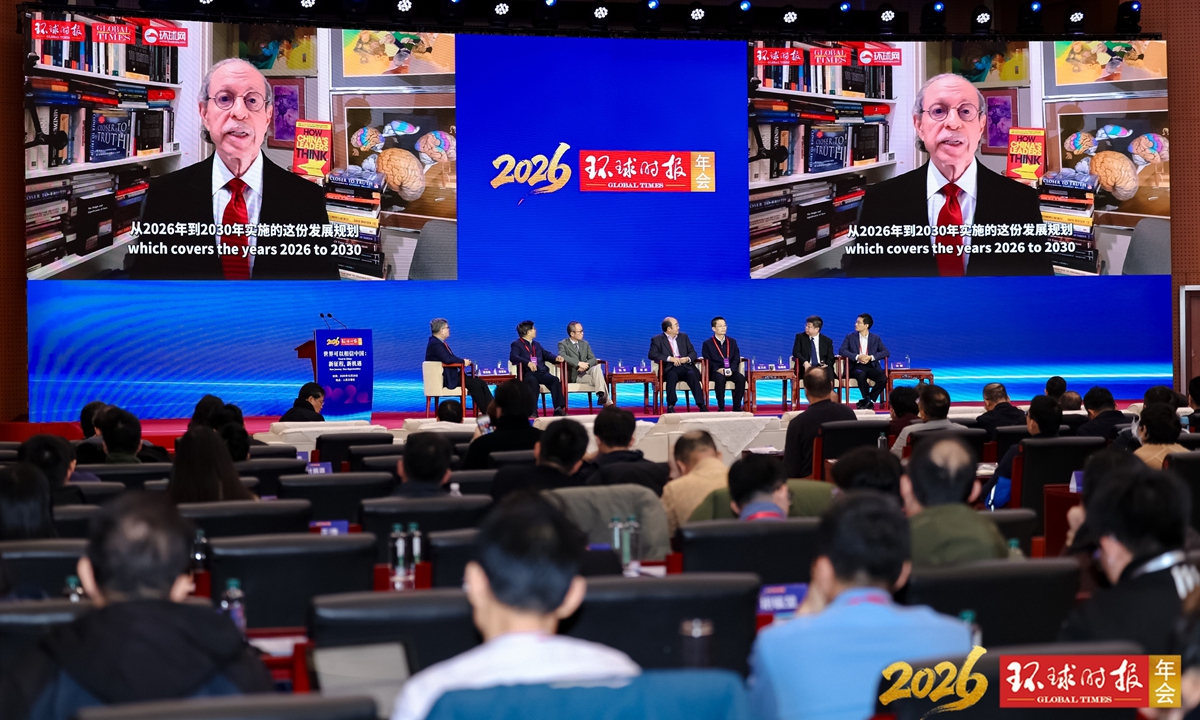
US scholar Robert Lawrence Kuhn delivers a video address at the Global Times Annual Conference 2026 on December 20, 2025, in Beijing. Photo: GT
The Global Times Annual Conference 2026 took place in Beijing on Saturday, under the theme of "Trust in China: New Journey, New Opportunities." During the discussion on the topic "An empowering country: what global dividends will the 15th Five-Year Plan deliver," Robert Lawrence Kuhn, chairman of The Kuhn Foundation, stated that China's ambition is stunning, and it would be a historic error to bet against China.
In assessing China's future, both its domestic developments and international engagements, nothing is more important than the country's 15th Five-Year Plan, which covers the years 2026 to 2030 and sets the national agenda and policy directives for the foreseeable future, Kuhn said.
In October, the 20th Central Committee of the Communist Party of China convened its Fourth Plenum, tasked with formulating the 15th Five-Year Plan, said Kuhn. The plenum's communiqué and the Recommendations of the Central Committee of the Communist Party of China for Formulating the 15th Five-Year Plan for National Economic and Social Development provide the ideological and strategic blueprint for China's next half-decade, he added.
According to the US scholar, the Recommendations outline four interlinked strategic pillars of the 15th Five-Year Plan, all designed to strengthen the country.
First, the Primacy of the Modern Industrial System. This is the highest economic priority. Innovation is now a pragmatic accelerator for high-quality manufacturing - from new products and raw materials to end-use products and services.
Second, High-Level Self-Reliance - an unprecedented mobilization of national resources - a "whole-of-nation" campaign - to break foreign strangleholds on critical technologies: high-end semiconductors, industrial software, and advanced materials. The entire industrial chain must drive breakthroughs.
Third, the National Security Shield - integrating security into development. Thus, broad self-sufficiency - supply chain redundancy, food security, energy security. While still encouraging foreign trade, the plan strengthens the domestic market so that it can prosper independently if some external markets are cut off.
The fourth pillar is common prosperity via public service equalization, said Kuhn.
"Taken together, China's ambition is stunning, and it would be a historic error to bet against China. Foreign analysts have long underestimated the government's capacity to use industrial policy to power and sustain directed growth. Look no further than China's global dominance in green tech: electric vehicles, batteries, and solar equipment," the US scholar continued.
The 15th Five-Year Plan sets the goals of "building a modernized industrial system," reinforcing the "real economy," and achieving "Chinese modernization" - all by prioritizing high-quality development, new quality productive forces, strategic industries, and scientific and technological self-reliance, Kuhn concluded.
For the international community, China's economic success domestically enables larger investments internationally, especially through its Belt and Road Initiative to build infrastructure in developing countries, and its Global Development Initiative that provides economic and social programs, such as business support, education, and healthcare, according to the expert.
RELATED ARTICLES