National Cultural Heritage Administration probes artifacts management at Nanjing Museum
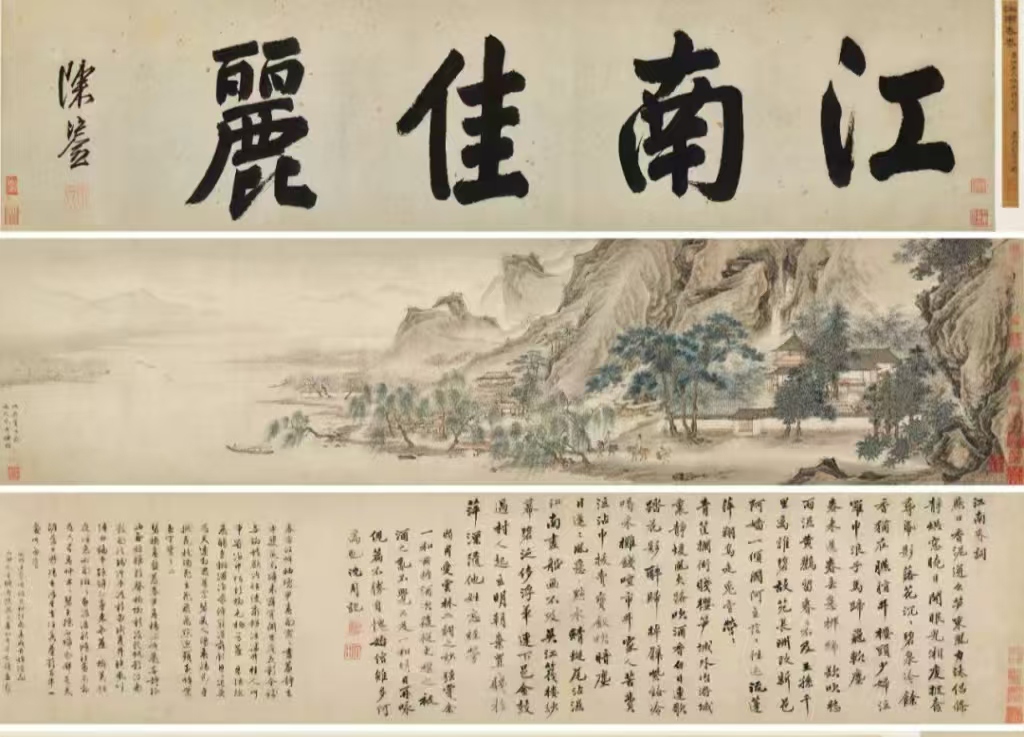
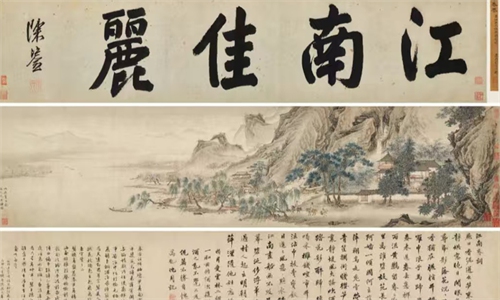
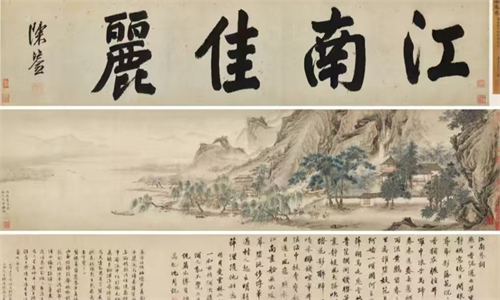
A partial view of the scroll painting "Spring in Jiangnan" by renowned Ming Dynasty painter Qiu Ying Photo: The Paper
China's National Cultural Heritage Administration (NCHA) has formed a working group to investigate issues related to the management of cultural relics at the Nanjing Museum, CCTV reported on Tuesday.
This came after the Nanjing Museum has been under spotlight for the whereabouts of some of its collections.
The Xinhua News Agency reported on December 19 that descendants of late renowned collector Pang Laichen discovered that five out of 137 ancient paintings and calligraphy works donated by their family to the Nanjing Museum in 1959 could no longer be located. The Paper reported that one of the "missing" paintings, "Spring in Jiangnan" by renowned Ming Dynasty painter Qiu Ying, appeared in a preview exhibition of a Beijing auction house in May this year with an estimated value of 88 million yuan ($12.50 million).
In response to public attention, the Nanjing Museum issued a statement on December 17 and stated that the five works had been identified as "inauthentic" decades ago by experts and were later "reallocated" according to regulations. The museum provided expert appraisal records and procedural documentation, indicating that the works were first reviewed in November 1961 by a national panel led by Zhang Heng (Zhang Congyu), and again in June 1964 by three other specialists, including Wang Dunhua, Xu Yunqiu, and Xu Xinnong, who concluded that the painting in focus was not genuine, Xinhua News Agency reported.
According to Xinhua, on May 8, 1997, the painting "Spring in Jiangnan", identified by experts as a forgery, was allocated to the former Jiangsu Provincial Cultural Relics Store and was later purchased by a "customer" for 6,800 yuan on April 16, 2001. The sales receipt clearly listed it as "Landscape Scroll Imitating Qiu Ying".
The incident is still under investigation.
Global Times
RELATED ARTICLES