China’s private firms account for 90% of all high-tech enterprises in the country: report
By Published: Dec 23, 2025 05:41 PM

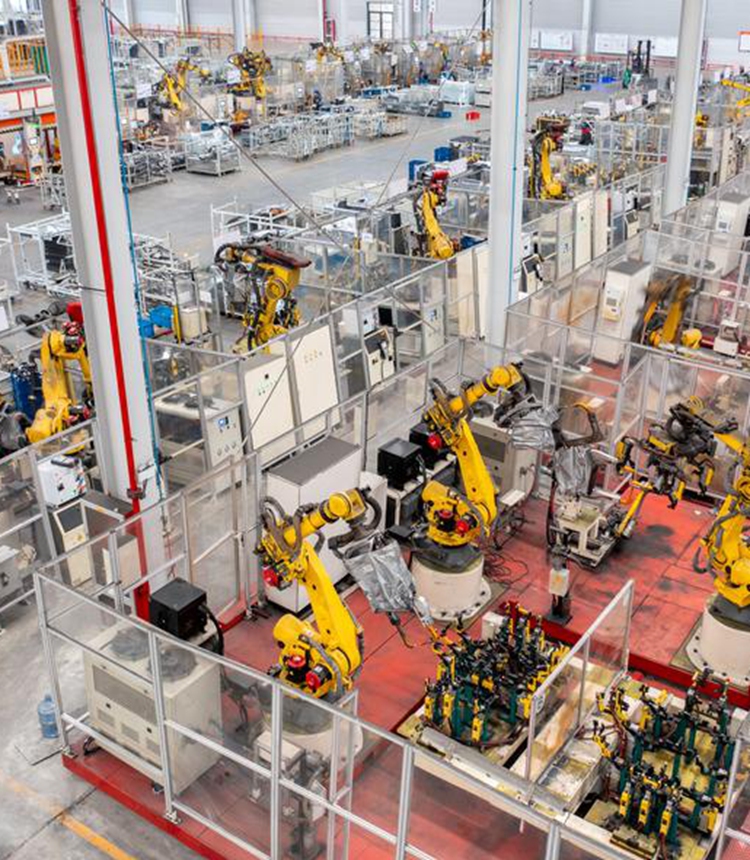
An aerial drone photo taken on Jan. 8, 2024 shows robotic arms processing components for new energy vehicles at a private company in Changxing Economic and Technological Development Zone of Huzhou City, east China's Zhejiang Province. (Photo: Xinhua)
China’s private enterprises account for over 90 percent of the country’s high-tech enterprises at the end of 2024, and the leading role of private enterprises in scientific and technological innovation continues to ramp up, making them a vital force in the development of new quality productive forces, the China Central Television (CCTV) reported on Tuesday.
As of the end of 2024, private enterprises accounted for more than 80 percent of both the specialized, refined, characteristic “little giant” firms and the companies listed on the China’s Science and Technology Innovation Board in Shanghai, and—for the first time—the group became the major participants in China’s high-tech product imports and exports with a 48.5-percent share, according to the report titled China Private Enterprises Social Responsibility Report (2025).
The report was issued on Tuesday by the All-China Federation of Industry and Commerce (ACFIC) in Changsha, capital of Central China’s Hunan Province, the CCTV News reported. The result is based on responses from 33,988 private enterprises which participated in the evaluation, including ACFIC executive committee enterprises, listed companies and top 500 Chinese private enterprises.
The top 1,000 private enterprises in terms of research and development (R&D) investment recorded a total R&D expenditure of 1.43 trillion yuan, with 112 of them ranking among the global top 1,000 in R&D spending, according to the report. The data showed that 71.6 percent of private enterprises achieved positive year-on-year growth in R&D investment.
Wang Peng, an associate researcher at the Beijing Academy of Social Sciences, told the Global Times on Tuesday that the report highlighted private companies’ pivotal role in the push for greater self-reliance in science and technology as well as building the country into a global sci-tech powerhouse.
Analysts pointed out that private companies, which are flexible in responding to market demand and willing to take higher investment risks, could actively explore the integrated development of scientific-technological innovation and industrial innovation in such sectors as artificial intelligence, big data, intelligent driving, and bio tech.
“Private companies could drive the demonstration and application of new technologies, new products, making themselves a prominent force in the development of new quality productive forces,” Wang said. And, China’s high-quality economic development also offers a “historical chance” for private firms to embark on industrial upgrade and move up on the global value chain, Wang said.
The report highlighted private enterprises’ role in stabilizing employment and accelerating green transformation. The private firms who participated in the survey has created 12.75 million jobs, with 71.4 percent of enterprises maintaining stable or increased employee numbers, the report said.
“One of the main characteristics of Chinese private enterprises fulfilling their social responsibilities” is a result of policy effect, the report said. In recent years, relevant policies and measures on the sustainable development of private enterprises introduced by the government have provided guidance for private enterprises in fulfilling their social responsibilities, thereby stimulating their endogenous motivation, according to the report.
Global Times
RELATED ARTICLES