IN-DEPTH / IN-DEPTH
Ecological Code of the Snowy Plateau: In Medog, scientific research is revealing how biodiversity is protected in one of China’s most remote ecosystems


Editor's Note:
Xi Jinping, general secretary of the Communist Party of China (CPC) Central Committee and Chinese president, has stressed that the environment concerns the well-being of people in all countries. Xi has always paid great attention to ecosystems, spanning from cities to rural areas, and from enterprises to communities.
Under the guidance of Xi's thought on ecological civilization, China has been advancing the green transition of its economy over the last decade. Regions across the country are actively promoting the construction of ecological civilization and advancing Chinese modernization, featuring harmony between humanity and nature. These efforts are creating a "Beautiful China."
Therefore, the Global Times is launching a series of stories to explore the progress of ecological civilization projects that Xi is concerned with, delving into the positive environmental changes occurring now, and offering valuable insights and references for both national and global efforts. From these practical examples, we can see how Xi's thought on ecological civilization is put into practice and further inspires public action.
In this issue, we turn our attention to the "roof of the world" - the Qinghai-Xizang Plateau - to examine the state of ecological conservation there in this three-part series titled "Ecological Code of the Snowy Plateau - Decoding China's Real Answers to Protecting the Qinghai-Xizang Plateau." In response to the biased perspectives and deliberate distortions in international discourse regarding the region's ecology and environment, this series is the result of an independently planned and systematically organized effort, grounded in firsthand field research and vivid stories.
In the second installment, we venture deep into Medog, a hidden territory surrounded by the mountains of the southeastern corner of Southwest China's Xizang Autonomous Region. There, newly discovered species continue to emerge, and the veil shrouding this mysterious gorge of the Yarlung Zangbo River is gradually being lifted.
Xi Jinping, general secretary of the Communist Party of China (CPC) Central Committee and Chinese president, has stressed that the environment concerns the well-being of people in all countries. Xi has always paid great attention to ecosystems, spanning from cities to rural areas, and from enterprises to communities.
Under the guidance of Xi's thought on ecological civilization, China has been advancing the green transition of its economy over the last decade. Regions across the country are actively promoting the construction of ecological civilization and advancing Chinese modernization, featuring harmony between humanity and nature. These efforts are creating a "Beautiful China."
Therefore, the Global Times is launching a series of stories to explore the progress of ecological civilization projects that Xi is concerned with, delving into the positive environmental changes occurring now, and offering valuable insights and references for both national and global efforts. From these practical examples, we can see how Xi's thought on ecological civilization is put into practice and further inspires public action.
In this issue, we turn our attention to the "roof of the world" - the Qinghai-Xizang Plateau - to examine the state of ecological conservation there in this three-part series titled "Ecological Code of the Snowy Plateau - Decoding China's Real Answers to Protecting the Qinghai-Xizang Plateau." In response to the biased perspectives and deliberate distortions in international discourse regarding the region's ecology and environment, this series is the result of an independently planned and systematically organized effort, grounded in firsthand field research and vivid stories.
In the second installment, we venture deep into Medog, a hidden territory surrounded by the mountains of the southeastern corner of Southwest China's Xizang Autonomous Region. There, newly discovered species continue to emerge, and the veil shrouding this mysterious gorge of the Yarlung Zangbo River is gradually being lifted.
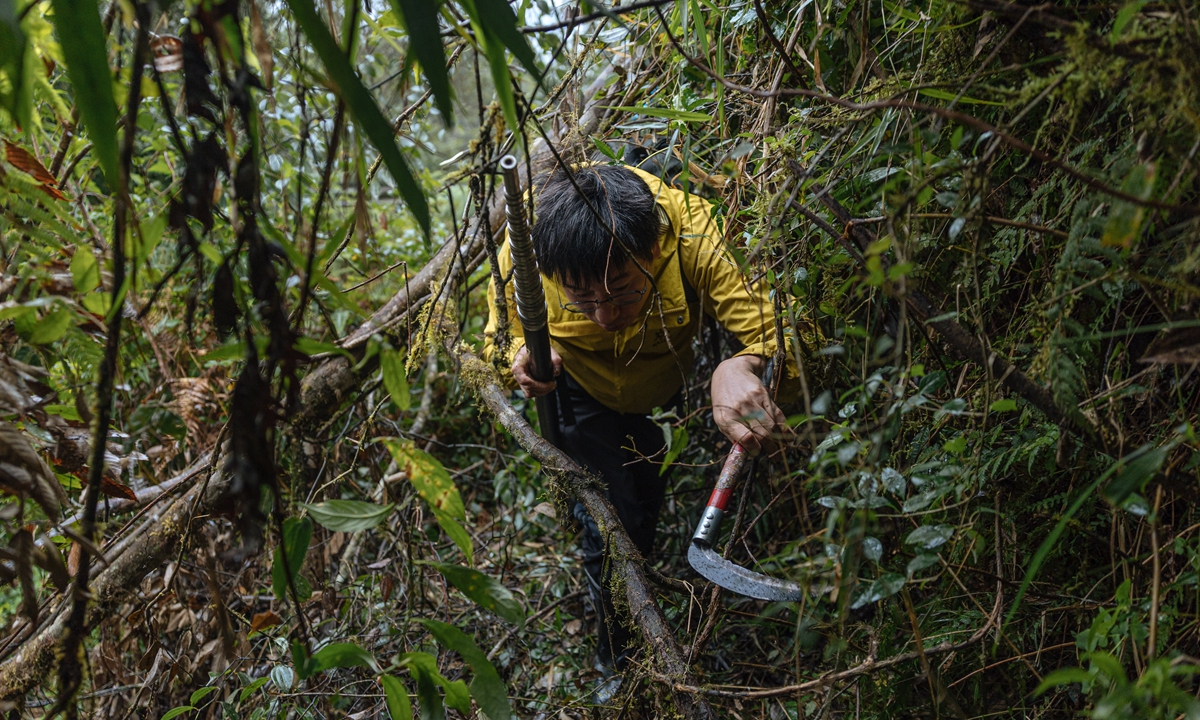
Wang Wenguang treks through the forest in Medog, Nyingchi, Southwest China's Xizang Autonomous Region in November 2025. Photo: Li Hao/GT
Wang Wenguang raises a hand-held axe, hacks through the branches blocking the way, and steps into the forest. Damp air clings to the skin, and the soil underfoot, softened by recent rainfall, slips easily beneath each step. Three students accompanying him follow one after another along a narrow path nearly swallowed by vegetation.
Sliding down another steep slope, the group stops beside a stream. Wang points to a vine-like plant climbing through the surrounding shrubs. This is one of the key species they have come to document in the field today - the "Medog ribbed gourd" (Herpetospermum motuoensis, or mo tuo bo leng gua in Chinese pinyin).
The plant was confirmed and formally named as a new species in the gourd family only in the past six months. Discovered in Medog by research teams from the South China Botanical Garden, Chinese Academy of Sciences, Xizang University, and other institutions, it is currently known to exist only locally. Some of its populations consist of very few individuals and face the risk of disappearing.
Wang, an engineer at the Center for Horticulture and Gardening of the Xishuangbanna Tropical Botanical Garden, Chinese Academy of Sciences, is continuing to study the new species along with peer botanists.
In Medog, such "new names" are not accidental. As systematic surveys advance, the county has maintained a relatively high frequency of discovering new species.
This is the heart of the Yarlung Zangbo Grand Canyon. Dramatic elevation differences unfold within a confined space, from low-altitude tropical monsoon forest to mid-mountain evergreen broad-leafed forests, and further upward into shrublands and alpine grasslands. Different ecosystems succeed one another over short distances. According to Liu Zhen, head of the Medog county forestry and grassland bureau, incomplete statistics show that the county is home to more than 4,500 species of vascular plants, 147 nationally protected wildlife species, 144 nationally protected wild plant species, and nearly 600 bird species.
Since 2021, more than 50 new species have been identified in the county, with over 18 confirmed this year alone.
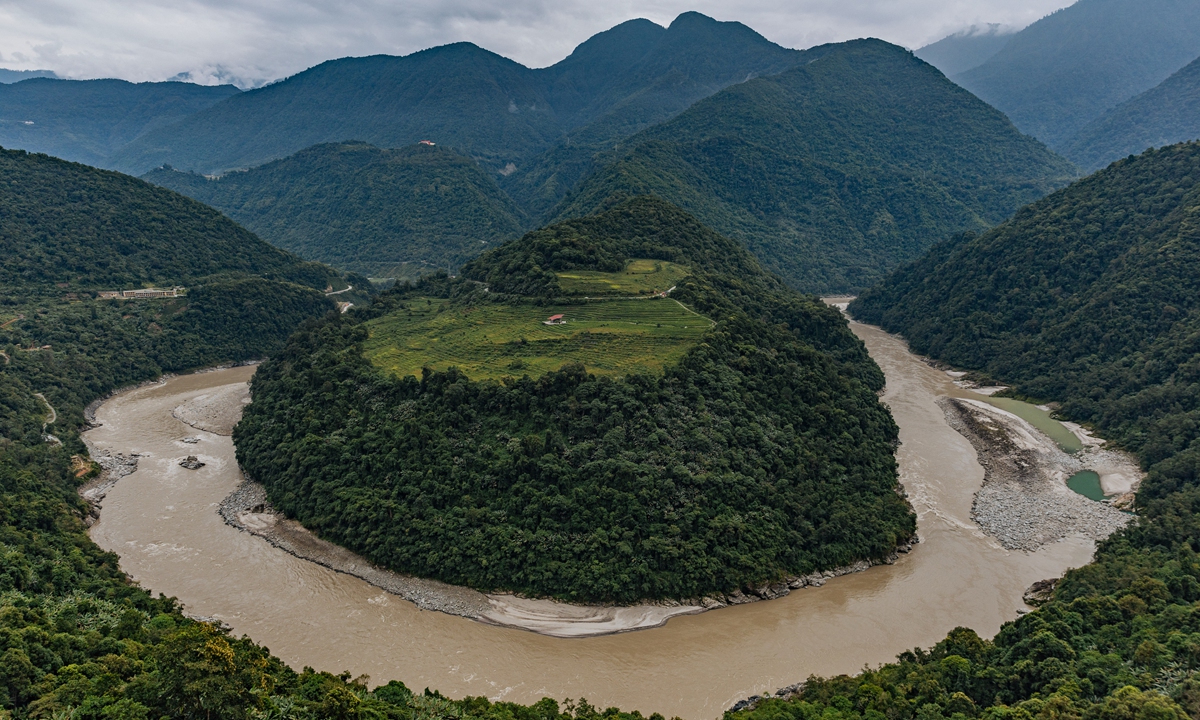
Guoguotang Great Bend of the Yarlung Zangbo River is the landmark of Medog. Photos on this page: Li Hao/GT
During his visit to Xizang in July 2021, Chinese President Xi Jinping noted that the ecological environment in Xizang should be well protected, stressing that snow and ice, comparable to green mountains and clear water, are also valuable assets that represent true wealth, according to the Xinhua News Agency.
The earth's third pole should be well safeguarded, Xi said.
In Medog, biodiversity conservation is neither abstract nor confined to slogans. It is embodied in repeated forays into the forest and sustained research on a newly identified species that the vision of "protecting the earth's third pole" is gradually being translated into specific actions.
A Vast Treasure House
Wang and his team continue forward, moving on to a different forest trail, their rubber boots already caked with mud. Dense, towering ancient trees stand on both sides, their trunks coated with mosses and ferns, branches interlacing overhead, enclosing the group in a dim, humid green world.
Leeches writhe on the leaves brushing against their legs, while cattle raised by local herders watch the visitors with curiosity.
Wang pauses occasionally to examine plants along the trail. When he encounters a target species, he raises a specially designed pole with a sickle-shaped blade at one end and cuts off a branch from beneath the canopy. A student steps forward quickly, retrieves the branch, and places it into a backpack. Bearing leaves, fruits, or seeds, the samples will later be catalogued, preserved as specimens.
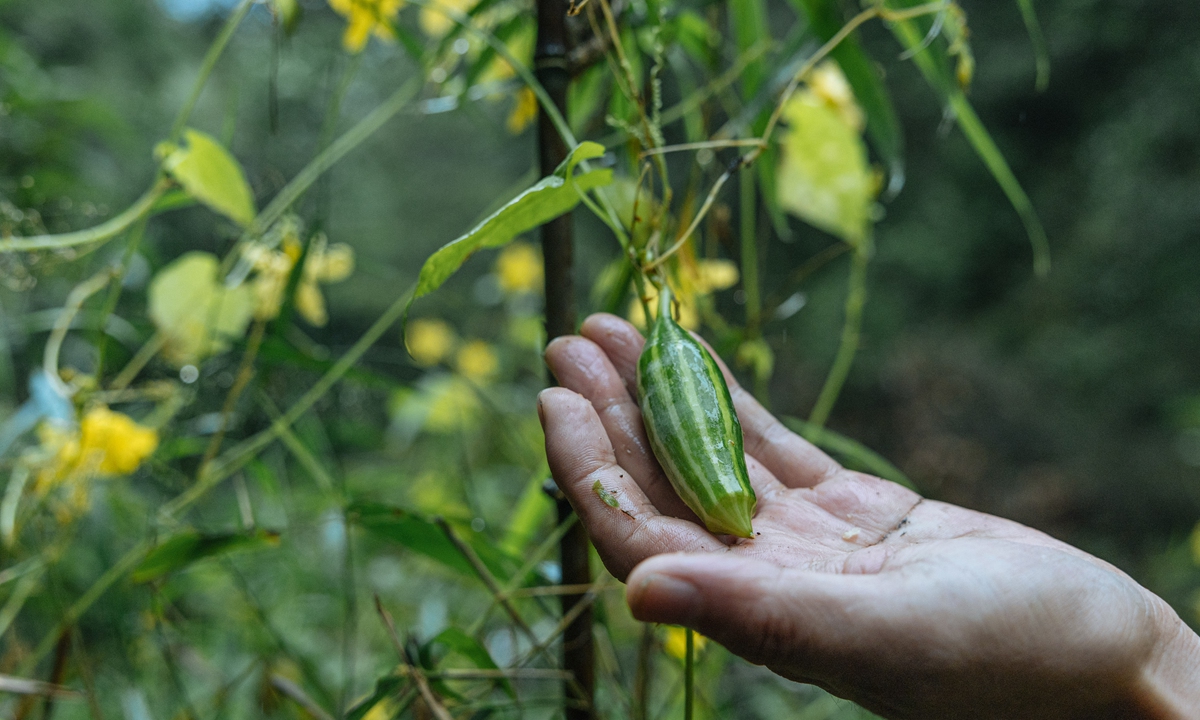
The "Medog ribbed gourd" (Herpetospermum operculatum), a newly discovered species found in Medog Photo: Li Hao/GT
Wang first entered Medog in 2016. Over the years, he has returned many times, conducting long-term research on Begonia species and describing several new species in the process.
In his view, Medog's uniqueness lies not only in the sheer number of species, but also in its high degree of endemism - many plants exist only within a single gorge or on a particular slope.
"This is a place where tropical monsoon forest ecosystems persist at the very edge of their latitudinal limits," Wang told the Global Times while standing before the giant Bhutan Pine (Pinus bhutanica) known locally as the "Tree King" in Gelin village.
As the Yarlung Zangbo River courses through the canyon, moisture is continually lifted and condensed by the narrow terrain, maintaining consistently high humidity levels. This stable, moist microclimate provides ideal conditions for plant groups such as orchids and begonias, which are especially sensitive to environmental changes, Wang explained.
In recent years, as road access has improved and more scientific teams have entered the region, baseline surveys of Medog's biodiversity have gradually increased, providing a more complete picture of this unique ecosystem.
The group presses on. Plants like the "Medog ribbed gourd" are easily overlooked - their slender vines disappear into the shrubbery unless one knows exactly where to look. Yet it is precisely these seemingly modest life forms that make up the intricate and complete ecological mosaic of the Yarlung Zangbo Grand Canyon, as they are steadily discovered, understood, and brought under the scope of protection.
Preserving precious samples
In a courtyard on the outskirts of Beibeng Township, Medog, Xi Huipeng, Wang's colleague, was checking seeds that had just been sown. This is the base of the institute. Though living conditions are basic, the site is spacious, equipped with greenhouse facilities, and a new laboratory set to come into use soon.
Xi Huipeng's work, as a senior engineer, does not take place in the depths of the primeval forest, but inside greenhouses and nurseries, where he works to propagate plants that are highly vulnerable in the wild.
"If we are truly going to protect a species, what we preserve is not a single individual, but a population with genetic diversity," Xi Huipeng explained, speaking animatedly about the plants he has devoted himself to. "We prioritize collecting seeds from different communities, then consider seeds from different plants, and finally, when we have no choice, we can consider collecting seeds from the same plant because even seeds collected from the same mother plant carry different genetic information," he said.

Xi Huipeng checks the plants in a greenhouse in Beibeng Township, Medog in November 2025. Photo: Li Hao/GT
In practice, not all plants, however, can successfully reproduce through sexual reproduction. In some cases, researchers can only rely on asexual propagation methods such as cuttings or tissue culture to keep the species alive first, before gradually expanding its population. "When you hit a bottleneck, the only option is to keep trying, method by method," Xi Huipeng said.
Before rare and endangered plants can be returned to the wild, pioneer or dominant tree species must first be planted to create suitable microhabitats. Once the environment stabilizes, target species can then be reintroduced.
Xi Huipeng repeatedly stressed that the ultimate goal is always a return to nature. "Once they are returned to the wild, we stop watering and fertilizing them altogether. They have to survive through natural competition on their own."
Ecological high ground
Biodiversity conservation in Medog is not a series of isolated actions, but part of a continuously functioning institutional framework. According to Liu, following the launch of the second Qinghai-Xizang Plateau Scientific Expedition, Medog was designated as one of the key focus areas. Official statistics show that no fewer than 40 research institutions now carry out field investigations in Medog annually. Around the Yarlung Zangpo Grand Canyon, multiple research platforms have been established, including field observation stations and joint research bases, forming stable mechanisms for field surveys, sample preservation, and long-term monitoring.
Advances in technology have also reshaped traditional forest protection practices. LiDAR and remote sensing are used to measure giant trees and analyze forest structure, while drones assist in monitoring forest pests and fire risks. Infrared cameras continuously record wildlife activity. Together, aerial, ground-based, and in-forest monitoring systems are gradually taking shape.
Before rare and endangered plants can be returned to the wild, pioneer or dominant tree species must first be planted to create suitable microhabitats. Once the environment stabilizes, target species can then be reintroduced.
Xi Huipeng repeatedly stressed that the ultimate goal is always a return to nature. "Once they are returned to the wild, we stop watering and fertilizing them altogether. They have to survive through natural competition on their own."
Ecological high ground
Biodiversity conservation in Medog is not a series of isolated actions, but part of a continuously functioning institutional framework. According to Liu, following the launch of the second Qinghai-Xizang Plateau Scientific Expedition, Medog was designated as one of the key focus areas. Official statistics show that no fewer than 40 research institutions now carry out field investigations in Medog annually. Around the Yarlung Zangpo Grand Canyon, multiple research platforms have been established, including field observation stations and joint research bases, forming stable mechanisms for field surveys, sample preservation, and long-term monitoring.
Advances in technology have also reshaped traditional forest protection practices. LiDAR and remote sensing are used to measure giant trees and analyze forest structure, while drones assist in monitoring forest pests and fire risks. Infrared cameras continuously record wildlife activity. Together, aerial, ground-based, and in-forest monitoring systems are gradually taking shape.
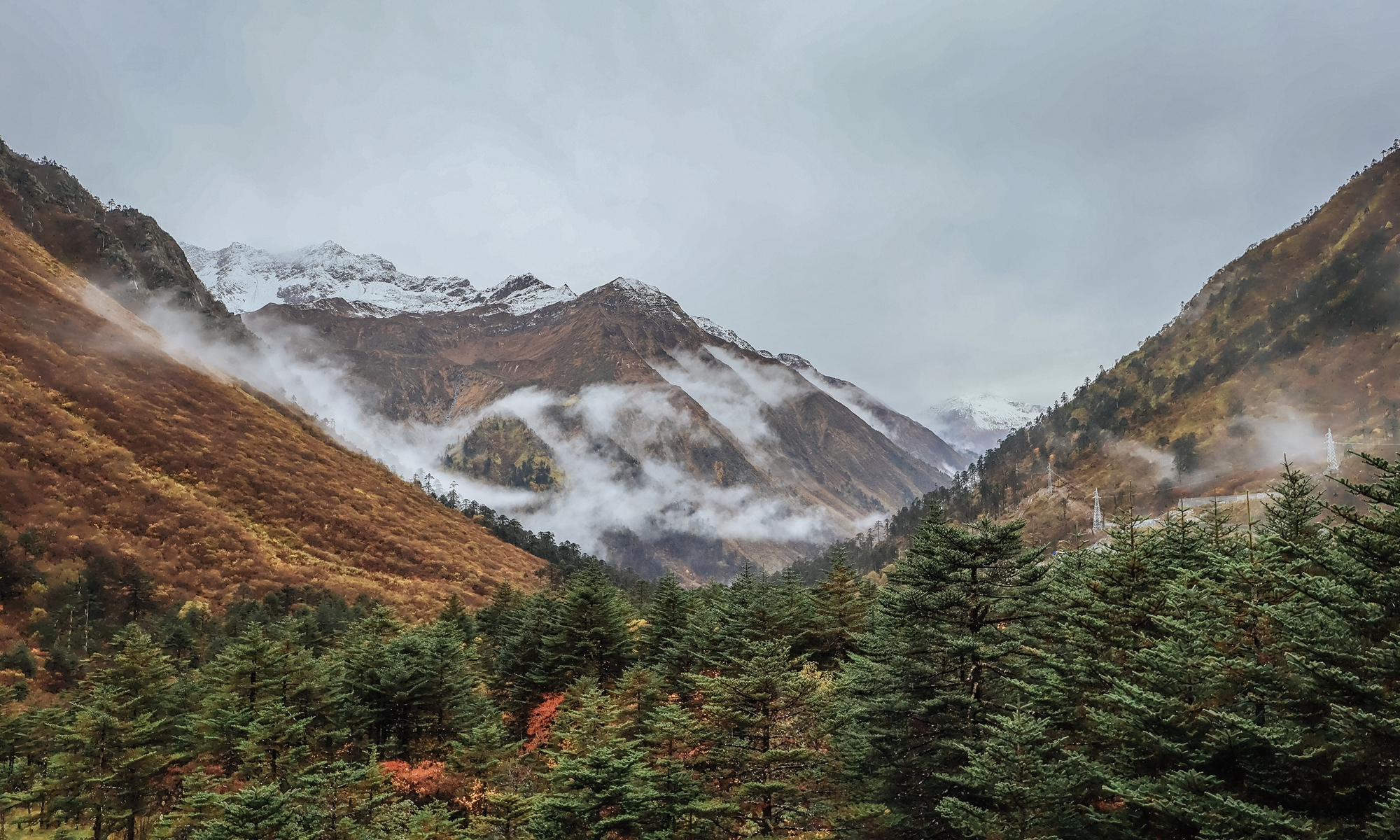
Medog, Nyingchi, Southwest China's Xizang Autonomous Region Photo: Li Hao/GT
Yet, in Liu's view, the true foundation of conservation does not lie in technology alone. "The role of local communities has fundamentally changed," he said. Medog has built a countywide grassroots protection network, with more than 3,000 professional forest rangers, patrol officers, monitors, and fire prevention personnel.
Despite rapid development, Medog has not lowered its guard against ecological risks. Liu summarized the county's work as "strictly safeguarding four bottom lines": Forest resource protection, wildlife and plant protection, forest and grassland fire prevention, and the control of invasive species. "All construction and development activities must operate within these boundaries," he said.
At the same time, ecological protection is not seen as the opposite of development. Drawing on its rich resources, the county has promoted under-forest economies. These efforts allow local residents to participate without exploiting wild resources, bringing tangible income while preserving ecosystems.
"Protection and development must advance together," Liu said. "The key is finding pathways to transform lucid waters and lush mountains into mountains of gold and silver."
Despite rapid development, Medog has not lowered its guard against ecological risks. Liu summarized the county's work as "strictly safeguarding four bottom lines": Forest resource protection, wildlife and plant protection, forest and grassland fire prevention, and the control of invasive species. "All construction and development activities must operate within these boundaries," he said.
At the same time, ecological protection is not seen as the opposite of development. Drawing on its rich resources, the county has promoted under-forest economies. These efforts allow local residents to participate without exploiting wild resources, bringing tangible income while preserving ecosystems.
"Protection and development must advance together," Liu said. "The key is finding pathways to transform lucid waters and lush mountains into mountains of gold and silver."
RELATED ARTICLES