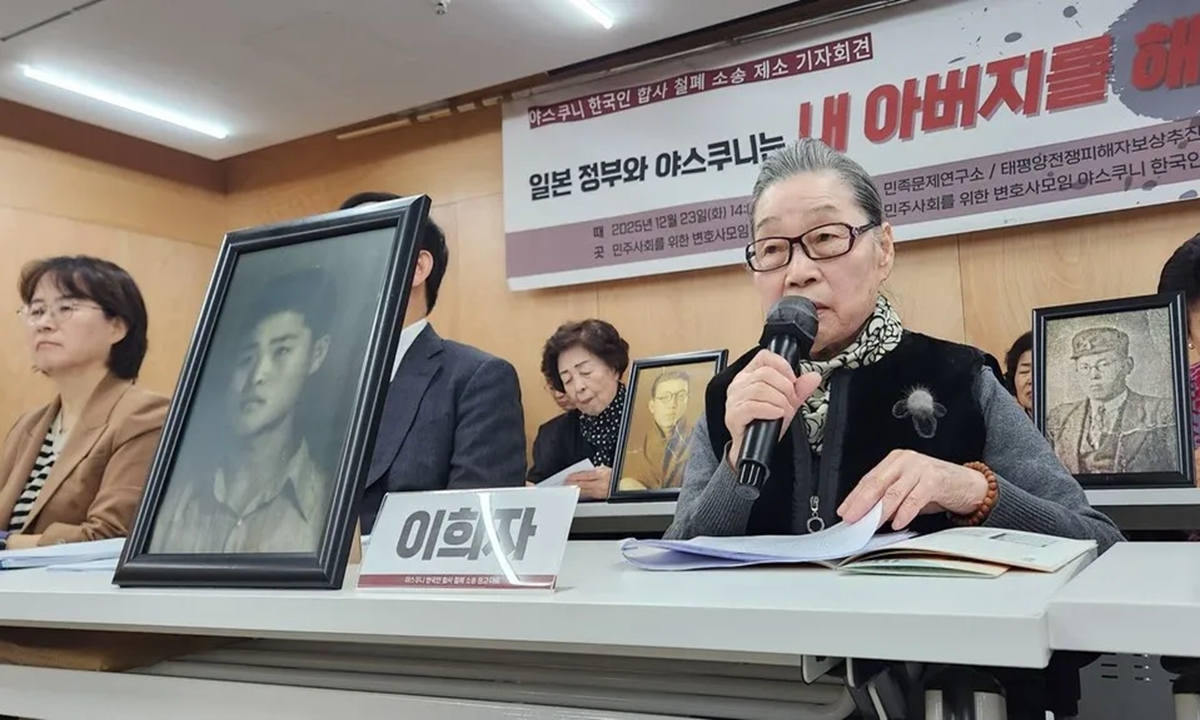
Lee Hee-ja (82), whose father Lee Sahyun - pictured on the left was forcibly enshrined at Japan's Yasukuni Shrine, speaks at a press conference on the filing of a lawsuit seeking the removal of Koreans enshrined at Yasukuni Shrine, held on December 23, 2025 in Seoul, South Korea. Photo: Screenshot from The Hankyoreh
Family members of Koreans forcibly conscripted by Japan during World War II have filed a lawsuit in South Korea, seeking the removal of the names of the deceased from the notorious Yasukuni Shrine that honors war criminals, civic groups said Tuesday, according to South Korean media.
Ten bereaved family members of Korean soldiers and civilian employees demanded that Yasukuni Shrine delete the names of the deceased from records which list the names and dates of death of those enshrined. They also filed to seek a total of 880 million won ($594,000) in damages from the Japanese government and the shrine, reported Munhwa Ilbo.
The Center for Historical Truth and Justice and the Pacific War Victims Compensation Promotion Council, among other groups, announced the move at a press conference in Seoul on Tuesday. The complaint was submitted on the same day to the Seoul Central District Court, marking the first time a lawsuit seeking the cancellation of enshrinement at Yasukuni Shrine in a South Korean court, per Munhwa Ilbo.
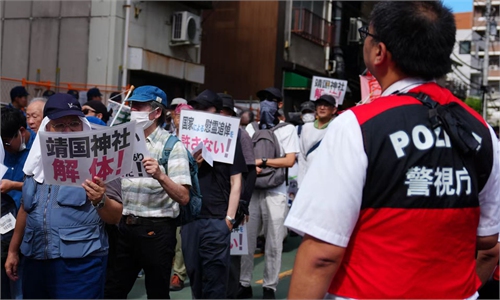
The Yasukuni Shrine, located in central Tokyo, honors 14 convicted Class-A Japanese war criminals from World War II. It has long been a source of diplomatic friction between Japan and its neighbors. Visits and ritual offerings made by Japanese officials to the shrine consistently sparked criticism and hurt the feelings of the people of China, South Korea and other countries brutalized by Japan during the WWII, according to the Xinhua News Agency.
According to the Yonhap News, many Koreans were forcibly mobilized for the Imperial Japanese Army during that time as Korea was under Japan's colonial rule from 1910-45. About 20,000 Koreans are believed to have been enshrined at the shrine.
The plaintiffs argued that the Japanese government not only forced the victims into wartime service, leading to their deaths on the battlefield, but also provided their personal information to Yasukuni Shrine, thereby infringing upon the families' personal rights as well as their freedom of religion and conscience, according to the Munhwa Ilbo report.
The plaintiffs' legal team said that, for the bereaved families, enshrinement at Yasukuni is not a mere religious ritual but an act of harm that incorporates victims into a structure that glorifies Japan's wars of aggression. They urged that the status of victims being incorporated as "those who died for the emperor," despite having been driven to death by war, be brought to an end, and that families' right to properly mourn their loved ones in the manner they choose be restored.
One of the plaintiffs, Lee Hee-ja, who is 82-year-old and head of the Pacific War Victims Compensation Promotion Council, said, "Although this year marks the 80th anniversary of Korea's liberation, my father, still confined at Yasukuni, has yet to be liberated."
She added, "How long must bereaved families continue to endure this painful history? Why must I still live as a victim of Japanese colonial rule?" according to Munhwa Ilbo.
The father of Lee Hee-ja, Lee Sahyun, was forcibly taken to China in February 1944, when his daughter was just over 1 year old, and served as a civilian employee attached to the military. He died on June 11, 1945, at the age of 24, just two months before Korea's liberation. In April 1959, he was enshrined at Yasukuni Shrine under the Japanese-style name "Lee Wonsayeon," which he had been compelled to adopt under Japan's colonial name-change policy, according to a report from South Korean newspaper The Hankyoreh.
Lee Hee-ja learned what happened to her father in 1997 and she said that "We are a liberated people and a liberated family, yet forcibly enshrining the deceased like this shows that they still regard (Korea) as their colony," according to The Hankyoreh.
According report, for the past 24 years, the bereaved families have argued that the enshrinement at Yasukuni Shrine was unjust and have sought compensation from Japan, but Japanese courts have repeatedly turned a blind eye to their claims. Beginning with a damage lawsuit filed in 2001 on behalf of victims of forced mobilization as soldiers and military laborers, the families went on to pursue the first and second lawsuits in 2007 and 2013, respectively, seeking the removal of unauthorized enshrinements at Yasukuni Shrine. All of these cases ended in defeat.
The reason such lawsuits could not previously proceed in South Korean courts was the legal doctrine of sovereign immunity, under which a state is not subject to the jurisdiction of another country's courts. However, in compensation lawsuits filed in 2021 and 2023 by survivors of Japan's wartime "comfort women" system, South Korean courts ruled that sovereign immunity cannot be recognized when crimes against humanity or illegal acts occur within the territory of the Republic of Korea. These rulings opened the door for bereaved families to bring lawsuits directly against the Japanese government, according to The Hankyoreh report.
In previous cases, including those involving comfort women, the Japanese government consistently declined to respond. Jang Wanik, head of the plaintiffs' legal team, said, "Even if we send the complaint, there is a high likelihood that the Japanese government will refuse to accept it, resulting in wasted time," adding, "We hope that the Japanese government and Yasukuni Shrine will approach this lawsuit with sincerity this time," per The Hankyoreh.
Global Times
RELATED ARTICLES