China summons Japanese diplomat, urges Tokyo to face wartime history amid Yasukuni visits
By Feng Fan, Zhang Changyue and Published: Aug 15, 2025 11:36 PM

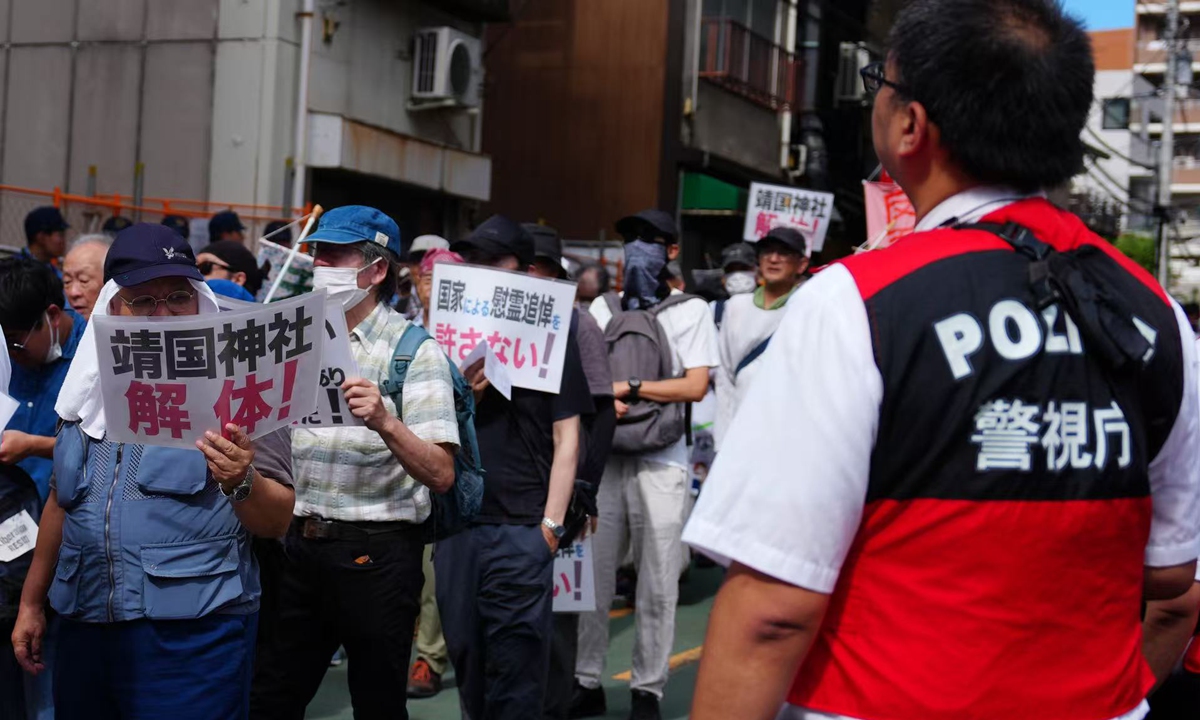
Dozens of Japanese people march through the streets holding signs and chanting slogans on August 15, 2025, calling on the Japanese government to face up to and take responsibility for its acts of aggression during WWII. Photo: Wu Di
China on Friday summoned a senior Japanese diplomat in Beijing and lodged stern representations with Japan over Japanese political figures' visits to the war-linked Yasukuni Shrine earlier in the day, which marks the 80th anniversary of Japan's unconditional surrender in World War II (WWII).
Also on Friday, China's top diplomat and embassy in Japan condemned certain forces in the country for attempting to glorify aggression, deny invasion, distort history, and whitewash war criminals, calling such moves "utterly contemptible and self-humiliating."
The démarches and remarks came as several Japanese political figures visited or sent offerings to the notorious war-linked Yasukuni Shrine on the anniversary of Japan's unconditional surrender in WWII.
Stern warning
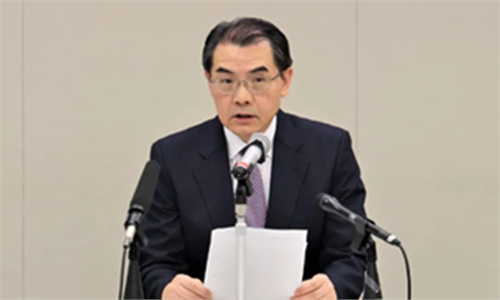
Liu Jinsong, Director-General of the Department of Asian Affairs at the Chinese Foreign Ministry, summoned Chief Minister of the Embassy of Japan in China Yokochi Akira, to lodge stern representations over Japanese politicians' visits to the notorious shrine on Friday, according to a release by the Chinese Foreign Ministry.
While briefing the press after the tenth Lancang-Mekong Cooperation (LMC) Foreign Ministers' Meeting on Friday, Chinese Foreign Minister Wang Yi clarified China's position on historical issues, saying that moves to glorify aggression and whitewash war criminals constitute a challenge to the UN Charter, the post-war international order, human conscience and the people of all victorious countries of WWII.
"Only by facing up to history can a country earn respect, only by drawing lessons from history can it embrace the future, and only by remembering the past can it avoid repeating past mistakes. We urge Japan to make the right choice," Wang said.
The Chinese Embassy in Japan said in a statement on Friday that Japanese leaders and politicians' reverence for the Yasukuni Shrine once again reveals Japan's erroneous attitude toward its history of aggression and shows that the specter of militarism still lingers. This has further heightened the concerns and doubts of its Asian neighbors and the wider international community about the direction of the country.
This year marks the 80th anniversary of the victory of the Chinese People's War of Resistance Against Japanese Aggression and the World Anti-Fascist War. A correct understanding and approach to history is an important prerequisite for Japan's post-war return to the international community, a political foundation for its relations with neighboring countries, and a benchmark for testing whether Japan can honor its commitment to peaceful development, said a spokesperson in the statement.
"We urge Japan to face up to and reflect on its history of aggression, speak and act prudently on issues such as the Yasukuni Shrine, make a clean break with militarism, remain committed to peaceful development, and win the trust of its Asian neighbors and the international community through concrete actions," the spokesperson said.
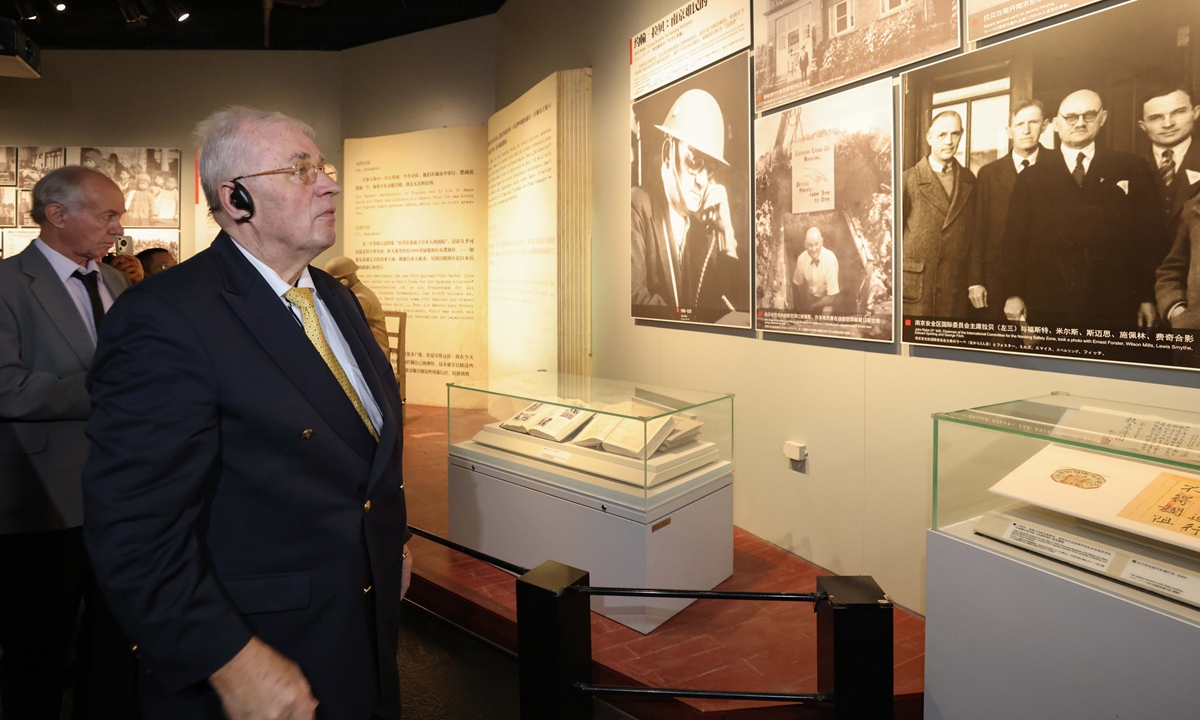
Thomas Rabe, the grandson of John Rabe, visits the Memorial Hall of the Victims in Nanjing Massacre by Japanese Invaders in Nanjing, East China's Jiangsu Province on August 15, 2025. During the Nanjing Massacre in 1937, German businessman John Rabe set up an international safety zone with other foreigners, and saved the lives of around 250,000 Chinese people between 1937 and 1938 from Japanese invaders, Xinhua reported. Photo: VCG
Shadow of the right-wing forces
Japanese Prime Minister Shigeru Ishiba sent a ritual offering to the Yasukuni Shrine on Friday, "a move apparently aimed at appeasing his party's conservative support base," Kyodo News reported.
Also at Japan's national memorial ceremony on the same day, Ishiba said Japan would "keep in mind" its "remorse" over WWII as it continues its pursuit of peace 80 years since its surrender, becoming the first premier in over a decade to use the term at the event, Japan's Kyodo News reported.
However, Chinese experts noted that Ishiba's administration broke with precedent by not issuing an official statement marking the 80th anniversary, instead intending to release his personal views, while some cabinet members visited the notorious Yasukuni Shrine - moves seen as reflecting strong resistance from right-wing conservative forces in Japan.
At the ceremony, Ishiba noted that 80 years have passed since WWII, and that most people alive today have never experienced it. "We should never repeat the devastation of war. We will never ever make a mistake in choosing the path to take. The remorse and lessons from that war should once again be engraved deeply in our hearts," he said.
Despite this, Kyodo noted that Ishiba — like his recent predecessors — avoided directly acknowledging Japan's wartime aggression or the suffering it caused across Asia.
Also on Friday, Japanese farm minister Shinjiro Koizumi and finance minister Katsunobu Kato visited the Yasukuni Shrine, becoming the first cabinet ministers to do so since Ishiba took office. Former economic security ministers Sanae Takaichi and Takayuki Kobayashi were also seen at the shrine, Kyodo reported.
On Friday morning at the Yasukuni Shrine, a Global Times special correspondent observed large gatherings of Japanese right-wing groups lining streets that stretched for hundreds of meters. Vehicles belonging to these groups, fitted with barriers and banners, were parked along both sides of the road, creating a strong militaristic atmosphere.
After stepped out of the Kudanshita Station near the Yasukuni Shrine, the correspondent encountered clusters of right-wing activists, including groups promoting anti-China rhetoric, holding signs and waiting for certain right-wing politicians to arrive.
Among the groups visiting the Yasukuni Shrine, some held placards with nationalist slogans, and others wore uniforms resembling those of the former Imperial Japanese Army or kamikaze pilots. Several right-wing local lawmakers also joined the visits, the Global Times special correspondent noted.
Da Zhigang, director of the Institute of Northeast Asian Studies at the Heilongjiang Provincial Academy of Social Sciences, told the Global Times that despite Ishiba used the term "remorse", his remarks are still dodging about Japan's aggression past, and his offering to the shrine, cabinet members' visits, and the absence of an apology for Japan's aggression against other Asian nations revealed Japan's increasingly conservative political climate.
Da also noted that Ishiba's comments were not an official war anniversary statement, and there is still no timeline for Ishiba to release his comment on the 80th anniversary of the end of WWII.
Xiang Haoyu, a research fellow at the China Institute of International Studies, said Ishiba's speech attempted to show a relatively clear personal view of history, but fell short in wording and expression in addressing Japan's wartime responsibilities- whether due to domestic political pressure or personal choice.
Xiang noted that Ishiba did not acknowledge Japan's responsibility for wartime aggression, and that Japan continues to mark the day as the "end of the war" with moments of silence instead of apologies or remorse to the invaded and harmed Asian nations and their peoples.
The speech, Xiang said, is insufficient for Japan's Asian neighbors that suffered under Japan's invasion, and reflects a dangerous conservative shift in Japan's politics, with a regressive perception of history and a tendency to portray itself as a victim.
In Japan, some citizens also opposed such distorted views of history. The Global Times special correspondent saw dozens of people marching through the streets with signs and slogans, calling on the Japanese government to face up to its acts of aggression and declaring that cabinet members and lawmakers must never visit the Yasukuni Shrine. Police attempted to block the march before it began, leading to a brief standoff between the two sides.
South Korean President Lee Jae Myung, in his speech marking the 80th anniversary of the Korean Peninsula's liberation from Japan's 1910-45 colonial rule, said, "I hope that the Japanese government will squarely face up to our painful history and strive to maintain trust between our two countries," according to Yonhap News Agency.
Da said that Japan now stands at a crucial crossroads: whether to uphold the post-war international order, maintain a correct view of WWII history, and show responsible reflection toward countries it once invaded, or to embrace historical revisionism that downplays or denies its aggression. "Japan still has a long way to go on historical issues, and concrete measures are needed to uphold a correct view of history," Da said.
RELATED ARTICLES