Expert warns Japan’s proposed record OSA funding to provide military equipment to allies a move threatens regional peace
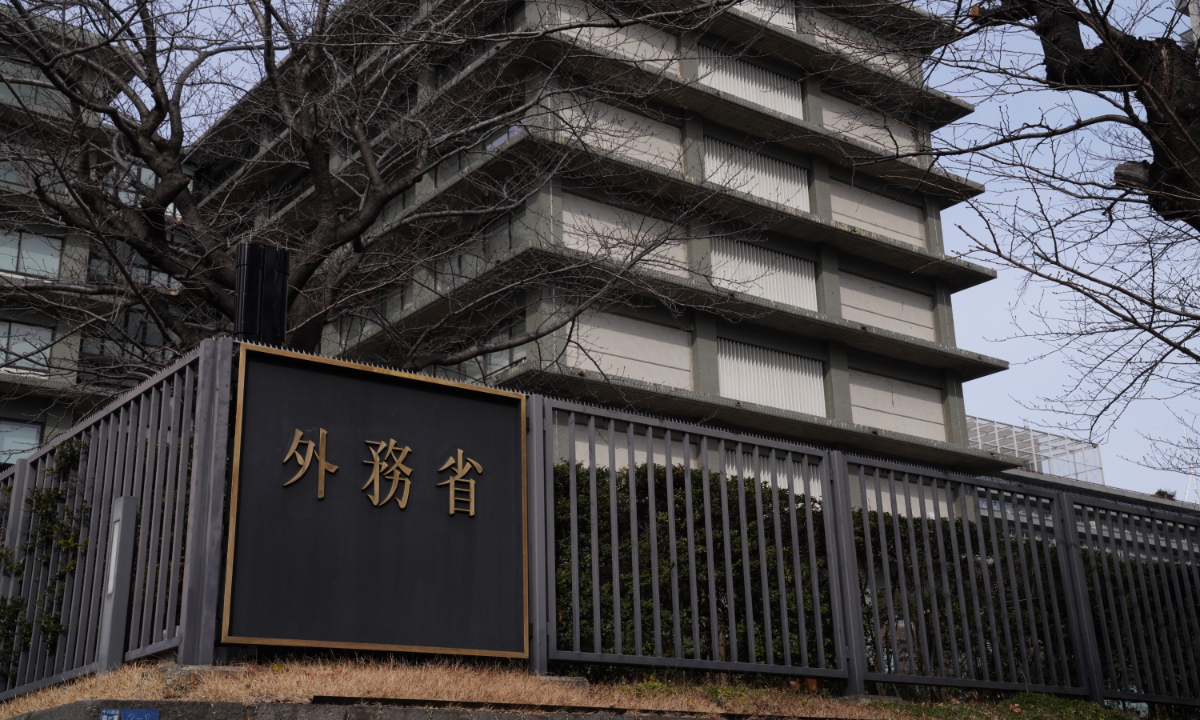
Japanese Ministry of Foreign Affairs Photo: IC
Japanese Foreign Minister Toshimitsu Motegi unveiled the ministry’s budget proposal for 2026 on Tuesday, which indicates that the Japanese government will accelerate the provision of weapons and equipment to allied countries in 2026, a move a Chinese expert warns of as an increasing presence of militarization that threatens region, seeking to construct a geographically oriented framework of strategic pressure against China.
According to the proposal, the Official Security Assistance (OSA), which provides defense equipment and materials to allied countries’ militaries, is expected to be allocated a record-high 18.1 billion yen ($116.29 million). This move represents an increase of 10 billion yen compared to fiscal year 2025, Kyodo News reported.
Moreover, in the 2026 budget plan, the Japanese Ministry of Foreign Affairs also intends to allocate 25 billion yen to so-called countermeasures against foreign information warfare, Jiji Press reported.
OSA is a framework established in April 2023 based on Japan’s National Security Strategy approved by the cabinet in 2022. In fiscal 2023, it provided support to four countries, including the Philippines, with a budget of about 2 billion yen. The budget for fiscal 2024 was approximately 5 billion yen.
Regarding the Japanese government’s OSA framework, Lü Chao, a professor at the Liaoning Academy of Social Sciences, told the Global Times on Wednesday that Japan has accelerated its military expansion in recent years, driven by US request to coordinate with its “Indo-Pacific Strategy” and the growing influence of domestic right-wing forces, a tendency which should not be underestimated. Through mechanisms such as OSA, Japan is seeking to construct a geographically oriented framework of strategic pressure against China.
According to the budget proposal, Japan’s initial defense budget for fiscal year 2026 will reach 9 trillion yen, setting a new record for initial defense spending. With the initial defense budget for fiscal year 2025 standing at 8.7 trillion yen, Japan’s initial defense budget has risen for 13 consecutive years. Including supplementary spending, total defense outlays are expected to reach about 11 trillion yen by the end of fiscal 2025, equivalent to 2% of GDP, China Central Television reported.
Lü said that Japan’s right-wing push to amend its pacifist constitution, abolish the Article 9, and expand the self-defense forces raises concerns as it threatens regional peace and stability.
Tokyo is also stepping up military equipment export to the Philippines, a move that risks significantly raising tension in the South China Sea.
In response to Japan’s reported plan to export six used Abukuma-class destroyer escorts to the Philippine, Chinese Defense Ministry spokesperson Jiang Bin said at a regular press conference in July that “We have consistently maintained that defense and security cooperation between relevant countries should not target third parties or undermine their interests.”
Japan’s militarism has not been fully reckoned with, Lü noted, saying that since Sanae Takaichi took office, Japan’s right-wing militarist tendencies have resurged, which is a dangerous development. Thus, China has repeatedly condemned this at the United Nation, warning the international community to remain vigilant against the revival of Japanese militarism, Lü said.
RELATED ARTICLES