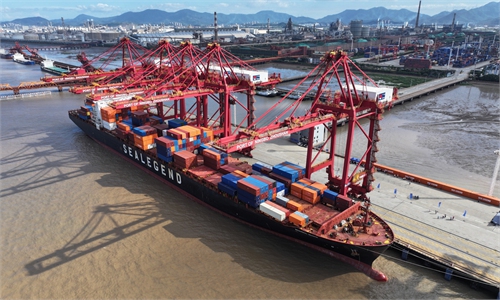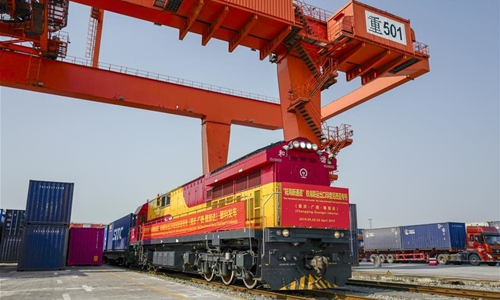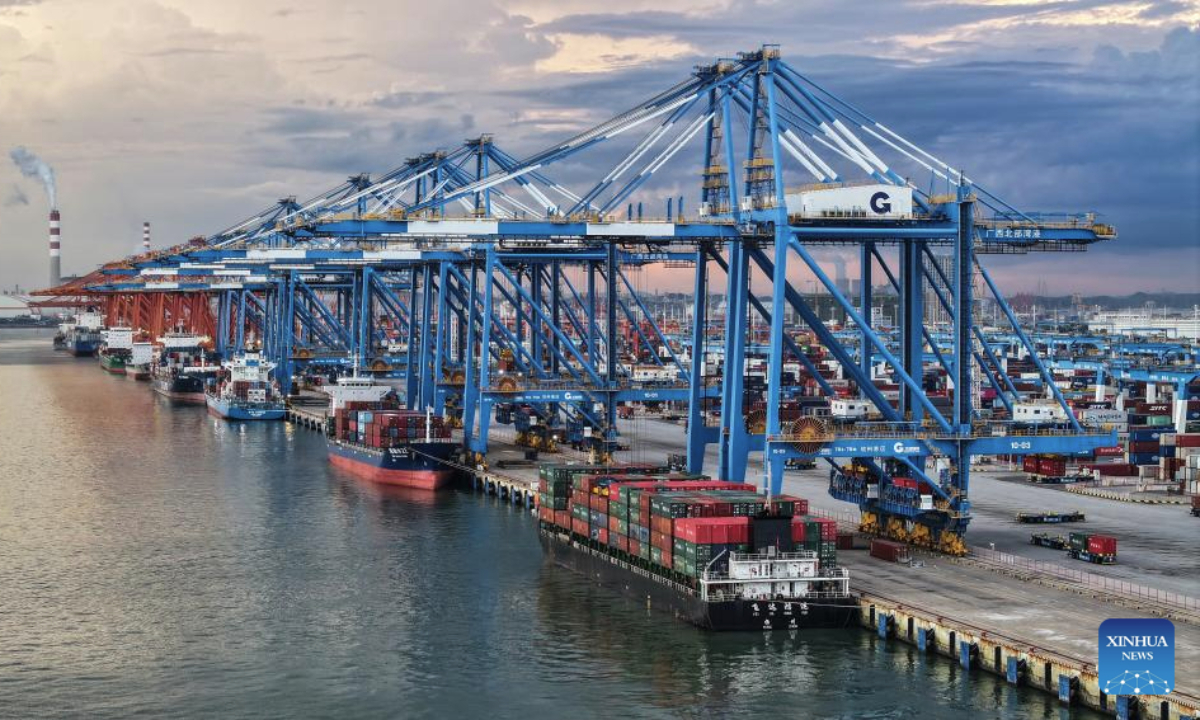
A drone photo taken on Sept. 16, 2025 shows a view of the Qinzhou Port in Qinzhou City, south China's Guangxi Zhuang Autonomous Region. As of August 2025, the New International Land-Sea Trade Corridor has expanded its reach to 577 ports in 127 countries and regions, handling over 1,316 product categories. (Xinhua/Zhang Ailin)
The People's Bank of China, the country's central bank, together with seven other government departments including the National Development and Reform Commission (NDRC) and the Ministry of Finance, recently released a set of opinions on financial support to accelerate the development of the New International Land-Sea Trade Corridor. The opinions put forward 21 key measures to promote the core financial functions of "financing" and "settlement" and support the high-quality development of the corridor, PBC announced on Wednesday.
Experts hailed the initiative as a key step toward stabilizing foreign investment and trade, noting that China's increasingly diversified trade ties — especially with Belt and Road partners and neighboring countries — has strengthened its standing in global trade flows and reinforced its status as a major trading power.
The opinions prioritize improving the financial organization coordination system and enhancing financial service quality along the corridor, which indicate strengthening domestic and overseas financial linkage, encouraging financial institutions to optimize overseas layouts.
Meanwhile, the opinions will expand the introduction of foreign financial institutions and organizations and support qualified banks from ASEAN and Special Administrative Regions of Hong Kong and Macao to provide financial services in provinces, regions and cities along the corridor through establishing legal persons, branches, or specialized institutions.
In terms of optimizing fund settlement convenience, the opinions mention facilitating cross-border trade settlement, promoting cross-border investment and financing convenience, piloting integrated onshore-offshore currency pools for multinational companies in qualified areas, and facilitating domestic reinvestment by foreign-invested enterprises.
The financial policy support not only helps solve financing difficulties in infrastructure construction and other cross-regional or cross-border cooperation, optimizing corporate fund usage and collaboration choices, but also promotes internationalization of yuan through settlement convenience, enhancing import and export trade support, Li Changan, a professor at the Academy of China Open Economy Studies under the University of International Business and Economics, told the Global Times on Wednesday.
He added that logistics enterprises, foreign trade companies, and even manufacturing enterprises will benefit from such financial support.
Cross-border use of the yuan will be further expanded along the corridor. Specific measures include strengthening currency cooperation with Southeast Asian and Central Asian countries to promote cross-border yuan use; deepening trade and investment yuan settlement convenience; supporting foreign trade enterprises, ASEAN investors and bulk commodity transactions to use yuan; and encouraging banks to use RMB for cross-border financing, guarantees, and asset transfer settlement.
The opinions also seek to enhance financial openness and cooperation, allowing eligible ASEAN, Hong Kong, and Macao banks to offer services along the corridor, promote participation in the multi-country central bank digital currency bridge, and pilot cross-border digital yuan payments with Thailand, Hong Kong, the UAE, Saudi Arabia and Singapore.
In addition, the opinions emphasize financial risk prevention and a series of safeguarding measures.
The NDRC, the country's economic planner, released an overall plan for the new Western Land-Sea Transportation Corridor in August 2019 to deepen two-way sea-land opening-up and development of western China, according to the Xinhua News Agency.
From January to October this year, the total import and export value via the corridor reached 1.35 trillion yuan, up 17.9 percent year-on-year. The cargo via Southwest China's Chongqing Municipality, an important node along the corridor, logged 48.96 billion yuan in import and export in the first 11 months of 2025, a 1.7-fold increase year-on-year, the city's government released on Wednesday.
Latest data show that the Western Land-Sea New Corridor currently covers 157 nodes in 73 cities across 18 provinces, regions and municipalities in China, and reaches 555 ports in 127 countries and regions worldwide, according to Xinhua.
RELATED ARTICLES