China's tech firms accelerate IPO process
Foreign financial firms upbeat on Chinese stock market amid AI devt
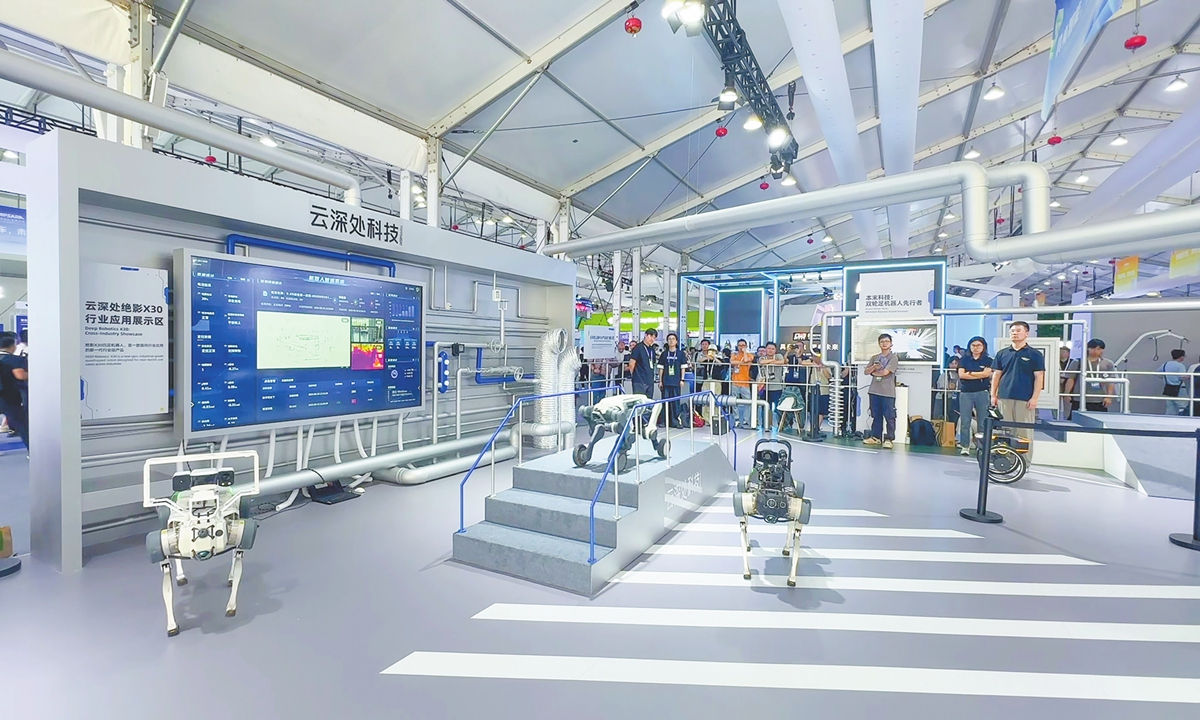
Visitors watch a wheeled-leg robot perform stair climbing and slope crossing during the Apsara Conference in Hangzhou, East China's Zhejiang Province on September 26, 2025. Photo: Courtesy of DEEP Robotics
Chinese technology enterprises have accelerated their listing procedures, with DEEP Robotics, a leading robotics producer and one of Hangzhou's "Six Little Dragons," setting a fresh example. The firm began its IPO advisory period on Tuesday, the Global Times learned from the website of the China Securities Regulatory Commission (CSRC) on Wednesday.
The CSRC's website showed that CITIC Securities is the company's advisory institution.
According to the Securities Times, this move followed Manycore Tech's filing on the Hong Kong Stock Exchange (HKEX) and Unitree Robotics' completion of its IPO advisory period in late November.
"As these companies continue to achieve technological breakthroughs, going public has become an important avenue for them to secure stable and sustained funding," Wang Peng, an associate researcher at the Beijing Academy of Social Sciences, told the Global Times on Wednesday.
Several domestic general-purpose graphics processing unit (GPU) chip companies have also ramped up steps to list on various bourses. For instance, Biren Technology has just passed the HKEX listing hearing, the Securities Times reported. Another Chinese GPU maker, MetaX, debuted on the STAR Market of the Shanghai Stock Exchange on December 17, with its share price surging by 692.95 percent on the day.
Pan Helin, a member of the Expert Committee for the Ministry of Industry and Information Technology, noted that IPOs bring mutual benefits and positive impetus to both tech companies and the capital market.
"These Chinese tech companies are raising capital to fuel research and development, speeding up innovation and market expansion. Meanwhile, these rich investment opportunities are injecting new vitality into the capital markets," Pan told the Global Times on Wednesday.
Boosted by China's tech advancement, especially in the artificial intelligence (AI) sector, foreign financial institutions have expressed optimism about China's capital market.
"We expect the Chinese stock market to usher in another bountiful year in 2026, as many favorable driving factors in 2025 will continue to support the market, including development in innovative sectors, especially AI," Wang Zonghao, head of China equity strategy research at UBS, said in a note sent to the Global Times on Wednesday.
In addition, supportive policies for private enterprises and the capital market as well as potential capital inflows from domestic and international institutional investors will boost the Chinese stock market, Wang Zonghao said. "We remain bullish on the internet, hardware technology, and securities brokerage sectors," Wang Zonghao added.
Goldman Sachs forecast in its China equity strategy on Monday that Chinese stocks will rise 38 percent by end-2027, led by 14 percent and 12 percent profit growth expected in 2026 and 2027 and about 10 percent re-rating potential.
The launch of DeepSeek-R1 sparked a powerful rally for Chinese tech companies in 2025, led by the data and cloud, semiconductor and AI infrastructure and power sectors, where stock prices have risen 40 percent on average and more than $2 trillion of market cap has been added, according to Goldman Sachs.
"Breakthroughs in AI have rewritten the narrative for tech equities. Fundamentally, we estimate that widespread AI adoption could drive a 3 percent annual increase in corporate earnings over the next decade via cost savings, enhanced productivity, and new revenue opportunities," the institution noted.
Wang Peng said that policy support has also ignited investors' enthusiasm.
According to Recommendations of the Central Committee of the Communist Party of China for Formulating the 15th Five-Year Plan (2026-30), the country vows to make substantial improvements in scientific and technological self-reliance and strength, noting that full integration should be achieved between technological and industrial innovation, and innovation should play a more prominent role in driving development.
Wang Peng said that supported by government policies, China's technology sector is making steady progress, delivering positive spillover effects to the capital markets.
RELATED ARTICLES