Nvidia Photo: VCG
In response to questions over the Trump administration's decision to allow the sale of Nvidia H200 chips to China, and if China will allow these H200 chips to be purchased and also whether and when did leaders of the two countries communicate the decision, Chinese Foreign Ministry spokesperson Guo Jiakun said on Tuesday at a press conference that "we have noticed the reports. China always advocates that China and the US achieve mutual benefit through cooperation," according to the Foreign Ministry website.
The US will allow Nvidia's H200 processors, its second-best artificial intelligence chips, to be exported to China, on the condition that the US government gets a 25 percent cut, Reuters reported on Tuesday. US President Donald Trump also wrote in a post on Truth Social: "the United States will allow NVIDIA to ship its H200 products to approved customers in China, and other Countries."
Trump said the policy will support American jobs, strengthen US manufacturing, and benefit American taxpayers.
The US Department of Commerce is finalizing the details, and the same approach will apply to AMD, Intel, and other American companies, according to Trump's post.
Nvidia shares rose 2 percent in after-hours trading after Trump made the announcement on Truth Social, per Reuters.
"Offering H200 to commercial customers is a welcome approach," a spokesperson with Nvidia told the Global Times on Tuesday via email.
Bloomberg reported on Tuesday that the US government's move represents a victory for Nvidia in its push to get Trump and Congress to relax export controls that have kept the company from selling its AI chips to the world's largest semiconductor arena.
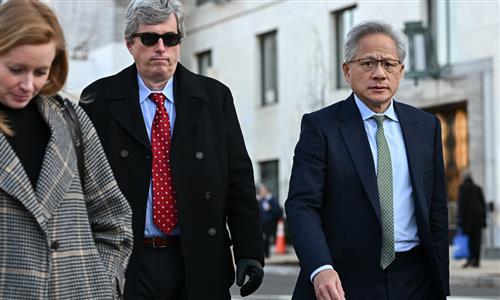
Jensen Huang, CEO of Nvidia, met US President Donald Trump on December 3 and talked about export controls but declined to offer specifics, according to Bloomberg. Asked whether Chinese authorities would allow Chinese companies to buy the H200 chips, Huang said, "We don't know. We have no clue," according to Bloomberg. Notably, Huang was quoted as saying that "we can't degrade chips that we sell to China, they won't accept that."
US media outlet Fox Business reported in November that Huang said that access to the Chinese market is essential for US competitiveness in AI, noting that US export restrictions have brought Nvidia's chip sales to China to a standstill.
China's market weight
Ma Jihua, a veteran telecom industry analyst, told the Global Times on Tuesday that China's AI chip sector is advancing at a pace that fundamentally reshapes competition. Both output and capability are rising quickly, and domestic players are iterating faster than expected. "China is now building an increasingly independent and mature AI ecosystem," Ma said, noting that Nvidia risks losing not only technological advantages but being pushed outside the ecosystem altogether. "On cost and price-performance, Nvidia chips will not remain competitive forever."
The US government's move to ease chip export restrictions against China indicates the importance of the Chinese market, Ma added. Years of US curbs have given China's domestic semiconductor industry room to grow, and even Nvidia's most advanced chips could lose their competitive edge if the firm remains barred from the Chinese market.
In addition to Nvidia, some other US chipmakers like Advanced Micro Devices (AMD) are also making efforts to sell chips to China, as the company reportedly said on Thursday that it has licenses to ship some of its MI308 chips to China and is prepared to pay a 15 percent tax to the US government if it ships them.
The US' move to ease chip export restrictions against China is a forced adjustment to meet the US' own needs for technological and economic development, as its protectionist measures have backfired on American companies' profits and even impacted future technological advancement, Huo Jianguo, a vice-chairman of the China Society for World Trade Organization Studies in Beijing, told the Global Times on Tuesday.
The incident proves that protectionism is against market rules and produces no winners, with more harms caused to the US itself and American companies, Huo said, urging the US to drop protectionism and unilateralism, and seek win-win cooperation.
Similarly, Zhou Hongyi, founder and chairman of 360 Security Technology, expressed a comparable view on Xiaohongshu on Tuesday. He argued that Washington's move is not an act of giving China an opportunity, but a sign that the US has been pushed to the wall by the speed of China's technological rise. And US's old containment playbook no longer works, he said, noting that the bid to block China's chip progress has effectively failed.
Recently, US business leaders expressed confidence to expand presence in the Chinese market and deepen industrial and supply chain cooperation between Chinese and American enterprises, according to the China Council for the Promotion of International Trade, which led a business delegation to visit the US at the invitation of its US counterparts.
Ma said Chinese competitors have grown stronger, and even if sales resume - or prices fall - "I'm afraid there won't be another buying rush." He noted persistent risks such as US policy uncertainty and future usage limits.
Ma said that losing access to China's advanced-chip market would effectively amount to what Jensen Huang has described as a drop to zero. Once shut out, returning would be extremely difficult. "The revenue loss would be huge, but more importantly, China's domestic market is the springboard for global expansion," Ma said, adding that this is why Huang is eager to regain entry.
RELATED ARTICLES