US govt confirms Nvidia chips sales to China; export relaxation underscores crucial Chinese market: expert
By Ma Jingjing and Published: Dec 09, 2025 10:51 AM

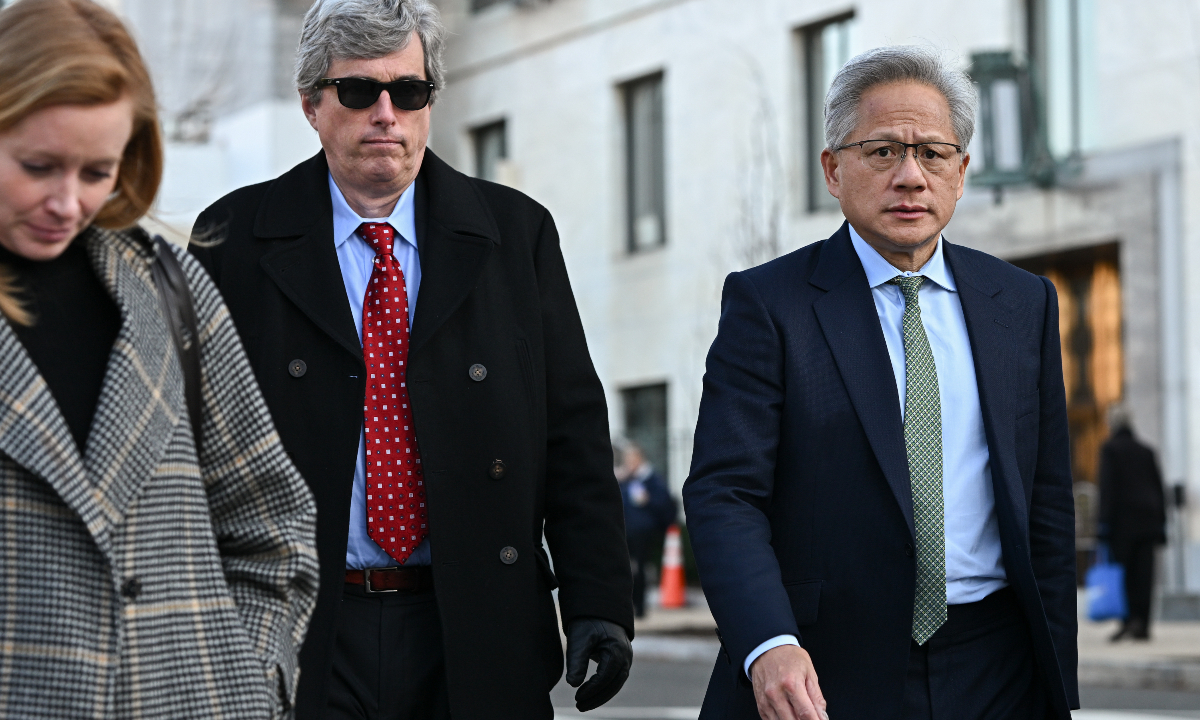
Jensen Huang, CEO of Nvidia Corp, departs following a meeting with members of the Senate Banking, Housing, and Urban Affairs Committee in Washington, DC, US, on December 3, 2025. Photo: VCG
Nvidia CEO Jensen Huang has finally heard the voices he desired the most, as Reuters reported on Tuesday that the US government will allow Nvidia to export its H200 artificial intelligence (AI) chips to China. US President Donald Trump also wrote in a post on Truth Social "the United States will allow NVIDIA to ship its H200 products to approved customers in China, and other Countries," and that the US Department of Commerce is finalizing the details.The development on Tuesday caps months of lobbying efforts by Nvidia and came after Huang's repeated public remarks about the importance of the Chinese market and risks of losing it.
Although Trump's post appeared to state that 25 percent of the chips sales will be paid to the US government, Nvidia shares, according to Reuters, still rose 1.2 percent in after-hours trading after Trump made the announcement on Truth Social.
Trump said that this policy will support American jobs, strengthen US Manufacturing, and benefit American taxpayers. "The Biden Administration forced our Great Companies to spend BILLIONS OF DOLLARS building 'degraded' products that nobody wanted, a terrible idea that slowed Innovation, and hurt the American Worker. That Era is OVER!" he posted.
The Department of Commerce is finalizing the details, and the same approach will apply to AMD, Intel, and other American companies, according to Trump's post.
"Offering H200 to commercial customers is a welcome approach," an Nvidia spokesperson told the Global Times on Tuesday.
The US government's move of easing restrictions on chips sales to China indicates the importance of the Chinese market, Ma Jihua, a veteran telecom industry analyst, told the Global Times on Tuesday.
Years of US curbs have provided a rare chance of China's domestic chip industry to grow and catch up, even Nvidia's most advanced chips may lose its competitive edge to Chinese counterparts if the company is to be kept away from the Chinese market for a few more years, Ma said.
Bloomberg reported on Tuesday that the US government's permission of Nvidia's H200 AI chip sales to China would mark a major lobbying win for the company and potentially let it regain billions of dollars of business lost in a key global market.
For months, Nvidia has made efforts to lobby the US administration and Congress for a relaxation of export controls that keep the company from selling its AI chips in the huge Chinese market. Huang said that access to the Chinese market is essential for US competitiveness in AI, noting that US export restrictions have brought Nvidia's chip sales to China to a standstill, with zero sales expected for the next two quarters, US media outlet Fox Business reported in November.
At an event hosted by the Center for Strategic and International Studies (CSIS) on Wednesday, Nvidia CEO Jensen Huang broke down US-China AI competition using a "five-layer" framework, noting that Al should not be viewed as "'a holistic thing reduced to "ChatGPT versus DeepSeek".
In addition to Nvidia, some other US chipmakers like Advanced Micro Devices (AMD) are also making efforts to sell chips to China.
Responding to a foreign media question saying that AMD said on Thursday that the company has licenses to ship some of its MI308 chips to China and is prepared to pay a 15 percent tax to the US government if it ships them, and whether China is willing and prepared to buy those chips, Chinese Foreign Ministry spokesperson Lin Jian said at a regular press conference on Friday that "China has made clear its position more than once on the US export of chips to China. We hope the US will take concrete actions to keep the global industrial and supply chains stable and unimpeded."
RELATED ARTICLES